Chauncey Judd or The Stolen Boy
(This book was scanned and the scanned document was converted to text thanks to Karl DeBisschop)
-
Preface
Few persons, probably, of the present generation are aware that in the time of the American Revolution there was carried on a border warfare between Long Island and the Connecticut coast, which for romantic incident was scarcely surpassed by anything related by Walter Scott in his tales of the Scottish Border. The parties in this warfare were mostly the whigs and tories of that day, between whom there was a bitterness of hostility far greater than existed between the colonies and the British themselves. The details of the strife, tragic and comic, the plots and counterplots, the deeds of wild adventure, of heroism and endurance, which then occurred, would, if fully narrated, fill volumes.
The tale we here present to our readers relates to one of the noteworthy incidents of those times. In all essential respects it is strictly true. Every important event mentioned is well authenticated. Many details as to times, places, persons, etc., have been ascertained from the public records of the county and state, and may be relied on as accurate, though differing somewhat from the statements which have been printed, or have been handed down by tradition. The outline of the story has many times been told to the writer by a near relative, a sister of the "stolen boy," who had herself a personal knowledge of the facts, and who died a few years ago at the extreme age of ninety-nine. He has also received much information from other aged persons who were well acquainted with the actors in the events, among whom he desires particularly to name his venerable friend, the Rev. Smith Dayton, of New Haven, still surviving, with vigorous step and unimpaired faculties, at the age of ninety, who has loaned him manuscripts left him by his father, Captain Ebenezer Dayton, in relation to the transaction.
Though the history of the Revolutionary period has been so often and so ably written, it is yet comparatively little known to many of the present day. A general acquaintance with its public events, the Declaration of Independence, and the principal incidents of the war which established it, may be possessed, but beyond this there is a great vagueness of apprehension. The people of the colonies were thinly scattered over a vast territory, so that much that occurred among them was never known outside of the immediate locality, and much that was known was never recorded. The ubiquitous news-gatherer of modern times had not then been born. The causes which led to the separation from the mother country, the struggles, privations and sufferings incident to the war, all indeed that may be called the domestic history of that period, is not only little known to most of this generation, but cannot easily be conceived of by them.
In carefully gathering up, then, what has been transmitted to us by tradition or otherwise, before it shall be irrecoverably lost, and while it may still be verified and illustrated by family manuscripts, and in some instances by the personal testimony of the very few surviving who lived near those times, we may not only furnish matter of interest to our contemporaries, but add something to the stock of materials which shall serve the uses of the historians, the artists, and the statesmen of the future.
Nor can we forbear to add that the examples of that age are full of instruction. The poverty and the hardships then endured were a severe school, in which, nevertheless, were trained many noble characters. It was a school of heroism which may well be studied by us, who live in these more favored times of ease and plenty. We cannot pretend to have delineated it fully in a single sketch like the present, but we may still hope that, as a glance at the time, and its lessons of both patriotism and religion, the story we relate may find a welcome in the Sunday schools and the homes of our land.
-
Special Notice
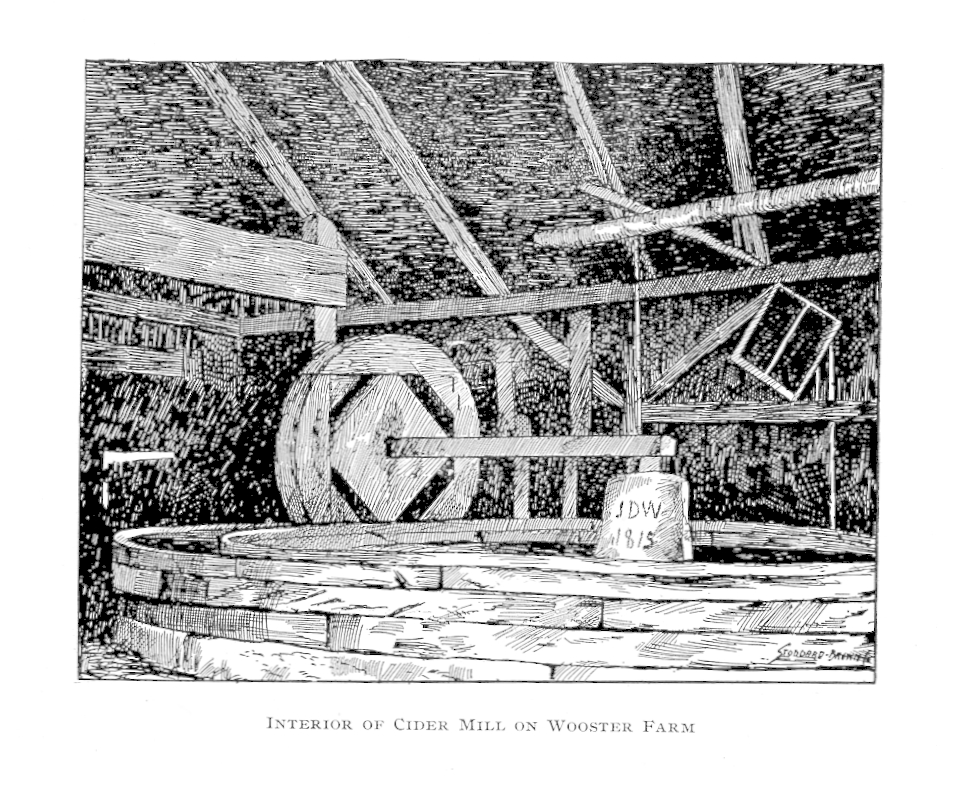
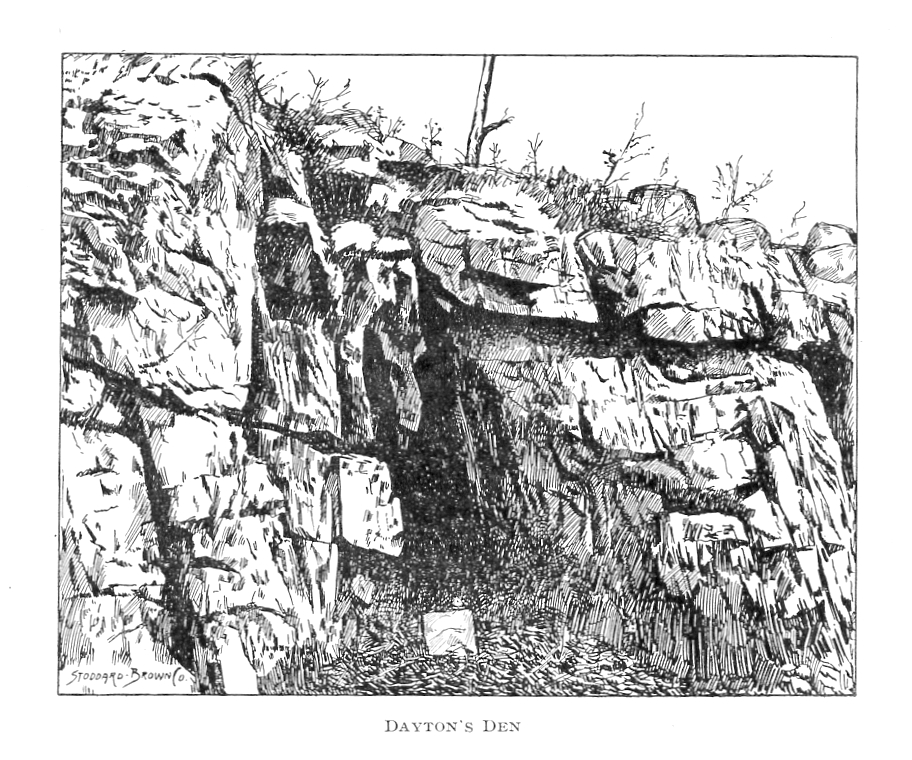
The illustrations of the Interior of Cider Mill on Wooster Farm, and Dayton's Den, are copied from photographs taken by Mr. F. S. Carrier in 1901 who very kindly loaned them for this purpose.
-
Returning From Mill
Halloo, youngster! give me ride, said a young man bearing a musket, and having a military sash around his waist, at the same time springing into the cart, in which a lad of about thirteen was sitting. Been to mill?
Yes, replied the latter, with a flourish of his whip, and a word of command to the ox-team which he was driving; and this is the third time I've been after this grist. The water is so low in the river that the mill runs but half of the time. Where have you been, Dave?
Why, don't you see? I've been up to town, to training.
Oh, yes; I forgot. Have to train pretty often now, don't you? I wish I was only older; I should like to go, too. I believe I'd go as it is, if father and the boys were at home; but our folks can't spare me now.
You! What a pity you can't! A pretty soldier you'd make – such a whipper-snapper as that. You couldn't carry a musket all day if you tried; and as to going into the army, you'd die in a week of crying for your mammy.
Well, 'tan't no use talking about it, anyway; for I can't go; that's certain. But I wish father was at home, for all that.
When do you expect him? asked the young soldier.
We are looking for him now every day. Mother had word from him, three weeks ago, that Roswell could walk about some, and he hoped they'd be able to start for home in a few days.
What's been the matter with Roswell?
Oh, don't you know that he's been sick? He took cold one day when they had been out skirmishing, and this brought on lung fever and rheumatism. He was sick a long while, and the doctor said he would not be well enough to join his company again very soon, if ever; so they gave him his discharge. Father went to take care of him. He is better now, as I told you, and we are expecting him home every day. But tell me, David, when is your company going?
Don't know; orders haven't come yet. And it's my private opinion they won't come very soon. The whole thing's pretty much played out, I guess.
Played out! What do you mean by that? exclaimed the lad, with much spirit.
Oh, don't go to firing up before you're hurt. I mean just what I say. Your "independence," as you call it, is all humbug. That 'ere fight on Long Island, which happened a few days ago, has finished that, and no mistake.
What fight do you mean?
Why, haven't you heard of it yet? It was a big one, you may believe. The British pitched into Old Put, and just chawed up about half of his men, and, if General Clinton hadn't been over-careful, might just as well have had the rest. They were all cooped up in a corner with the Hessians behind them, and the general thought he'd keep them there till be could bring his vessels up the bay and take them in front; but Washington, for once, was too smart for him. That night there came up a fog so thick that you could cut it with a knife, and he took advantage of it to send over a parcel of boats, and hurry his men all across the river, before morning, into New York. Sergeant Hickox was up to the muster to-day, and told us all about it. He was not in the fight, but with the troops on this side, and has come home to see about getting some more men sent down there, and some stores for the hospitals. He boasts of the affair as a smart thing, and so it was for the fellows who got away; but the fact is, the rebels got a good sound thrashing, and – served them right, too.
The last words were spoken in a lower tone, and with a slight pause, as if expressing an opinion which he cared not to have reported. They met an indignant response from the young teamsman.
Dave Wooster, you are a tory and a villain! A pretty soldier you'll make to defend the cause of Liberty. You ought to be reported to the authorities. Guess you'll find there's independence enough to take care of such traitors as you.
Well, my pretty one, you'd better go and tell of me yourself, if you want your head broke. But what's the use of getting mad, Chauncey? I an't the only one that thinks so. I've heard lots of them talk this very day. Parson Scovill himself was one. Father and he were listening to the news; and says the parson, 'What a child's play all this training is! 'Tan't of any use. All the Continental army is no more account against the British redcoats than a parcel of squaws. The Assembly at Hartford has no right to take our time this way, and subject the colony to so much expense. Talk about liberty! What do they care for it? Just see what they did to Captain Bronson and Ensign Scovill, cashiering them for speaking their honest sentiments on this subject. They are as arbitrary as the Pope of Rome, and the people won't stand it much longer.'
Did he say that, David?
Yes, he did, for I heard him. He said the whole trouble was brought on by the rich men of Boston destroying the tea. He thought it a mean and contemptible thing that they shouldn't be willing to pay a tax of a few shillings to the king to help bear the expenses of the government. He has to defend us against the French and Indians, and it's no more than fair that we should pay our taxes, like any other loyal subjects.
But Squire Hotchkiss says he's no right to tax us without our consent. Besides, I don't believe anything about his defending us, as you call it, against the Indians and French. Who was it, I should like to know, that took Canada from them a few years ago? Squire Hotchkiss himself was one of the soldiers in that war, and a great many of his neighbors, I've heard him say, went with him. Parson Leavenworth, the minister, was chaplain of the regiment. I think, if anybody ought to be paid, it's our own people, for helping the king get a province that wasn't his before.
Much you know about! I'll take my father's opinion before the old Squire's any day. And I know he thinks much as parson Scovill does. I have heard him say the same kind of things scores of times. He says, now that we belong to England, we are somebody; but if we were independent and had to stand on our own feet, we should be just nobody. We are only a handful of us, put us all together, scattered along the shore a thousand miles, ready for France, or Spain or any foreign nation that chose to do it, to come and plunder us. We have no ships of any account to prevent it, and few soldiers, and each of the colonies is too poor to take care of itself, let alone doing anything for the rest. Here now in Waterbury look at the families. Half of them are starving. You can't get any money; and if you could, it wouldn't be good for anything. Father sold a cow last week, and took his pay in paper dollars, and it make a pile so high that he couldn't get it into his pocket-book.
Well, said Chauncey, plying his whip with unwonted severity upon the loitering cattle, 'tis rather hard times I know, – at any rate up at our house, – but for all that, we an't going to give up yet. We had a tolerable good harvesting of rye this summer, though, father and the boys being gone, it was rather tough on me to get it thrashed. However, the girls helped me and I got enough to make a grist, and we are going to have some bread. Father will be here pretty soon, and that will be a comfort. And I tell you what, David Wooster, the country will never submit to the rascally Britishers till we have had worse times than any we have seen yet. Be sure, I'm only a boy now, but I shall be bigger if I live; and when the old folks are dead or discouraged, the boys will take up the cause and fight it through. Mother and the girls haven't made a cup of tea for months, and they would not any more than they would brew poison. I believe every one of them would shoulder a musket, and march into the army to-morrow, if it were necessary, and shame you tories and cowards. Depend upon it, Dave, the cause is just and right, and it'll come out right by and by; you'll see.
Oh, blaze away, you young bantam! I don't care for what you say. I thank you for my ride, anyway. When Roswell gets home, I should like to see him. He'll have a good deal to tell us about the war, and maybe I'll run over some evening and have a chat.
So saying, the young man leaped from the cart as they reached a corner of the street, and turned down the road westward in the direction of his home.
But it is time that we more formally introduce to our readers the speakers in this colloquy.
David Wooster, Jr., and Chauncey Judd were members of two neighboring families, living in what was called, after certain of the principal inhabitants, "Gunntown," an out-district in the southwestern part of the town of Waterbury, in Connecticut. David was the older of the two, being of an age to be enrolled in one of the militia companies of the place, although boys of sufficient size and strength were sometimes admitted into them under the prescribed age. He was a stout, young man, with dark eyes and black, curling hair, fearless in his disposition, and with a sort of generous roughness of manners and speech that made him a favorite among his companions. We have not repeated all the terms with which he was wont to garnish his conversation – terms which he used, as many a thoughtless lad beside him has done, under the mistaken idea that they imparted force and smartness to his sayings. The two boys had sometimes attended the same school, which was usually kept a few weeks in the winter in that district, and had often met in their ordinary employments, as well as at huskings and raisings, and the other occasions which brought the people of the neighborhood together, so that a familiar, if not an intimate, acquaintance existed between them.
The interview above described was in the fall of the year 1776, one of the most gloomy periods of the war of the Revolution. The declaration of independence in July, which stirred to fresh enthusiasm the hearts of the patriot citizens, had been followed, a few weeks afterward, by the disastrous battle on Long Island, in which the Americans had lost five hundred men in killed and wounded, and over eleven hundred prisoners. The latter were confined in the hulks of old vessels in New York Bay, where they endured those fearful sufferings which made the name of the "British prisonships" a word of terror and indignation throughout the land. Requisitions were immediately made upon the colonists – or states, as they now began to call themselves – for fresh troops, and the business of recruiting men, and furnishing ammunition and commissary stores, was being vigorously prosecuted all over the country.
-
The Tories
From the beginning of the troubles with our mother country, there was a considerable portion of the people in these colonies "in some of them even a majority" who were opposed to the popular measures of resistance against the acts of the British Parliament. These were commonly called Tories, a term of reproach long used in England to designate the upholders of the arbitrary acts of the king and his ministers. It is said that the name was first derived from the wild Irish troops whom James II. enlisted into his army for the purpose of recovering his English crown; and hence it came to be employed to denote all those who approved and defended the odious enactments of the royal government. For themselves, in like manner, the patriot colonists claimed the name of Whigs, originally another term of ridicule given by the court party to the Scotch Covenanters, whose favorite drink was said to have been
whigg , or sour whey, and afterward, like many another name of reproach, it was adopted as a term of honor by the opposers of arbitrary government.In the days of which we write, both these terms had come to be freighted with the intensest signification. The Tories were hated and denounced; they were regarded as the vilest of men, ready for any treacherous crime that would bring ruin upon their country. They were often subjected to personal violence and abuse. One of the most common methods of doing this was by tarring and feathering "a process which Trumbull, in his satirical poem of McFingal, thus describes:"
Forthwith the crowd proceed to deck With haltered noose McFingal's neck, While he, in peril of his soul, Stood tied half dangling to the pole,[1] Then, lifting high the ponderous jar, Poured o'er his head the smoking tar. With less profusion once was spread Oil on the Jewish monarch's head, That down his beard and vestments ran, And covered all his outward man.So from the high-raised urn the torrents Spread down his sides their various currents. His flowing wig, as next the brim, First met and drank the sable stream; Adown his visage, stern and grave, Rolled and adhered the viscid wave. With arms depending as he stood, Each cuff capacious holds the flood. From nose and chin's remotest end The tarry icicles depend, Till all o'erspread with colors gay, He glittered to the western ray Like sleet-bound trees in wintry skies, Or Lapland idol carved in ice. And now, the feather-bag displayed Is waved in triumph o'er his head, And clouds him o'er with feathers missive, And down upon the tar adhesive. Not Maia's son, with wings for ears, Such plumage round his visage wears, Nor Milton's six-winged angel gathers Such superfluity of feathers. Now all complete appears our squire, Like Gorgon or Chimera dire, Nor more could boast, on Plato's plan, To rank among the race of man, Or prove his claim to human nature, As a 'two-legged, unfeathered creature'.
As the war went on, and the feelings of both parties became more and more bitter, severe laws were enacted against the tories. Persons suspected of being such might be arrested under a magistrate's warrant, and tried for their sentiments, and if convicted might be banished and sent away to the enemy, under the penalty of death if they should return. They who absented themselves from their homes in the country, or withdrew to British protection, were liable to the confiscation of their estates. In Connecticut, the offense of supplying provisions to the enemy, or giving them information, or aiding in the enlistment of troops, or harboring and countenancing those who were engaged in such "treasonable practices," was punished by fines, confiscation, and imprisonment. Even to speak or write, or act in any way against the doings of Congress, or the General Assembly, was to incur disarming, disqualification for office, fines, and imprisonment, according to the aggravation of the offense. Even death itself was added to the other penalties prescribed, and in some cases was actually inflicted. A man named Dunbar, belonging to Northbury, now Plymouth, Conn., who joined the British, and received a captain's commission from the king, was convicted of treason, and hanged in Hartford, in 1777, and the gallows, in a public place, was kept standing for a long time, as a warning to others.
In many instances, doubtless, the tories suffered great injustice. Mistaken as they were, and criminal as they often became in their acts of hostility to the country, there can be no question that not a few were upright, and even patriotic, men. It may be interesting to glance for a moment at some of the causes which led them to sympathize with the British side.
Some of them thought that rebellion against a lawful government was a sin. They could not believe there was any deliberate design on the part of the British ministry to infringe upon the chartered rights of the colonists, or to destroy their liberties as Englishmen. But if there were, they held that it was wrong to resist their encroachments by force. To them the king was the anointed minister of Heaven, ruling "by the grace of God," and his subjects were under command by the highest of all authority to "honor the king," as well as to "fear God." Armed resistance to his government was treason and rebellion, crimes justly punishable by all laws, human and divine. Men of this class there have always been. In the time of the Stuarts they were believers in the "divine right of the king to do wrong," and denounced Cromwell and the Puritans of 1640 as traitors and regicides. In our own day they upheld the Mexican war and the fugitive slave law, because they were "constitutional," and pronounced the doctrine of the "higher law" fanaticism. We will not condemn these men. Many of them were honest and conscientious, and in private life above reproach. Nay, they have a valuable part to play in society. Conservatism is the ballast which often keeps the ship of state steady on her course, and enables her to bear the propulsion of bolder principles and more energetic purposes in safety.
Another class, no less honest in their views, were those who were impressed with the hopelessness of resistance. To such it seemed little short of madness in these feeble colonies to think of contending against the entire force of that empire, upon which, it has been so proudly said,
the sun never sets,
How often had she humbled the proudest nations of Europe! Many then living had seen the triumphs of her victorious arms in Canada, when the "Grand Monarque" of France had been compelled to cede his provinces to her. Her armies were composed of veterans, commanded by accomplished officers, and in the highest state of discipline. They looked with contempt on the raw Yankee militia, and were considered by the latter to be in every respect their superiors. The successes these had achieved at Lexington and Bunker Hill and Ticonderoga, astonished themselves as much as their enemies. On the sea, England had confessedly no rival. Half a dozen little vessels and a few privateers were all that the colonies could float to match that imperial navy whose undisputed boast it was, thatBritannia rules the waves.
The sentiments of the burlesque hero McFingal were scarcely a caricature of those which extensively prevailed among all classes:Have you not roused his force to try on, That grim old beast, the British Lion? And know you not, that at a sup He's large enough to eat you up? Have you surveyed his jaws beneath, Drawn inventories of his teeth? Or have you weighed in even balance
His strength and magnitude of talons?To rebel, therefore, against the mother country, and that, too, on mere sentimental grounds, taxation without representation, or a miserable three-pence a pound on tea, seemed to them suicidal folly. And indeed, it must be confessed, that, looking back upon the situation from our day, this was by far the most rational view to take. The success with which Providence was pleased to crown our cause was due quite as much to the blunders of the British Cabinet and Parliament, as to the military skill and prowess of the colonies.
It must be remembered, too, that at the outset nobody dreamed of separation from Great Britain. The leading patriots of the time, Adams, Otis, Franklin, Henry, Washington, and others, are often spoken of as having deliberately planned the steps leading to that separation, as if by some prophetic instinct they foresaw the future greatness of this country as an empire of powerful states. But nothing can be further from the truth. They resisted to get rid of wrongs then pressing upon them, and only advanced to rebellion as they were pushed to it. England was, in their regard, still the dear homeland, loved as such and bound to them by all the associations of a common faith and a glorious history. The highest boast of our fathers was, that they were Englishmen, and their constant plea, that they were only maintaining their inalienable English liberties. What they wanted, then, was not independence, but the equal enjoyment of those liberties with their British brethren. Dr. Franklin, just before the fight at Lexington, told the Parliament committee that he had
more than once traveled from one end of the continent to the other, and had kept a variety of company, eating and drinking, and conversing with them freely, and had never heard in any conversation, from any person, drunk or sober, the least expression of a wish for separation, or a hint that such a thing would be advantageous to America.
And even John Adams declared afterward,There was not a moment during the Revolution when I would not have given everything I possessed for a restoration to the state of things before the contest began, provided we could have had a sufficient security for its continuance.
While such, then, had been the common sentiments of all classes of the people, it is not to be wondered at that so many still adhered to them, even after the war broke out. The loyalists claimed that they simply stood on the ground they had always occupied.
The whigs
says Sabine,[2]were willing to remain colonists provided they could have their rights secured to them; the tories were contented thus to continue without such security. Such, as it appeared to me, was the only difference between the two parties prior to hostilities.
It was in such slight beginnings that the separation between them originated, which, under the progress of events, and the mutual provocations of which both were guilty, at last ripened into the most bitter enmity.- The, "Liberty Pole,"so called "" the flag-staff from which banners and other symbols of liberty were often suspended.
- American Loyalists, p. 63, 1st ed.
-
Religious Aspects of War
A large portion or the American colonists were decided in their sentiments by what may be called their religious affinities. From the first settlement of the country, it was well known that the design had been cherished by a certain party in England to extend the national church establishment over the colonies.
Those who believed in the validity of Presbyterian ordination,
says Bronson,and the independence of the American churches, who abhorred prelacy almost as much as they did the pope, were quick to see the religious bearings of the questions of the day. They felt that such a measure as the stamp act must be resisted at the beginning, as a dangerous encroachment upon their just rights, and which, if not opposed successfully, would end in the loss of their most cherished institutions, political and religious. The Church-of-England men held different visions and had different sympathies. They looked upon theirs as the only true church, and Congregationalism as a heresy which had ruled too long in this country. They favored the views and hoped for the triumph of the British government.
[1]These views were very prevalent in the town of Waterbury.
The two parties were more evenly balanced than in most other towns. The Churchmen were in a minority, but they were still numerous – sufficiently so to excite the jealousy, and even the fears, of the majority. When at one time they obtained the ascendancy in society meeting in Northbury,[2] the manner in which they conducted themselves had not inspired confidence in their moderation. Religious denominations in power are not wont to treat the opposition with peculiar leniency. Such is the transcendent importance of religious truth, and such the wickedness of unbelief, or a contrary belief, that men are apt to think any means justifiable which tend to spread the one or suppress the other. The Congregationalists cannot plead guiltless to the charge of attempting, when in authority, to crush out dissent by the use of power.
When at last the war of the Revolution broke out in 1775, the Churchmen of Waterbury, of Connecticut, and New England were seen ranged upon the side of the parent country and against the rebel colonists. They were royalists, or tories. They had reasons satisfactory to themselves for their opinions and conduct. They wished the success of the British government because on that success depended their hopes of worldly distinction and religious privilege. On that they supposed they must rely for the permanent ascendency of the Episcopal Church in America – its doctrines, its faith, and its worship. To England they were bound by the strongest ties. From that country their parish clergymen had from the first received a great part of their support. They owed it a debt of gratitude, which, if they could not repay, they were unwilling to forget. They had always been the weaker party, had been ridiculed in their weakness, and sometimes voted out of their just rights. Their feelings had not been conciliated, and they had come to hate the whigs heartily. They now hoped that their wrongs would be redressed.
The Episcopal clergy of Connecticut and of New England took the lead in opposition to the war. They kept up a correspondence with the Society [for Propagating the Gospel] at home, of which they were beneficiaries, in which they expressed their views freely of the merits of the controversy, and gave information of the state of the country. The loyalty of their own church was a subject for frequent comment and congratulation. Dr. Richard Mansfield, of Derby, wrote in December, 1775, that he had preached and taught quiet subjection to the king and parent state, and that he was well assured that the clergy in general of the colony of Connecticut had done the same. Of the one hundred and thirty families under his charge, one hundred and ten, he continued, are firm and steadfast friends to the government, and detest and abhor the present unnatural rebellion, and all those measures which led to it. Further on, he remarked that 'the worthy Mr. Scovill [of Waterbury] and the venerable Mr. Beach [of Newtown] have had still better success, scarcely a single person being found of their congregations but what hath persevered steadfastly in his duty and loyalty.'
[3]Among these royalists were several of the principal families of Germantown. Mr. Jobamah Gunn was the largest landholder and richest man in the town. He carried on extensive operations on his farm, and employed many men to labor for him. In his sentiments, as well as in the magnitude of his business, he resembled an English squire. He did not believe in the doctrines of equality which began to be so rife in society. He would have the good old custom of lords and tenants maintained, and thought that all who were not rich enough to own land should be bound to service to those that were.
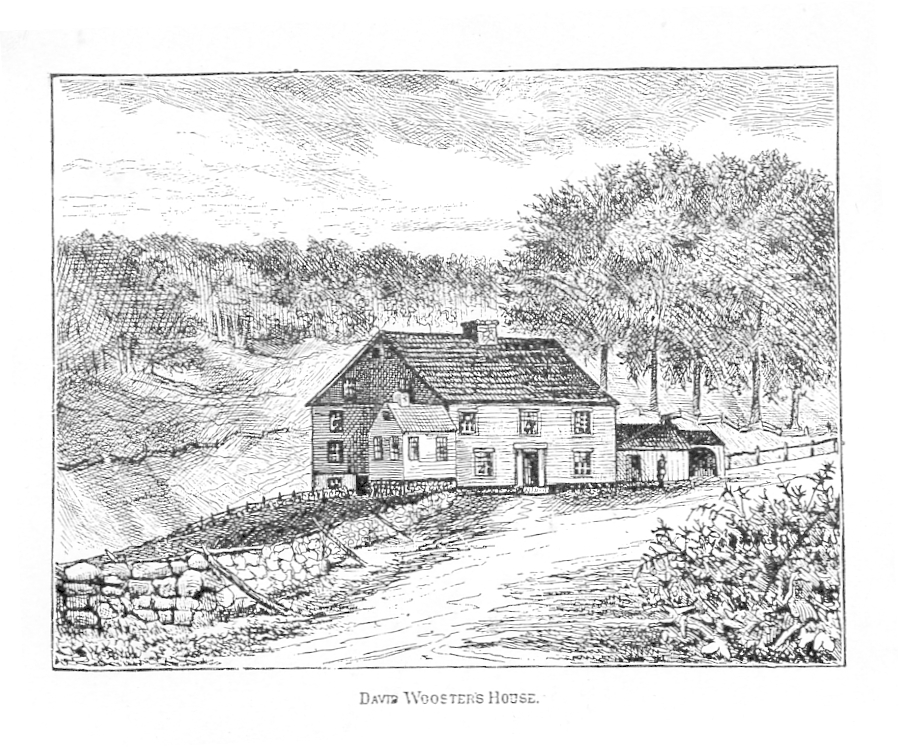
Near him resided the Wooster family, one member of which we have already introduced to our readers. David Wooster, Sen., had twelve children, some of whom, in after years, attained distinction as persons of respectability and piety. He was imbued with sentiments of opposition to the war, and became noted among the leading tories of the town. His brothers, Daniel, John, Thomas and Henry, lived in Derby, all of whom agreed substantially in their opinions, and were highly obnoxious to their townsmen of the opposite party. Numerous other families of like faith lived in the neighborhood; indeed, it became known through all the surrounding region for its disaffection and as a place where refugees from the recruiting service, and those guilty of offenses against the authorities, were harbored and protected.
This disaffection pervaded even the militia of the town. There had been two military companies in Waterbury, one of which was commanded by enthusiastic friends of the country. Of the other, Captain Brown and all the officers except one sergeant were tories, and were free in expressing their sentiments. Of course, in the excited state of feeling then prevalent, such utterances could not fail to attract attention. A formal complaint against the captain was made to the General Assembly for disloyalty to the colonies, coupled also with the charge that he had refused to detach men for service in the army when ordered by the lieutenant-colonel of the regiment. For these offenses he was summoned before the Assembly, and, after a full hearing, was found guilty, cashiered, and made incapable of holding any military office, and the company under his command was disbanded. Smarting under his disgrace, he soon after joined the royal troops in New York, received a captain's commission, and, in the following August, died there.
His example was followed by not a few of the disbanded company and others, chiefly young men.
During the year 1776,
says Bronson,after the defeat of the American forces on Long Island, when the British army was lying in and about New York, the patriot cause looking desperate enough, about eighty persons (royalists) left Waterbury with the intention of joining the enemy. Some were taken on the way by the Americans, but most of them reached their destination. They did not, however, meet with the reception they had expected. Instead of being welcomed and petted, they were treated with superciliousness and neglect. The discipline of the army they found almost intolerable, and a thorough disgust for their new friends soon took the place of former admiration. Many, taking advantage of the proclamations by Congress of pardon to such as should return to duty, departed the royal standard, came home and took the oath of allegiance to the state. A part of these entered the American service. Numbers died or were killed while still with the British army. A few served in it till the close of the war. Of the latter number, a part, after peace was declared, settled in Nova Scotia. Others found a home in the southern states, while two or three returned to Waterbury.
[4]As might readily be supposed, these tories in the British service were among the most dreaded foes of the inhabitants living in the vicinity of the royal armies. They became notorious for their plundering excursions, in which they carried off cattle, hay, fruits and stores of all sorts for the use of the troops. In the neighborhood of New York they were named
cow-boys,
from the frequency and success of these raids. Their familiarity with the country and its people enabled them to plan their excursions successfully, and escape, for the most part, with impunity. Often they had old grudges against those who had insulted or prosecuted them, and they could now couple with the plunder they carried off the sweets of revenge. It is needless to say how rapidly the morals of men thus engaged would deteriorate, and how soon many of those who at first were simply honest royalists, became robbers and murderers, hardened in every crime.- History of Waterbury, p. 328. The succeeding statements as to the royalists of that town, and of the attitude of the Episcopalians toward the war, are given on the authority of that work.
- The northern parish of the town, now Plymouth. On finding themselves the majority in the parish, they took possession of the meetinghouse, voting out the services of the Congregationalist pastor. – Bronson, p. 310.
- History, pp. 329, 330, 332.
- History of Waterbury, pp. 353-354.
-
The Judd Family
The family to which our young friend, Chauncey Judd, belonged was descended from one of the oldest and most respectable in the town. His grandfather Joseph was son of Thomas, the third in a succession of Thomas Judds, who were among the colonial magnates, enjoying the highest offices and honors of the community. The first was one of the little band that made their long journey, in 1635, through the woods from Massachusetts to the banks of the Connecticut, carrying the wife of their pastor, Rev. Mr. Hooker, in a litter upon their shoulders. Afterward, removing to Farmington, he was the first deacon of the church there, and very often a deputy to the General Court. The second removed to Waterbury where he was repeatedly chosen deputy and also a justice of the peace and lieutenant, the highest military office permitted in a town until the number of soldiers it was able to enroll in its company was sixty-four. The third was a constable, town clerk and treasurer, schoolmaster, and
literary oracle of the settlement.
We may add that the succession of Thomas Judds has continued unbroken to this day, and has, we believe, perpetuated in itself and its collateral branches, to a good degree, the same qualities which so honorably characterized their Puritan ancestors.At its first settlement Waterbury was not considered a very eligible spot for a plantation. The committee appointed by the colonial legislature to visit the place and ascertain its capabilities, reported that, in their estimation, it contained about six hundred acres of land fit for cultivation, and that it might support thirty families. This will excite a smile, in view of the fact that now Waterbury alone, without including the towns and parts of towns which have been set off from it, has a population of over thirteen thousand souls.
As the lands at the center were taken up, it became necessary for the young men and others who afterward removed thither to find abodes in the remoter districts. Four or five miles down the valley were broad, natural meadows, on either side of the river, which were annually enriched by the overflow of its waters. These had belonged to Lieutenant Thomas Judd, from which circumstance the spot, with the surrounding district, came to be called "Judd's Meadow." Afterward, when the district became a distinct parish, it was designated "Salem"; and still later, at the time of its incorporation as a separate town, it borrowed from the romantic stream which traverses it the name of "Naugatuck," a word said to be derived from the Indian terms naiag, or naug, signifying a high point of land or promontory, and tuk, a river, meaning thus the "river of the high hills," a name that will be recognized as entirely appropriate by those who are familiar with the picturesque mountain valley through which it flows.
Hither Isaac Judd, the son of Joseph, removed with his family a few years before the date of our story. His farm was situated on the old road leading from "the Bridge" toward Gunntown, about a mile distant from the present village of Naugatuck. It was a pleasant location, on the southern slope of a hill, overlooking the valley of the "Longmeadow Brook," a tributary of the Naugatuck. But the soil was thin and sandy, the surface of the ground was stony, and whatever in the way of crops was obtained from the farm was extorted by hard and untiring exertion.
They were brave hearts, who, in those old times, went forth from the paternal roof to make to themselves new homes, and to subdue the wilderness. Young men and maidens both were brought up to work, and they looked forward to it without dismay, as to the one necessary and honorable business of life. And by work was meant farm labor, with its in-door accompaniments of the dairy, the distaff and the loom. There were few trades, the carpenter, the blacksmith, and the shoemaker supplying the chief wants of the people that were not supplied by home industry. Manufacturing, save of the simplest kind, had scarcely begun in the colonies, the mother country having by stringent regulations suppressed, as far as possible, all attempts in that direction which would tend to spoil a market for her wares. The sons of the rich only could aspire to the learned professions. Thus the choice of an occupation by a young man was, for the most part, a very simple matter, and the only preparation needed for it that which he received as a matter of course from his own labors on his father's farm.
Isaac Judd was twenty-five when be took the young Anna Williams, then in her seventeenth year, to be a sharer in his lot of toil. Their patrimony on either hand was small. The bride's "setting out" usually consisted of a bed, with its linen and covering, the work of her own fingers, and sometimes a cow and a calf, or a dozen sheep; while a young man received his "freedom suit" of home-raised and home-made cloth, and a few pounds in money, or a horse or pair of oxen. But the young couple did not murmur. They were rich in each other's love, and in that inexhaustible treasure of hope which is the priceless heritage of all who have youth, good health and a pure heart; and they went forth, hand in hand, to carve out their own fortune, trusting to Him who had been the God of their fathers to guide and to bless them.
The farm having been purchased, the next thing was to build a house. This was a more formidable undertaking in those days than it is at present. Timber was indeed abundant, but it was growing in the forest, and most of the processes necessary for converting it into boards, shingles and laths had to be performed by hand. Nails, glass, latches and other hardware came from England, and were scarce and expensive. Bricks might be made, of course, for clay was everywhere about; but it cost labor to make them, and there was ever a convenient substitute in the fragments of granite which were thickly scattered over the ground.
In due time the house was completed and occupied. It is still standing, though now devoted to menial purposes. The covering of one end has been removed, and the owner stores there his ox-cart and other farm utensils. The low attic is an open harbor for the swallows, which hang their mud nests upon its blackened rafters, and fly twittering around in endless convolutions. The massive frame, sufficient to make half a dozen such as we construct in modern times, still hugs the great smoke-stained stone chimney, whose yawning fire-places were the cosy retreat of the youngsters in cold winter nights. There are the rent oaken clapboards, unpainted, and weather-beaten by the storms of a century and a quarter; the small windows; the doors, with their wooden hinges and latches; and the naked joists of the low ceiling, from which used to hang strings of apples and sliced pumpkin to dry for pie-making. There is the bed-room where the little ones were born and nursed, where soft, motherly hands smoothed the sick pillow, and whence, alas! some precious ones were tenderly borne away to their cold resting-place on the sandy hillock by the riverside, There is the old
best room,
where company was received, and where, from time to time, blushing maidens heard the sweet words which wafted them into the fairy-land of love and promise. Ah, it is sad to see these household shrines, consecrated by the joys, the tears, the loves, the aspirations of successive generations, falling into decay, and soon, like those who once dwelt there, to be known no more forever!But we have been carried beyond our story. The house was completed, – at least so far as to be habitable, – and Judd and his young family moved to their new home. They had lived a few years in the same neighborhood with his father, at Buck's Hill, and already numbered some half a dozen as they met around their household board. Others came to them here, making, in all, the patriarchal number of twelve – seven boys and five girls; and when standing in a row across the end of the kitchen, as the good father loved to arrange them, their heads rose in smiling gradation, from the little toddler Harvey to the manly Roswell, like notes on the gamut of home love and happiness.
Roswell was the eldest, his father's pride,
the beginning of his strength.
He was now, in 1776, absent in the army. Next was Rosanna, a fair, quiet girl, whose excellencies had reached the hearing of Mr. Edward Perkins, a young widower in Bethany, and caused him to ride up to Judd's Meadow oftener than any apparent business rendered necessary. He was a tall, dignified person, in velvet small clothes and snowy stockings, with his jet-black hair hanging in a shining queue from under big cocked hat – the very picture of a gentleman of the olden time. It was a great wonderment with some of the younger ones what that tall man used to come there for so often; and they were not much pleased with the solution whichsister Rosy
one day gave them, that became to tell them of his four poor motherless children, that had nobody to take care of them, and how he had asked her father if she might go down there and do it, and he had said she might; and so, before the cold weather came, she was going.
But she comforted them by adding that it was not far away, and, may be, father would some day let them come down, and see her and the children – a suggestion which was subsequently verified in a way which even sister Rosy herself did not anticipate. For one of them, grown to fair maidenhood, not only saw thechildren,
but one of these also saw her, and persuaded her to remain in Bethany, by which it happened that she became the daughter of her own sister; and other singular relationships were formed too complicated for my ingenuity to unravel.As I have said, no young woman, in those days, of any smartness, was married till she had provided her linen for personal wear, bedding, table covering, towels, etc., with her own hands. Of course these were busy days for Rosanna. Seated at her spinning-wheel by the west window, which looked out upon the valley below, with the shining flax hanging upon the distaff before her, she spun daily her self-prescribed number or
runs,
the soft hum of her instrument rising and falling in gentle cadences, like the murmur of a busy bee-hive on a sunny bank in June.Isaac, the second son, had already taken to himself a wife. He was barely nineteen, and might, one would think, have waited a few years; but the sweet-faced Patience Hammond had beguiled him, and most impatiently did he count the days till he had made her his own. As yet she had not removed from her childhood's home, but she was often over at Father Judd's to see Rosanna, and help her in her tasks at the wheel and loom. There was a great deal of confidential intercourse between them, and much mysterious and low-toned talk in the said west room, where these operations were carried on.
Walter, the third son, had gone into the army with his brother Roswell. The next daughter, Appellina, now sixteen, was emphatically her mother's help. Lively and cheerful, she could turn her hand to anything, from the Monday's wash and the Tuesday's ironing to making a rag baby for little Millie, or a whistle for the chubby-faced, four-year-old Reuben. Chauncey came next; then Anna and Ruth, the twins. These had a special charge of out-door matters. They knew all the hens' nests in the barn, and the age and pedigree of all the chickens in the coops. They knew where the biggest strawberries grew in the meadows, and where the scarlet winter-green plums hid themselves under the glossy leaves in the woods. Hand in hand they were always seen, running over the hills or racing after the yellow butterflies in the street – bright pictures of healthy, happy childhood.
It was a busy family: for the mother was a notable housewife, and all the children were taught to work.
Come, girls,
she would say, if any loitered at their tasks,every kit must catch her mouse;
and she herself set the example, catching more than any of her daughters. The short gown and petticoat of checked linen, or in winter of linsey-woolsey, home-spun and home-woven, were their usual garments, except on Sunday, when a lighter stuff was worn, the mother and elder daughters, on special occasions, displaying the charms of chintz or calico. If the children at home went barefooted, even up to womanhood, it did not hurt them; and if the boys had stubbed toes and stone-bruised heels, they were tenderly cared for with rag and salve, and the loving word and gentle admonition to be careful next time soon dried the tear-stained face. -
Puritan Training
In those days the means of education was scanty. For some years a school had been established in Judd's Meadow, to be kept a few weeks in the winter; but while the boys might brave the winds and snows to attend it, the task was, for the most part, too severe for the girls. Indeed, the acquisitions of those who did go were not great. Spelling, if we may judge from the specimens which have descended to us, came, as Dogberry has it,
by nature,
for no art could have taught such achievements in misplacing the alphabet. Reading, writing and a small amount of arithmetic made up the list of the branches taught. Grammar, geography and the higher studies common to our day were practically unknown. But if little learning was imparted, little comparatively was needed. People lived by the strength of their arms, not by their stores of book knowledge; and the chief science needed was the knowledge of how to coax from the scanty soil sufficient supplies for man and beast.Religion had its appropriate place in Isaac Judd's family; nay, we had almost said was indigenous in every true Puritan home of the early times. The big Bible lay upon the table, and from its throne of authority dispensed instruction and admonition to the assembled household. Reverently they all stood as the morning and evening prayer was offered by the father, and when the blessing was invoked upon the meals. The Sabbath began at sunset on Saturday night, when all work save that of the most imperative necessity was laid aside. On the Lord's day as many of the family as possible must go to meeting. There was then no meeting house nearer than Waterbury Center, the society at Salem not having been organized till 1781. The distance was six miles, the roads rough, and horseback the only means of conveyance. To the elders of the family, of course, it was assigned to ride. Reining the steed up to the side of the horse-block, the father mounted first; then, adjusting her cushioned pillion to the saddle, the mother sprang up behind him, holding herself in place by her arm around her husband's waist. Lastly, the baby – for there was rarely an interval in that family when a youngster of this designation did not claim parental attention – was placed in its father's arms; and thus amply freighted, the patient animal took its jog-trot journey to the house of God. The young people accompanied them on foot with sober and reverent pace, as became the sacred day, none being allowed to remain home unless sick, or having the care of some one else, or for some indispensable need of the household or the farm.
The drum, vigorously beaten at the meeting-house door, announced the hour of worship. Entering the little sanctuary, no cushioned and carpeted pew was seen, but bare benches ranged in two
teer
before the pulpit; one for the men, the other for the women, anddignified according to the age and wealth of the worshipers.
In 1769, however, it had been voted thatthose who are seated in the seats
should have permission,at their own expense, to turn them into pews;
and, shortly after,that men and their wives might be seated together in the pews.
Furnace or stove there was none, save the small foot-stove, containing a little pan of coals, which the wealthier matrons carried with them. No matter how severe the winter, the people, who perhaps had faced the cutting winds, or waded through the deep snows, on the way, sat the hour and a half through with heroic fortitude. Those who lived at a distance had, if they were able, small
Sabbath-day houses,
to which they repaired in the intermission to warm their stiffened limbs, and thaw their bread and cheese, and bottles of cider, which they had brought for a lunch. Then another hour and a half in the unwarmed meeting-house completed the services of the day, and they were dismissed to the long, cold ride home.Did they count it a hardship thus to honor God in his sanctuary? No; it was a service of love, of unfeigned, heartfelt devotion. We know of nothing more affecting than the old, misspelled records, in which we may read of the sacrifices endured by the first settlers of the New England towns to procure for themselves and their children the privileges of public worship. The people of Waterbury were poor; the whole property of the township, real and personal, would not amount to as much as the cost of any one of a dozen of the church edifices now standing within its ancient limits. The little meeting-house in use at the time of the Revolution was
forty by fifty foot
in dimensions; and when built, fifty years before, it is said that the entire population of the town might have found found seats together upon its sills.We love to linger amid the recollections of these old, Puritan families. They had their weaknesses and their faults, like the rest of mankind. Petty vices may have existed among the lower classes–the indolent, the shiftless, and the intemperate. Poverty, toil, the want of books, and remoteness from cultivated society may have caused a lack of polish, and some coarseness of manners and habits. But, making all allowance for these things, they were the salt of the earth. These hard-working, God-fearing fathers and mothers were the founders of the state, and none in all the family of nations had nobler than they.
When the oppressions of the mother country began to be felt in the colonies, there were none more prompt to join in resistance to them than Isaac Judd and his sons. Three of them–Roswell. Isaac and Walter– were of an age to bear arms, and at different times all entered into the army. Roswell was then a member of one of the militia companies of Waterbury. The British General Howe, having evacuated Boston, appeared in June, 1776, off New York, threatening an attack upon that city. Congress made a requisition upon Connecticut for troops, and the legislature, then in session, authorized seven regiments of volunteers to be raised in that colony to join the Continental army. A few weeks later the condition affairs became so critical that General Washington sent an urgent appeal for help, and the governor of Connecticut responded with an order directing the whole body of the standing militia west of the Connecticut River, and two regiments from the east side, to march forthwith to New York,
until the present exigency is over.
This was substantially a levy en masse for over one-half of the colony.It is estimated.
says Bronson,that fully one-half of Washington's army in and about New York this year were Connecticut men; and that during this year (1776) the colony had in full twenty thousand troops in the service, whereas her whole available military force–from sixteen to fifty years of age–did not exceed twenty-three thousand.
[1]The companies from Waterbury arrived in season to take part in the disastrous battle of Long Island, and the various skirmishes and fights that followed. Many men were lost, both by casualties and sickness; indeed, the latter was the more fatal of the two. Called suddenly into service in the sultriest days of summer, subjected to the severest duty in the field, resulting in defeat and retreat, with no proper commissary or sanitary stores, it is no wonder that these raw levies were unable to stand the hardships, and that the hospitals, such as they were, were speedily filled with disabled men. In these circumstances, the Connecticut Assembly directed the governor to write to General Washington, requesting him, as soon as might be, to discharge the sick in the militia who should be adjudged incapable of further service.
Mr. Judd, receiving intelligence of Roswell's sickness and discharge under this order, hastened to the camp to look after him. He was, however, too ill to be at once removed; but owing to careful nursing. with a naturally vigorous constitution, he at length sufficiently recovered to warrant the journey. It was a long and toilsome undertaking. His father rode from Waterbury on horseback. There were no railroads then, nor even stage coaches. Small vessels had been wont to sail, more or less frequently, from New Haven or Derby; but during these troublesome times all regular communications of this sort were suspended. Only one way was left. Roswell was placed upon the back of the horse, and his father trudged on foot by his side. Their progress was slow, for the invalid was too weak to ride far in a day. It was nearly a week before they reached home – a trip which may now be easily accomplished in three hours.
As the war went on, the hardships it occasioned were more and more felt in the homes of the people. As early as 1774, Congress adopted a series of resolutions pledging the delegates and inhabitants of the colonies to a system of non-intercourse with Great Britain, hoping, by thus depriving her of a market for her manufactures, to compel her to redress their grievances. Nothing which was produced by England or her colonies was to be imported or consumed. Tea, coffee, sugar, molasses, spices, indigo, etc., were to be disused, Home industries were to be fostered. The rich were to discard their silks and broadcloths, and appear in homespun, which, if inferior in texture and finish, was at least the product of free hands.
To enforce this abstinence from imported goods, one of the resolutions of Congress recommended the appointment of a vigilance committee in every town,
whose duty it shall be attentively to observe the conduct of all persons touching this association.
If any were found violating the compact, the case was to bepublished in the Gazette, to the end that all such foes to the rights of British America may be publicly known and universally contemned as the enemies of American liberty; and thenceforth we respectively break off all dealings with him or her.
This Resolution was seconded by a vote of the town of Waterbury, in which it was agreed that the people would
faithfully adhere to, and strictly abide by, the association entered into by said Congress, and appoint the gentlemen hereafter named a committee to see the same carried into execution in every article thereof.
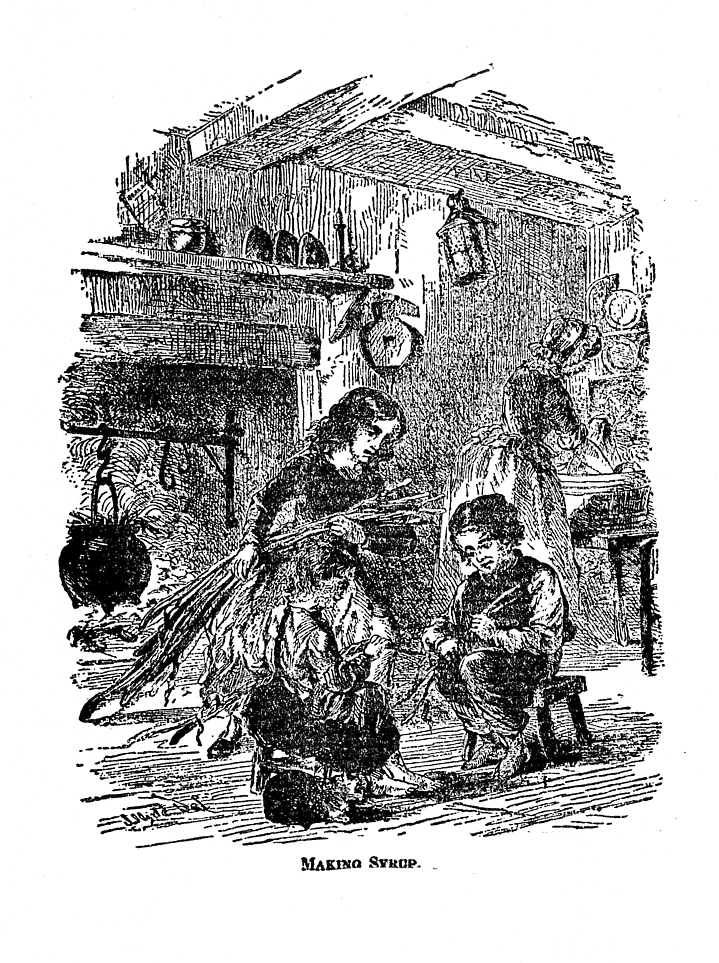
 It required no small courage and self-denial to comply fully with the terms of this agreement. The people had few luxuries at the best, and these swept them all away at a blow. What could families do without tea, sugar and spices, and a thousand articles needed for housekeeping and for personal use. But necessity is the mother of invention. Substitutes for forbidden articles were found or contrived, many of which would excite no little surprise at the present day. The cider cup more than ever supplied the place of both coffee and tea, and the tall maples furnished, to those who possessed them, their delicious syrup and sugar. In the family of Mr. Judd, who seemed not to have been thus favored, the necessary "sweetening" was procured in another way. The Indian corn is the botanical cousin of the sugar cane, and its juices, when fresh, are not without saccharine qualities. So the cornstalks were cut, their leaves stripped off, and the stems, bruised and wrung, were placed in a kettle and boiled, from which a coarse syrup was obtained, which helped to make pies and cakes palatable. The writer has often heard his relative, the venerable lady before mentioned, then one of the younger daughters of the family, describe this unique process, and say that she had many a time twisted the cornstalks for syrup-making till her little bands were blistered.
 - It is a fact, of which the Sons of Connecticut may well boast, that this little colony furnished more men, regulars and militia, in the war of the Revolution, than any other of the old thirteen. Massachusetts excepted. The following table will show: 1. The quotas of each, as fixed and required by Congress; and 2. The actual numbers furnished:
Colonies. Quotas Required. Numbers Furnished. New Hampshire 10,194 14,589 Massachusetts 52,698 83,052 Rhode Island 5,694 10,192 Connecticut 28,336 39,277 New York 15,734 21,647 New Jersey 11,396 16,782 Pennsylvania 40,416 32,965 Delaware 3,974 2,763 Maryland 26,608 17,761 Virginia 48,522 31,101 North Carolina 23,994 11,238 South Carolina 16,932 6,660 Georgia 3,974 2,679 Totals 288,472 290,706
- It is a fact, of which the Sons of Connecticut may well boast, that this little colony furnished more men, regulars and militia, in the war of the Revolution, than any other of the old thirteen. Massachusetts excepted. The following table will show: 1. The quotas of each, as fixed and required by Congress; and 2. The actual numbers furnished:
-
A Quilting Party
Year after year passed, and still the war dragged on. The battles of Trenton and Princeton had revived the drooping hopes of the patriots, and the capture of Burgoyne had gained for them the powerful assistance of France. Still it was an exhausting struggle. Thousands of men were called away from their homes and occupations, many of them never to return; labor was interrupted, the credit of the nation depressed, and the prospects of a successful issue seemed as remote as ever. The courage of the patriots, however, did not fail them, and from the very prolongation of the war rose a forlorn hope that the British cabinet would at length be convinced of the futility of their endeavor to conquer a people so determined, and ultimately concede their independence.
It was a bright day in March, 1780. Though spring according to the calendar, it was still winter in fact. Snow yet covered the ground, the buds showed no signs of awakening life, and the keen winds, blowing as only March winds can, kept the world still prisoner under the reign of the Frost King.
On the evening of that day, Judd's Meadow was enlivened with one of those festive occasions characteristic of the times one hundred years ago – a quilting. A young couple of the neighborhood was soon to be married, in anticipation of which the bride expectant invited her friends to assist her in completing that most indispensable article for housekeeping, a bed-quilt.
Marvelous achievements of industry and skill were those ancient specimens of patchwork. By some inexplicable rule of computation their value seems to have been estimated in exact proportion to the number of pieces of which they were composed. The gathering of these had been the work of years. They consisted largely of bits of the materials from which the dresses of friends and relatives, near and remote, had been made. Such a piece, you would be assured, was of sister Sally's wedding gown, such another was from cousin Hannah's. That chintz flower was from the dress of the minister's wife, that she wore on the very day of the ordination. This scrap was from the wardrobe of Lieutenant Lewis's second wife, who was the rich widow Hopkins, you know. Here was a bit from Mrs. Dr. Bird's wedding gown, which she first pieced into a cradle-quilt for her eldest baby, etc. Of course fragments of bridal robes and baby dresses were most precious of all. The fitting and sewing of these had been long going on, perhaps even from childhood; and now, as the eventful day, so full of hope and promise, draws nigh, the piecing is completed, and the final process of quilting is to be performed.
The invitation had been given on the previous Sunday, and on this blustering Tuesday afternoon a merry group of girls are assembled around the quilt-frames. in the best room. A blazing fire in the wide, old fireplace roars, and sparkles, and snaps, as if to do its utmost in adding warmth and cheer to the occasion. Fingers and tongues move with equal speed: quaint figures, in circles, and crescents, and stars and triangles, grow under the needlework, and by the time the daylight fails, the task is completed, the quilt cut from its frame, the room tidied of its disorder, and all is ready to welcome the guests of the evening.
I know not how it was that this piece of purely feminine industry could never be wholly finished without the aid of the young men. But such was the fact; and though these did not participate in the actual labor, yet it is unquestionably true that the expectation of their presence led to the production of many more quilts than would otherwise have been made. The evening was devoted to merry-making. Not infrequently a fiddler was engaged to officiate; but he was not always to be had, and indeed his presence was not, in the best families, quite approved. There were plenty of plays, however, to supply the lack. There was
button, button,
androll the trencher,
andmarching to Quebec,
andoats, peas, beans,
and thecushion dance,
andblind man's buff,
and not least, if last,running 'round the chimney,
for which the structure of the houses in those days afforded splendid facilities. And then, at a seemly hour, rarely later than midnight, the party broke up, and the delicious after-play ofgoing home with the girls,
followed; in regard to which we have this singular fact to record, that no matter how long or rough the road, or dark the night, no one either thus attendant or attended was ever known to complain of either.At the quilting to which we have referred, the young people of the Judd, Williams, Hotchkiss, and other families in the town, were present; and on this occasion Chauncey Judd, for the first time in his life, ventured to offer himself for escort duty to a young lady on her way home. Her name was Ditha Webb, and she lived about half a mile west from Mr. Judd's, on the old road leading to Gunntown. Her father was a day laborer, working for the most part for Mr. Jobamah Gunn, the rich tory farmer near by. She was a sprightly girl, beaming with good nature, and something of a favorite among the young folks. Her mother was frequently employed by the neighboring families to assist them on special occasions, and in this capacity, as tailor or seamstress, she had worked for Mrs. Judd in cutting and making garments for her numerous household. Ditha was quite intimate with the girls of the family, and often found time of an afternoon to ramble with Anna or Ruth for berries and flowers in the fields.
Chauncey was now in his sixteenth year, tall, slender, with light-blue eyes and fair, brown hair. Naturally he had a poetic temperament, though be knew little of what poetry was. He felt the beauty of the landscape as it lay stretched out before him; of the hills and valleys, and the blue arch of heaven above; of the green foliage of summer, and the ermined mantle and hoarse voices of the winter. Especially did he feel the attractions of a fair face and a winning smile, though his own timidity made him repel with ingenuous blushes any intimation from his ruder companions of such a weakness as this.
Therefore it was with a beating heart that he made up his mind to offer his services that night as an escort to Ditha. He heard her voice in merry laughter from the room whither the girls had gone to don their hoods and cloaks, and when, with forced courage, he met her at the door when she came out, and asked,
May I have the pleasure of seeing you home, Ditha?
and received her prompt reply,Thank you, Chauncey,
at the same time putting her little mittened hand within his arm, he felt that he was a lucky fellow, and that Ditha was as good as she was pretty.They reached her home, as Chauncey thought, in an incredibly short time, and as the hour did not seem late, he accepted her invitation to go in. Mr. and Mrs. Webb had retired for the night, but the fire still smoldered on the hearth, and being replenished with the wood laid in readiness for the morning, it soon filled the room with its ruddy glow. Had it been a regular Sabbath evening visit, after the most approved mode of courtship, she would have made a fire in the best room; but as be only designed to remain a few minutes, that was dispensed with, and the kitchen where the family for the most part lived answered in its stead.
But he stayed longer than he had expected. What were the topics of conversation which beguiled those midnight hour we cannot affirm; we can only guess. Both were of an age when the young buds of the sweetest of all passions were beginning to swell in their bosoms, as would the germs of life in the vegetable world a few weeks later. It was this which gave its charm to the lateness, and made him forget both himself and the hour. True, there was no clock to tell him the lateness of the hour, nor had he a watch, for these were luxuries possessed only by the rich; but the full moon, already past the meridian, should have sufficiently supplied their place.
It must have been nearly or quite three o'clock before Chauncey rose to depart. Ditha took the candle and guided him to the back door, the only one used in the farmers' houses of the country during the winter. The good nights were spoken, and the young man started down the road homeward. With a bounding step he sped along the snowy path. Never did the world look so beautiful; never was his heart so light.
-
The Abduction
Presently Chauncey came to a small piece of woods, through which ran a foot-path, cutting off an angle of the road, and shortening by a few rods the distance to his home. As he emerged from the woods upon the highway, be suddenly met a party of men, who had come up the road from the bridge and were traveling toward Gunntown. They were all armed with muskets or halberts, and most of them carried heavy packs, as of merchandise tied in bundles and slung upon their shoulders.
At first Chauncey hesitated a moment as if he would turn back into the woods; but the men had seen him the same moment that he discovered them, and be felt that retreat would be useless. He therefore drew to one side of the path and hastily passed them, recognizing as he did so one or two, under the bright moonlight, as persons whom he knew, among whom was the young man whose conversation with him we have before recorded, and who as he passed exclaimed,–
Halloo, Chauncey! Is that you?
Halloo, David!
was the reply; but Chauncey, under the circumstances, desired no further recognition, and moved rapidly on.The men halted for a moment in low conversation, when another, who seemed to be their leader, called after him,–
Halt there, young man, we want to see you!
For any instant Chauncey slackened his steps, as if about to comply with the summons, but the next moment he started forward with quickened pace.
Stop!
cried the harsh voice again, with an oath.Come back here, or I'll make daylight shine through you.
At the same time the sharp click of a gunlock warned him that it would be no idle threat. The young man stopped accordingly, and looked around.What do you want of me?
he asked.Come back here, and we'll tell you,
was the peremptory answer.There was no alternative but compliance, and he slowly retraced his steps.
So, Chauncey,
said Wooster,you did not want to see your friends, it seems. But how came you to be here at this time of night? Where have you been?
It's none of your business, Dave Wooster. My errand has been an honest one, at any rate, which is more, I guess, than you can say of yours.
Well, whatever it was, it's a pity it did not keep you a little longer, at least till we got by.
By this time several others of the party had gathered round whom he knew. Most of them were tories belonging in Gunntown, but two or three were strangers to him. The former called him by name, but be answered only in monosyllables, as if feeling anything but pleasure at the interview. Very soon the harsh voice of their leader broke in again:–
Come, young man, you must go with us.
With you?
exclaimed Chauncey, in dismay.For what?
No matter now; we want you; so right about face, march!
But where do you want me to go?
We've no time to confab about it now,
cried the other, with an oath.Come along, and you'll find out.
The truth is,
interposed Wooster,nobody knows that we are away from home to-night, and it wouldn't be quite convenient for us to have them. Might have too many asking questions about it, you know. Folks are mighty inquisitive sometimes.
Oh,
said Chauncey,is that all? I won't tell of you.
No, we don't mean you shall,
said the leader;so, to make sure of it, we'll take you along with us. Come, be quick! Get into the road here before us; we can't wait. Daylight will be along soon, and that is another of our friends that we don't care to see just now.
It was plain that remonstrance would be useless; so the young man took his way with the gang. The leader, whose name was Graham, and whose accent betrayed him as a foreigner, stepped forward by his side, and they walked on together, the rest following in the rear.
Sorry to cause you inconvenience,
he said,and we don't mean you any harm. If you go along peaceably it will be better for you, but if you attempt to get away, or if we should meet anybody and you should betray us, you wouldn't live three minutes. Here are five loaded muskets, and you can calculate your chances of escape if I give orders to fire.
But,
said Chauncey,do trust me. I give you my word and honor that I will never tell any living soul that I have seen you to-night.
That's very easy for you to promise,
replied Graham,but we are too old birds to be caught with chaff. We shall, as Wooster says, have people inquiring very affectionately for us in a day or two, and you could not keep the secret if you tried. So there's nothing more to be said, but come along.
Thus saying, Graham pulled his slouched hat more closely over his face, and bidding his men to
hurry up.
the whole party moved rapidly down the hill, around the corner of the woods, in the direction of Gunntown.They soon reached the house of Mr. Webb, now wrapped in darkness and silence. Keenly did Chauncey feel, as they passed it, the change in his circumstances which the last half hour had brought. How little did she, who had parted from him with a soft good-bye a few minutes before, imagine that he had already returned, in far less agreeable company, and that he was being unwillingly hurried away, he knew not whither.
It was but a short mile further to the abode of Mr. Gunn, where they expected to make a halt. This was a large two-story house, now the residence of a grandson of his, standing in a bend or hollow of the hillside overlooking the Longmeadow valley. Around it were the various out-houses usually belonging to large farmers, for the kitchen, the dairy, the wash-room and the like.
On arriving in sight of the house, the party halted for consultation. They were reluctant to call up the family at that time of the night, though not apparently from any doubt of the friendliness of the reception they might meet with. But what they needed just then was rest. They had been up all night and had traveled a considerable distance, burdened with their heavy guns and bundles, and some of them were greatly exhausted. After a few minutes' consultation, they decided to enter the large barn by the roadside a few rods east of the house, and stow themselves away in the hay until daybreak.
Meanwhile the dogs, of which "Uncle Joe" never had less than two or three, had discovered the approach of the strangers, and with loud barking had announced it to the family. The clamor was redoubled in violence when some of the party went to the barn door and attempted to gain an entrance. Graham tried to soothe these vigilant custodians of the premises, but in vain. Caresses and friendly tones were unavailing; nay, had it not been for the muskets and halberts which the men carried, they would, doubtless, have been in considerable danger.
Presently there were indications that the outcry had made itself heard in the house. A window was raised, and a head thrust out with the inquiry,
Who's there?
Friends,
answered Graham.What do you want?
We want the privilege of lying down in your barn and resting till morning. We have been up all night and are very tired. We should have taken the liberty without disturbing you, if it had not been for your cursed dogs, and settled with you for it afterward.
Come out here a moment, Uncle Joe,
cried another voice.We are not strangers, you see; you will find us all right.
The window was closed, and a few minutes afterward Mr. Gunn appeared. As he drew near the party, David stepped forward and said,–
Good morning, Uncle Joe. Just call off your dogs, and you'll soon see who we are. You know me, of course, and my cousin Henry, and Sam Doolittle. Cady and Scott are no strangers, I reckon. Here's one you don't know, – Captain Graham.
We are sorry to disturb you, sir, at this unseasonable hour.
said the latter.Well, boys, I didn't think of seeing you to-night, I declare. Get down, Lion! Be still, Tiger! What are you about, I should like to know. Where have you come from, David?
Oh, from down below,
said Wooster.We've been doing a little business that may be the rebels won't thank us for, and we shall have to keep dark for a day or two.
Then I can't say I want you here, if you have been in any scrape. They've got a vigilance committee, as they call it, in town, and are watching us here in Gunntown pretty sharp. If you are caught, they will very likely treat you, as they did Joel Hickox, to a term in the old copper mine at Simsbury; and that might not be so pleasant. However, I have no objection to your going into my barn, if you want to, but don't get me into any trouble by it.
Oh, no; we'll look out for that. I shall go up to father's by and by, and see how things are there. They'll keep us for a day or two. I know.
By this time Mr. Gunn had silenced his dogs and opened the barn door, and the travelers, without staying for further ceremony, entered, and creeping under the hay were soon in deep sleep. Chauncey was placed between Graham and Wooster, with a charge, enforced with an oath, not to stir or make any noise that would betray them, on pain of having a bayonet put through him. Even he, overcome with the night's excitement, soon fell into a perturbed slumber.
-
Ebenezer Dayton
While these nocturnal travelers are snatching a few minutes' sleep in Mr. Gunn's barn, let us explain who they are, and why they appear here in these circumstances.
We have already related the reasons which led so many of the people of Gunntown and vicinity to espouse the cause of the royalists.
After the disastrous battle of Brooklyn Heights, and the masterly retreat of General Washington and his forces to New York, Long Island fell wholly under British control. It became in consequence one of the haunts of the tories, and a general resort for thieves and desperadoes of every description.
The engagement of the 27th of August, 1776,
says Thompson[1]was followed by an abandonment of Long Island to the enemy; and the town and county commissioners, in many instances, either through fear or necessity, were inclined to repudiate all legislative authority exercised by the Provincial and Continental Congresses. The inhabitants who continued on the island were compelled to subscribe to the oath of allegiance and fidelity to the king. General Howe had, immediately on landing at Gravesend, issued a proclamation promising security of person and property to those who should remain peaceably upon their farms. This island became, therefore, conquered territory, forts being erected and garrisons established in different places. Martial law prevailed, the army became a sanctuary for criminals of every grade, and means the most despicable were resorted to for increasing the numerical force of the enemy. Those inhabitants who had theretofore taken an active part as officers of militia and committeemen, deemed it most imprudent to remain, and consequently sought refuge within the American lines, leaving the greater part of their property exposed to the ravages of the unprincipled foe.…
"The enemy took possession of the best rooms in their houses, and obliged their owners to provide them accommodations and support for men and horses. The property of those who had fled from their homes, and especially those engaged in the American service, was particularly the object of rapine, and in very many instances the damages were immense."
Among the persons who thus fled from the island was a man named Ebenezer Dayton. He was a native of Brookhaven, a descendant of Rev. Nathaniel Brewster, D. D., one of the first ministers, and connected with some of the most respectable families in the town. He had long carried on mercantile business there, not only at his own store in Brookhaven, but also by traveling tours in adjacent towns, in consequence of which he became extensively known throughout the middle and eastern portions of the island. The following amusing incident, related by Thompson, will give us a glimpse of the manner in which the business of a country tradesman was then carried on, and the perils to which it was liable:–
Dayton arrived in the village of Easthampton on Saturday evening, with a stock of fancy goods for sale. He was apparently laboring under slight indisposition resembling the measles; but for the purpose of apprising the people of his presence, and against the earnest remonstrance of his landlady, he made his appearance the next day at church, and placed himself, of course, in the most conspicuous part of the assembly. Meeting was no sooner dismissed in the afternoon than a rumor of his indisposition was spread through the town; and the general indignation was so apparent that the delinquent, considering prudence the better part of valor, departed early the next morning.
But the incensed population was not so easily satisfied. A few ardent youngsters set off in pursuit, and, overtaking the peddler on the road, seized and brought him back to the village, and having paraded him through the principal streets on a rail, drenching him thoroughly in the town pond, and committing other indignities upon him, permitted him to depart. The terrors of the law were speedily visited upon the actors in this scene of violence, through the instrumentality of Col. Burr, then a young and aspiring practitioner, which resulted in a verdict of one thousand dollars damages; yet, strange to say, the verdict was never fully approved by the people, seeing that nearly one hundred persons took the disease, of whom several died. The era is still alluded to as the time of the Dayton measles.
Mr. Dayton espoused the American cause, and was very active in the measures taken to protect the towns and villages in that part of Long Island, and to annoy the British troops and tories. He was clerk of the Committee of Safety appointed by Brookhaven, under the authority of the Provincial Congress, to apprehend and punish traitors. In 1776 he was commissioned as quartermaster in the regiment raised in that county. Of course he had become exceedingly obnoxious to the royalists, and when Brookhaven fell into the hands of the enemy, he removed, with his merchandise, to Connecticut. At that time the intercourse between Brookhaven and the main coast was very frequent. There were family ties connecting the people of that town with Derby; indeed, it had formerly itself been within the Connecticut jurisdiction for several years. At first Dayton fixed his abode at Milford, but in view of the exposed position of this place to attack by sea, he shortly afterward removed some ten or twelve miles inland, to what is now Bethany, then a part of the ancient territory of New Haven.
But notwithstanding the removal of his family and goods to this supposed place of safety, he did not personally abandon the scene of conflict. Under a privateer's commission, he raised parties of men with whom he made frequent incursions upon the enemy. Expeditions of this kind were very common at that time.
Most parts of the island,
says Thompson,and particularly along the Sound, suffered greatly from depredations of little bands of piratical plunderers, designated "whale-boatmen", from the fact of their craft resembling those used in whaling along the shore. With this they would make frequent descents under cover of night, attack detached houses, rifle the inhabitants of their money, plate and other valuables, and availing themselves of the speed of their boats, reach their lurking places among the islands of the Sound, or upon the main shore, before any effectual means could be taken to intercept them. Indeed, so great was the apprehension of these sudden attacks that many of the inhabitants had their doors and windows protected by iron bars, and it became usual for people to pass the night in the woods and other secret places to avoid personal violence.
[2]One of these expeditions, in which Dayton was engaged, is thus described in New York Gazette of February 16, 1778:–
At two o'clock last Thursday morning, a party of twelve rebels seized at Coram, in Suffolk county [in Brookhaven], two wagons loaded with dry goods, the property of Obadiah Wright of Southampton. These marauders had been several days on the island, visited most parts, and committed many robberies, especially at the house of Colonel Floyd, Setauket, which they robbed of goods and cash to a considerable amount, and took some property of Mr. Dunbar, who rides down the island occasionally, and happened to lodge in the house that night.
Communication between the towns on the eastern part of the island and New York city was then, for the most part, carried on in small vessels, which transported provisions, forage, wood, etc. for the use of the British army, and brought back groceries, dry goods, and money in payment. These vessels, therefore, became a coveted article of plunder to parties like those above described. Mr. Dayton had already captured no less than twelve of them, which were condemned as lawful prize of war, and had become known among the British and their adherents under the designation of a "rebel pirate."
Nor was he held in much better estimation on the patriotic side. It was strongly suspected that, of the large quantities of goods brought by him from the island, no small part was procured by smuggling, and sometimes even by the robbery of personal friends of the American cause. The two wagon loads mentioned above, were replevied by Mr. Wright, their owner, in the Superior Court at New Haven, and recovered on the ground of his fidelity to his country. Other goods in Dayton's possession were attached on similar allegation; and, although he claimed that he had received them in payment of a debt due to him, the plea was disallowed and the goods forfeited.
The result, as a whole, was that Mr. Dayton was in ill odor on both sides. By the royalists he was feared and hated as a "rebel pirate," and by the Americans suspected as a smuggler and indiscriminate plunderer of friend and foe. So keenly did he feel this general odium, that, while some of the aforesaid cases were pending in the courts, he prepared an elaborate defense of his conduct, which, with numerous affidavits from persons in Brookhaven, Derby, Stamford, etc., be caused to be published in the Connecticut Journal of April 12, 1780. Its seems due to his reputation, and will at the same time most forcibly exhibit his standing in the community, to quote a few passages from this statement:
The parties against me in the eight fore-mentioned suits [for smuggling], and the said sixteen traitors indicted for treason [including the robbers and their friends mentioned in the next chapter], being a very great number of persons, all imagine it of great importance to them in the several trials depending to slander me, and that their conduct will appear less dishonorable and not criminal if they can make me appear extremely odious and detestable in the opinions of the good people of this state; for which purpose they have jointly employed all their arts of corruption, together with their interest and friends, to raise a popular clamor against me by propagating and spreading the following reports, viz., that I am a tory, and as such have carried immense quantities of provisions to the enemy; that I am a plunderer, and have robbed the people of Long Island to a great amount; that, before I fled from the island I was worth nothing; and that all the property I have had taken from me, and what I yet have, was procured by feeding the enemy and plundering on Long Island; and that, therefore, it is just and right for anybody, either whig or tory, to plunder me of my property; and that I ought to be considered as outlawed, and not entitled to protection of person or property. And as I am a refugee stranger, without friends or connections in this state, while the parties secretly propagating these reports are numerous, consisting of whigs and tories, they have succeeded so far in spreading these reports that they are generally believed where I am not known, and by many of those who live near me, to that degree that I am in constant fear that my life and property are in danger, and on that account have been induced to keep an armed guard many nights for my defense.
Mr. Dayton then proceeds to declare solemnly that, except the capture of twelve vessels and the seizure of Mr. Wright's goods, – in the latter case acting only as a private of the party, and not the commander, – he knows of
none the least foundation in truth for any of the forementioned reports.
The affidavits of friends were to the effect that they knew him to have been a merchant at Brookhaven who had been in the habit of selling goods on credit; that he went to the island only to collect what was due him; also that they had never heard that he had plundered anybody of either party, though they acknowledged that his reputation in this respect is greatly injured among people of all ranks, denominations, etc.It is impossible at this day to determine the truth in respect to this matter, nor is it of great importance in relation to our story. It is enough that such were the opinions generally entertained of Dayton at this time, especially among the tories. These opinions, with the current belief that he had in his dwelling-house, a large amount of money and valuable goods, undoubtedly led to the perpetration of the outrage we are now to record.
- History of Long Island, vol i, p 392
- History of Long Island, vol. i. p.295
-
The Robbers
Upon the high bluff of land a little east of the present village of Seymour stood, in 1780, a tavern of some celebrity, kept by a man named Tural Whittemore. This locality was, and we believe still is, called "Indian Hill," having once been the residence of the remnant of a tribe of the Milford Indians, of whom the lands in this vicinity were purchased. Their sachem was Mauwee, named by the English settlers "Joe Chuse," it is said from the manner in which he pronounced the word "choose"; and from him the settlement was often called "Chusetown." It was a part of the ancient town of Derby, which then included what is now Derby, Ansonia, Seymour and the larger portion of Oxford.
About a mile south of Whittemore's tavern resided Henry Wooster, a brother of David Wooster, of Gunntown, of John and Thomas Wooster, in what is now Oxford, and of Daniel Wooster, of Derby. Like his brothers, he was a tory, and had become highly obnoxious to his patriotic neighbors, not only from his political sentiments, but from having, like so many other of the royalists, been ready to harbor and assist those who went from thence to join the British army.
On the Saturday evening preceeding the events recorded in chapter seventh, a number of young men were gathered at the tavern above mentioned. Among them were a son of Mr. Wooster's, Henry Wooster, Jr., his cousin, David Wooster, Jr., from Gunntown, and Samuel Doolittle, belonging in Litchfield, but then living near by, within the limits of New Haven. Other persons of the neighborhood were there also, drawn in by the usual attractions of a country tavern. The blazing fire in the bar-room, with the store of good things in the bar itself, made it a favorite place for passing the winter evenings, while the progress of the war and the latest news from the army and from England were related and all the petty gossip of the town indulged in. Sometimes, though not often, disputes arose between those of opposite politics, for such was the severity of the laws and the danger of expressing sentiments adverse to the popular side, that the more discreet tories were either very moderate in the utterance of their opinions, or altogether silent in the presence of others.
In the course of the evening there entered a couple of travelers, who asked for accommodations for the night. Their request was granted; and after they had had supper, a place was made for them in the circle which surrounded the huge, hospitable fireplace. They were strangers to the town, and one of them, who seemed to be spokesman for both, was, from his speech, apparently, an old country-man. Neither of them entered much into the conversation at first, but sat listening attentively to what was said by the others, and closely observing the persons that spoke.
After a little while the stranger, who had given his name to the inn-keeper as Graham, inquired if any one present knew a Captain Dayton, formerly of Long Island, who, it was believed, kept a store somewhere in that vicinity.
The reply, of course, was in the affirmative. No man, certainly, was better known to the tories of Derby, and none more intensely hated than he.
Without explaining the reason of the inquiry, the conversation turned at once upon the exploits of Dayton in his privateering expeditions. This was a subject with which Graham seemed quite familiar, and he related at length the particulars of one of the latest of these expeditions, in which he was supposed to have brought home a large stock of goods procured by plunder on Long Island. Graham affected much admiration of the adroit manner in which this had been done, and of the just retaliation upon those who scrupled not, whenever they had an opportunity, to plunder the whigs. This drew out from many of those present a strong dissent from these opinions, and unmeasured denunciations of the man and all his proceedings. In the course of the evening the strangers thus obtained full knowledge of the sentiments of all present, while all the same time managing to conceal their own.
At length one after another of the company departed, and the two strangers, with Henry and David, remained alone. Even the landlord had retired, leaving his place supplied by a fellow named Wooding, who lived near by, and was for the most part employed in the service of Mr. Whittemore as bar-keeper, hostler, and general assistant in the establishment. The hour was waxing late, and the two Woosters rose, as if to go, when Graham, with a sudden change of manner, said:
Don't go yet, friends; let me have a little private talk with you.
Oh, certainly,
replied Henry, resuming his seat;what do you want?
Can I trust you with a secret?
Depends upon what it is. You are strangers to us, and may have many secrets that we'd better not meddle with. However, we can keep anything, I guess, that ought to be kept, so go ahead.
Be your own judges, then, as to that. I'm not afraid to trust you, at any rate. If I mistake not, you are on the loyal side in this war that's going on, and don't approve of the rebellion. Isn't that so?
Well, supposin' 'tis; what then?
I want to get a few just such young fellows as you two are to join us in a little adventure.
Then, dropping his voice to a whisper, and drawing his chair nearer his auditor, he continued,–
I have a commission from General Howe as lieutenant in his majesty's service, to raise recruits from among those who are well affected to him. Here are the enlistment papers. Give me your names and those of any others you know of the right sort, and then I will show you a nice thing to be done. That young man who was with you – Doolittle, I think he was called – is one of that kind, an't he?
Oh, Sam? He's my cousin," replied David, "and a first-rate fellow, too, though I do say it. But what is this affair you make so much of? What's to be done, anyway?
The bar-keeper is listening,
whispered Graham's companion, at the same pointing over his shoulder to Wooding, who stood observing the company.Never mind him,
said Henry;he's all right – an't you, Lem?
he added, turning to the latter.Come and sit down here, and hear what this gentleman has to propose to such fellows as we – tories you know.
Thus invited, Wooding drew near the party and listened.
You know,
resumed Graham,where this Captain Dayton lives, you say?
Certainly.
And it is not far distant from here?
No; up in Bethany a little way – four or five miles, perhaps.
And he's got a houseful of stolen goods carried off from the island, and any quantity of money, too – not your miserable Continental trash, but hard coin – the real chink?
Yes, I s'pose so.
And there's nobody – at least not more than two or three – to guard it.
Oh, that's what you're up to, is it?
interposed David.But I thought now you were a friend of the old pirate. You seem to be a great admirer at him, at any rate?
Ah, well; it isn't always safe to trust to appearances, especially in such times as these. We did not want to show ourselves till we were sure of our men, you know. But what do you think of my proposal now that we understand one another?
Well, I must say,
replied Henry,it might not be a bad thing to do. We should get a good haul, I've no manner of doubt, and pay off the old man in some of his own coin, too. Rather a skittish business, though. He's smart, you may depend on't; and besides, a pretty uproar it would make in all the regions about here. Then, what should we do with the things?
Carry them back to the island with us,
said Graham.And what object would there be in that? They would do us no good there unless we should go there ourselves to stay.
And that's just what you'd do. Come now; I am authorized to offer you liberal bounties if you join the army. We have several regiments of loyal Americans in the service, you know. Of course, King George is going to whip the rebels yet, even if it takes an age to do it. There will be plenty of confiscations then, and those who have stood true and loyal, and much more, those who have helped put down the rebellion, will be rewarded. Come, landlord, make us a good stiff toddy, all 'round, of your best old Jamaica. And while he's doing that, put down your names here and we'll drink success to the good cause.
No,
said David,we are not quite ready for that yet. Old folks wouldn't consent. But I'll tell what we can do. Carry the things up to Gunntown; they'll be safe enough there. Dayton'll believe it's somebody from Long Island come to be revenged on him, and never think of chasing up there for them. And if he should, we could ourselves just come down the other way, by Hawkins' to the landing below here, and slip across the island until the affair should blow over.
It is not necessary to detail the conversation further. The feasibility of the project was fully considered, with its difficulties and dangers. The young men did not think it would be safe to make the attempt without a considerable force. Henry said it was well known that there were other persons from the island stopping at Captain Dayton's, who were doubtless armed, and they did not hope to succeed without having men enough to overcome them at once. David only wished that three or four of his friends, whom he names, were there, and he would have no fear of the result.
The conclusion they finally reached was, that David should go next day to Gunntown and see what he could do in raising a sufficient force for the undertaking. Henry would in the meantime communicate the scheme to Doolittle, and enlist his co-operation, and make also such preparation as should seem necessary. Wooding pleaded that he could not join them because he could not leave the tavern, nor his family, but he would do what he could to help, and Graham and his companion might well come and stay at his house – a small hut on a lonely back street nearly half a mile distant – till David's return.
Accordingly, next morning, David hastened home. That day was the Sabbath, and a violent storm from the northeast of
hail, snow, sleet, and rain,
[1] prevailed nearly all day. He, however, contrived to see several of the persons he desired, and succeeded in inducing two of them, Jesse Cady and Amasa Scott, to join in the expedition. A third, William Seeley, offered to do the same, but the others objected. Seeley was comparatively an old man. He had been a soldier in the French war twenty years before, and it was feared that he was no longer equal to the undertaking. It was foreseen that the attempt would task all their strength, and they did not wish to be encumbered with one who, however zealous in intention, might lack in power of endurance, and possibly prove an incumbrance rather than a help. It is a part of the wickedness of war, especially a civil war, that it confounds all the distinctions of right and wrong, and both permits and encourages acts, which, in other circumstances, would be condemned as crime. An outrage committed by an opposing party is often made a justification for a similar, or even greater, outrage in retaliation. The necessary violence of regular military operations is made a pretext for multitudes of acts which can have no bearing on the final issue of the contest, and can serve only to inflict pain or annoyance on a foe. We remember the indignant sentiments expressed by a Confederate officer in the late war at the wanton cruelties inflicted by some of General Sherman's troops in their march through Georgia. A valued family picture, the portrait of an officer of the Revolution, was not only carried away, but, grown tired of the burden, the plunderer tore it from the frame and nailed it upon a tree by the road-side as a mark to shoot at. Such barbarities are indeed war, but it is war against civilization, and all the sentiments which distinguish an honorable soldier from an untutored savage.We are slow to believe that the young men who were persuaded into this scheme of robbery by the renegade Graham were deliberate thieves in their own understanding of the term. They would doubtless have revolted from perpetrating an ordinary burglary. Their friends, too, – for David did not hesitate to disclose the scheme to his father and others at Gunntown, and to consult them as to the course to be pursued in certain contingencies, – would never have encouraged an ordinary act of crime. But Dayton had been so active in plundering the British and their tory sympathizers, that to plunder him in turn was deemed only fair play. It was, as they phrased it,
paying the old pirate in his own coin.
A few hundred pounds apiece, in many and valuable goods, it would be pleasant to have; and, if they only escaped the clutches of the rebel laws, – which for them had no moral force, – why need they trouble their consciences as to the way they obtained them? We are sorry to say that not a few articles of value found their way from southern cities, during the late rebellion, whose possession was justified on precisely similar grounds.On Monday night, the storm having abated, David Wooster and his two associates started for Derby. Next day, they completed their preparations as secretly as possible, provided themselves muskets, and sacks for holding the goods, and late in the evening repaired to Wooding's residence, which they had agreed to make their rendezvous. All but Doolittle were there. He had been notified that they would call for him on the way and promised to be ready when they should come.
- President Stiles' MS. Diary in Library of Yale College.
-
The Robbery
Captain Dayton's residence was on the eastern side of the meeting-house Green, about three fourths of a mile south from the present churches in Bethany. At a later period it became the abode of Colonel Elihu Sanford, the father of Elihu and Harvey Sanford, Esqs., long known as among the most respectable citizens of New Haven. On the other sides of the Green were the houses of the pastor, Rev. Mr. Hawley, and the physician, Dr. Hezekiah Hooker.
The party described in the last chapter reached their destination a little before midnight. They were seven in number, viz.: Alexander Graham, their leader; David and Henry Wooster, Jr., Samuel Doolittle, Jesse Cady, Amasa Scott, and Graham's companion from the island, whom we will call Martin, his real name not being known to us. Graham was armed with a pistol; two or three of the others carried muskets. The moon shone brightly, and the newly fallen snow, which covered the ground, rendered the night almost as light as day.
Lights were still visible at the houses across the Green, and it was apparent that the work in hand must be performed as noiselessly as possible, and without permitting any member of the household to escape. It was agreed that entrance should be effected into the bed-room where Dayton would probably be sleeping, and while two of the party remained in charge of him, the rest were to pass directly through into the chambers, and seize upon the men who might be lodged there. These were to be secured at whatever cost, while the women and children of the family should be frightened into silence, but not otherwise hurt.
The attack, as thus planned, was carried into execution. Stationing one of their number outside to give an alarm in case of danger, Graham procured a heavy bludgeon from the wood-pile, and with a single blow dashed in the bed-room window, sashes and all, through which he instantly sprang, followed by the rest. Fortunately for them, neither Captain Dayton nor the other persons supposed to be staying there were at home. The former had gone to Boston on business, and the latter had, a day or two before, removed with their effects to Waterbury. In fact, there was no one in the house at that time but Mrs. Dayton and three young children, one an infant six months old, and two young colored servants, a boy and a girl. The robbers were thus spared the severe, perhaps bloody, struggle which they anticipated.
Graham sprang to the bed, and before Mrs. Dayton could recover from her fright, clapped his hand over her mouth, commanding her to be silent under pain of instant death, at the same time assuring her that if she obeyed no personal violence was intended to her or her children. The rest of the gang, meanwhile, searched the chambers above, but found nobody.
After again charging Mrs. Dayton on her life to give no alarm, Graham retired from the bed-room, to afford her an opportunity to throw on her clothes; but the instinct of fear proved too strong for her prudence, and rushing to the broken window, she shrieked, "Murder! Help!" hoping that her voice might be heard by the neighbors across the Green. It was afterward ascertained that such was the fact, but owing to the distance and the murmur of the rude March wind the sound was not heeded. With a terrible oath, Graham burst again into the room, and seizing the frantic lady by the arm, drew her into the family room, and placed her in a chair; then set David Wooster by her side with a musket pointed at her breast, and orders to fire if she moved or made the least noise again. Her infant child, which had been sleeping by her side, was now awake and crying, to get rid of which he carried it out and deposited it in her arms; then ordering the sheets to be torn into strips, he bound her feet together, and tied her into the chair where she was sitting. The other children and servants were gathered into the same room and placed under Wooster's surveillance, with the assurance that if they did not keep still they should have the sharp bayonet put through them on the spot.
The way was now prepared for work, and right vigorously did they set about it. They were in high spirits at the success they had achieved, and the apparent ease with which the adventure was likely to be completed. From cellar to attic the house was ransacked. Large quantities of goods were found, and the most valuable packed into sacks and bundles. They were mostly manufactured articles of foreign production – coats, cloaks, ladies' gowns, laces, worsted hose, silk handkerchiefs, hollands or linen goods, several pairs of silver shoe-buckles, a spy glass, two muskets with accouterments, four halberds, a sort of pike with a hatchet near the point, etc. Much that they could not take away was destroyed. Diligent search was made for money; chests and closets were broken open, and every place where it seemed likely to be deposited examined. Nor was the search in vain. Between four and five hundred pounds in gold, silver, and copper coin, and two hundred Continental paper dollars were obtained.
Nor was this all. Their fatigue and excitement had given them keen appetites, which they resolved to appease before they left. The servants were ordered to bring upon the table in the kitchen whatever the pantry and the cellar afforded, one of the men accompanying them, to make sure of their obedience and silence. Others, seizing a light, went below to see what they could find. Liquors in abundance were discovered, and what was not wanted was destroyed, the faucets of their casks being opened, so that the earth received their contents.
During their repast a brief consultation was held as to the expediency of setting fire to the house and so completing the work of devastation they had begun. But there were practical difficulties in the way. Graham was hardened enough for any crime, and would not have hesitated to murder the whole family and leave them a prey to the flames. But the rest were less abandoned in villainy than he. Whatever was necessary for the accomplishment of their purpose they would have done, but deliberate and needless cruelty they shrunk from. They concluded, therefore, to leave Mrs. Dayton and the servants securely bound, with one of their number to guard until the remainder, with their heavy luggage, had gone out of sight, when he could follow at a rapid pace and overtake them.
Having at last satisfied their appetites, the robbers shouldered their packages and departed, first charging the lady, with fearful threats, not to attempt giving an alarm, or to leave the house till morning. They did not start in the direction they intended to go, but set off westward, as if bound again for Derby; but after a half mile, they turned northward by a side highway, and soon emerged upon the main road leading to Waterbury.
Meanwhile David Wooster, who had remained to guard Mrs. Dayton, not satisfied with what had already been accomplished, executed a little supplementary plundering on his own account. As she sat bound, in undress, before him, his cupidity was excited by the personal adornments which she wore in rather unusual profusion. He stripped the rings from her fingers, the jewels from her ears, a pair of gold sleeve-buttons from her chemise, and a string of gold beads, with a locket attached, from her neck. The lady was highly indignant at this outrage, which she regarded as a personal insult; but her anger availed no more than her fright. Having accomplished this, and deeming his comrades by this time sufficiently advanced on their way, he bade her good night and hastened onward to overtake them.
It was now past midnight. The air was sharp, the road in some places blocked with snow, and a hard two or three hours' journey was before them. What they most feared was, that they might meet some person on the way, especially as the brightness of the moon would make it impossible to avoid being seen. Two or three times they were thus alarmed; but by keeping a sharp lookout, and hiding in the bushes, or behind a fence, they managed to escape notice. Lights were occasionally visible in the homes they passed, and several times they excited a violent barking from dogs; but silence and speed were their best friends. Passing through the wild gorge of the Beacon Mountain, usually denominated the "Straits," they reached the "bridge" in Judd's Meadow, where they turned westward toward Gunntown, and shortly after met our young friend, Chauncey Judd, on his way homeward from Mr. Webb's, in the manner already related.
-
Gunn's Barn
It was full sunrise the next morning, before the robbers, in Mr. Gunn's barn, awoke. The severe toil of the preceding night, coupled with the lack of sleep, had thoroughly exhausted them, and they continued in those heavy slumbers, which are usual to strong men overcome by fatigue. At last the broad daylight, the crowing of the cocks, and the bustle connected with a large farm-house, aroused them. A man came into the barn to feed the cattle, and care for the young animals housed there from the severe weather of the early spring.
Chauncey's first impulse was to call to him for help; but a motion which he made, as if for such a purpose, was detected by the vigilant Graham, who instantly placed his hand over the young man's mouth, and with a whispered oath, ordered him to be still. The man was recognized by David as an acquaintance, named Francis Noble, now in the employ of Mr. Gunn, as a laborer. Indeed, he was one whom David had invited to join him in the expedition, but for some reason of his own had declined. He was known, however, to be one of the tory party, and it instantly occurred to David that he might be of assistance to them in their present circumstances. Accordingly he called out from under the hay, where he lay hid,–
Halloo, Frank! Is that you?
Halloo!
responded Noble, looking 'round in surprise, but seeing no one. At length espying Wooster, as he threw the hay from his and sat up, he said,–Oh, it is you – is it?
Yes,
said the latter,what there is left of me. I declare, I was never so tired in my life.
By this time the rest of the party were awake, and began to disclose themselves. Noble at once comprehended the reason of their presence at the barn, and a few words of mutual introduction and explanation between him and the strangers of the party put them all at their ease.
So then,
said Noble,it was you that made that confounded racket in the night – was it? I couldn't think what stirred up the dogs so. How did you manage to get in here without being eaten up?
Uncle Joe came out, and called them off. But say, Noble, how is it here just now? Anybody 'round?
No, I guess not. Webb's going with me over to the mountain chopping to-day. There's nobody else here but the women folks.
Where's the old man himself?
I don't know. He was up and off as soon as it was light; in fact, I don't believe he went to bed again after you came. His wife says he had to go to town very early this morning, and couldn't stay for breakfast with the rest of us.
He wouldn't go to make trouble for us – would he?
More likely to keep out of trouble for himself, I guess. He wouldn't want to have it known, maybe, that he had seen you. But you haven't told me how you made out with your adventure last night.
No, and we an't going to; at least, not now. Haven't time for long yarns this morning. We have got to think what to do next, and you must help us a little. Can't we leave our bundles here, covered up under the hay, for a while? 'Twon't do for us to be seen with them.
Yes; I s'pose so. 'Tan't likely anybody but me will come into the barn to-day. But what are you going to do with yourselves?
I'm going to run up home for a few minutes, and see if all is clear there. If it is, we can stay there for a while at least, safe enough. I shall be just in time for breakfast; and while I am gone, you must arrange to get something for the rest. We are all as hungry as bears. Aunt Nabby will find them a breakfast, I know, with a little coaxing. Of course Uncle Joe told her who we are. I'll be back here before you are through.
Better have the captain go in and speak to her himself. He would have more influence with her than I; and besides, I must be off with Webb. He'll be along in a few minutes.
Well, if Captain Graham is willing,
replied David;only it won't do for him or the rest to be seen by anybody, if it can be helped.
Graham, after some demurring, consented; and when Noble had finished his morning work in the barn, he accompanied the latter to the house. The dogs still showed some disposition to regard the stranger as an intruder, but the reproving voice of Noble silenced them, and they permitted them to pass.
Mrs. Gunn was engaged in the usual housework of the morning, assisted by a stout serving woman and maid of all work, who was washing up the breakfast dishes at the sink. Her husband, as David had supposed, had informed her who their unseasonable visitors were, and cautioned her to have as little to do with them as possible. So it was an ungracious reception which she accorded to them when Noble introduced Graham to her.
We came rather unceremoniously last night,
said the latter,but preferred quarters in the barn rather than disturb you at that unseasonable hour. And now we propose to leave as soon as possible, but need some breakfast before we start. We were up nearly all night and are very hungry. If you will get us something we'll be really obliged to you.
I'm very sorry,
she said,to refuse anybody a meal of victuals; but I hope you will excuse me this morning.
But we'll pay you well for your trouble.
Oh, as to that, I don't care for any pay. But my husband told me who you are, and what you have been doing, and it will be dangerous for us to have you here. The rebels are keeping a sharp lookout on us here in Gunntown, and if they could get hold of anything against us, it would cost us dear.
But we can't live without eating, you know. We'll carry it out to the barn, so that you need not see anybody; and we'll take care that nobody sees us.
I'd rather not,
said the lady.You can get breakfast somewhere in the neighborhood, I've no doubt; but Mr. Gunn would not like to have me get it.
Then, ma'am,
he replied tartly,there's nothing for us to do but to come in and help ourselves. We don't leave these premises till we have had something to eat; so there's no use in making any more fuss about it.
How many are there of you?
she asked.Six, not counting Wooster, who has gone to get his breakfast at his father's. Rather seven, I should say; for the youngster we caught last night will want something to eat, I suppose.
Who is that?
she inquired.His name is Judd, I believe. We met him half a mile or so below here, in the street, and concluded it would be safest for us to bring him along with us.
I hope you don't intend him any harm,
she said.Oh, no; at least we have nothing against him, except that he happened along as he did. But excuse me for saying that we haven't time for anything but breakfast now. Most of our party are your own acquaintances, living somewhere in this neighborhood, and you can't run any risk in giving us a little something to eat.
Then, throwing a couple of silver dollars upon the table, he added,–
There! that will pay you for your trouble, and the risk, too.
It was not easy to resist persuasions so enforced, for these ringing coins were anything but plentiful in those times; so the good woman yielded at length, and set about her preparations. Several slices of ham, with a garnishing of eggs and a huge rye loaf, were soon ready. Noble seized the big cider pitcher, and went into the cellar, whence he presently returned with it full; and the two, taking the food now prepared, bore it to the barn, where the others were waiting with what patience their sharpened appetites permitted. Nobel forthwith returned to the house, and Mr. Webb just then arriving, he called the dogs to accompany them, and the two set off together to the woods, with their axes, for their day's work.
-
Longmeadow Brook
The breakfast in the barn was dispatched speedily and in silence; and then Graham, drawing his pipe from his pocket, and lighting it by a flash from his pistol, seated himself upon an upturned bushel measure, and called his men to order for consultation. As to their own movements, they must wait, of course, for David's return before they could decide. Meanwhile another inquiry, of no less importance, was, what should be done with their captive? They could not talk of this very freely in his presence; so one of their number was directed to take him aside to one of the stables, where he would be out of hearing.
Their meeting with him was the one misfortune which threatened to upset all their skillfully devised plans. They had so arranged their proceedings the night before, that the alarm awakened by the robbery should be turned in an entirely different direction, and believed that nobody would think of looking for the perpetrators of it in this out-of-the way region. Three of the party belonged here; two others had relations in the vicinity; so that their presence would occasion no suspicion. Graham and Martin might easily be concealed, it was thought, till a convenient opportunity should be afforded for getting away. But now that they had stumbled upon Chauncey, all this went for naught. If he was released, he would disclose their secret and concealment would be impossible. If he was not released, his disappearance itself would create an alarm, in that very neighborhood, which would surely lead to a discovery.
The consultation was earnest, but brief. The exigencies of the situation were too obvious to need long consideration. It was very clear that they could not stay in Gunntown, and equally clear that they must not release their prisoner. But what should they do with him? He might be kept in confinement at Mr. Wooster's, or some of the other tory houses, till they could get away; but this would be at the utmost peril of their friends, or whoever should be engaged in it. They might take him along with them; but he would encumber their flight, and expose them every moment to discovery. To every suggestion they could think of, there were insuperable objections.
At last Graham, waxing impatient, exclaimed, with an oath,–
What a fuss you make about the boy! I say now, there's only one thing to be done, and if it an't pleasant, you have to come to it. We must put him out of the way, and then run for it. "Dead men tell no tales," you know. In time of war, it's kill or be killed; and when it comes to that, I an't long in choosing which. Probably it is something worse than that now. It is kill or – Newgate, or some such cursed nonsense as that.
The rest of the party at first stood aghast at this speech. Bad as they were, they were not yet prepared for downright murder. And yet, it was easier to object than it was to find any other way out of the difficulty. Graham was resolute, and, as he was wont to be when opposed, overbearing. They needn't soil their lily hands, he said; he would do the job himself. Let them show him a place where the body might be easily disposed of, and he would soon relieve them of the burden. He only wished he could get rid of the whole Yankee race as easily.
At that time the low grounds adjacent to Mr. Gunn's house, now a beautiful meadow, were covered with a thicket of alders and swamp willows. Through this ran the Longmeadow Brook, a good-sized millstream, then, under the melting of the snows and copious March rains, flowing in full banks, and with a swift and strong current. In this thicket a deed of crime like that suggested might be committed without molestation, and any one of the numerous eddies of the brook would afford a place where a body might be sunk out of sight. After a little more demurring from some of the party, it was concluded to take the lad thither.
The distance from the barn to the swamp was only a few rods, down a lane, between two stone walls, which served the cattle as a path to water. Calling Chauncey and his keeper from the stable, the men set off down the lane, after reconnoitering the house and road, to ascertain that nobody was in sight. The young man perceived, from the manner of his captors, that something final had been decided on his fate, and began to beg for release. He promised most solemnly that he would keep his meeting with them a secret, but it was without avail. Little was said to him in reply, and the whole party only hurried forward as fast as possible.
An open spot was found among the bushes, near where the stream made a deep pool of dark water, flecked with foam from the rapids above. Chauncey was dragged to the brink, and bidden to fall upon his knees, while Graham, with a loaded musket, withdrew a short distance from him.
Young man,
he said, in a low, but determined voice,you must prepare to die! We are very sorry it has come to this, – sorry that we met you at all, – but it can't be helped now. It's hard, I admit; but you are young, and haven't so much to answer for as some that are older, and that's in your favor. So you must make the best of it and submit. Say your prayers as quick as you can. We have no time to waste, but will give you ten minutes to do it in.
We cannot attempt to depict the consternation of the poor lad at this announcement. Dark as his forebodings had been, he had not dreamed of this, and the sudden shock almost deprived him reason as well as speech. Rallying again in a moment, he instinctively fell on his knees to beg for his life. He besought them to have pity upon him. He protested that he had no wish to injure them, and repeated the most solemn promises, that if they would release him, he would never reveal their presence in the neighborhood to any human being. He turned to the young men with whom he had been acquainted, and whom he had met at huskings and merry-makings, and entreated them to save him. All seemed in vain. Graham stood immovable, with his watch held forth in his open hand, counting off the minutes as they passed.
Three, four, five!
God in heaven!
cried the boy, frantically,help me! Oh, mother, mother!
– for in the hour of mortal anguish, the heart leaps unconsciously to hide itself upon the bosom which was so oft a safe place from infancy's fears –save me! save your boy!
Seven, eight!
said Graham, in unaltered tones. The of the lad sank into a low inarticulate moan of despair. The robbers stood like statues in silence, but with faces that revealed some misgivings within. It must have been a hard heart indeed that could resist such pleadings of innocence and helplessness unmoved.
Nine, ten! time's up!
exclaimed the captain, returning the watch to his pocket, and raising the musket to his shoulder.At that moment Henry Wooster sprang forward and clapped his hand over the muzzle.
No, captain,
said he,don't fire; it's too bad!
Get out of the way!
thundered the ruffian,or I'll blow your hand off!
Almost at the same moment both Cady and Scott interposed, rushing in between him and Chauncey. Wooster seized the gun and raised the muzzle into the air. He was, though slender, a powerful young man, and once roused to his full energy, was not to be trifled with. With an oath that outdid for the moment the captain's own, he said,–
You shan't kill him! He hasn't done us any harm, and it's a mean, cowardly trick to shoot an unarmed boy like him, just to save your precious carcass. You've got to shoot me first!
And me!
ÂAnd me too!
cried the others; and the planted themselves firmly as a screen before the kneeling figure of the youth.Graham was pale with rage. He vented his anger in the most passionate curses. But he saw that he must desist from his purpose, at least for that time. Great as was his influence over men ordinarily, there was a point beyond which they would not go. That point was reached, and he was obliged sulkily to acquiesce.
Before the altercation had subsided, a rustling was heard in the thicket near by, and suddenly David Wooster sprang into the open space among them.
Are you crazy, men?
he shouted, in a hoarse whisper.I heard you swearing clear up to the barn, and in that way found out where you were. If you are going to wrangle like this, we shall have all the rebels in Waterbury down upon us before night. What's the row, anyway?
Oh, David!
cried the respited boy,save me! Don't let them shoot me!
Shoot you? Of course he won't I say, Captain, Judd shan't be hurt. He's an old schoolfellow and neighbor of mine, and I'll stand by him if he is a rebel.
Come, fellows,
he added;I've seen the old folks, and the coast is clear. We can stay there safely till night, and then we'll see what's to be done. But don't go back to the barn now. Keep along here in the swamp, out of sight, till you get near the house, and then mind your chance, and you will get in without being seen. Our things will be safe where they are for a while, and father will send a team, by and by, to take them home.
So saying, he led the way, by paths with which he was familiar, through the swamp and the adjacent fields, till they all arrived safely at Mr. Wooster's. Henry and David kept Chauncey near to them, not only to prevent his escape, but to secure him from harm by Graham, who muttered imprecations on his soul, if he was going to be foiled by a set of white-livered cowards like them.
-
Pursuit from Bethany
Wearily the leaden hours of night dragged themselves onward, while Mrs. Dayton and her frightened children sat, where the robbers had left them, waiting for the dawn. By the help of her servants, she had succeeded in extricating herself from the strips of sheeting with which they had bound her, but she could do nothing more. Neither commands nor entreaties would have induced the blacks to venture out in the night to arouse the neighbors; and Mrs. Dayton herself, overcome with prostration from excitement, found herself unequal to the exertion. Besides, she had shuddered at the fearful threats of vengeance which had been heaped on her if she attempted to give the alarm before morning; so she composed herself as well as she could, and wished for the day.
At last a faint blush began to spread over the east, and the noisy fowls, calling to each other from the neighboring barns, announced the coming of the morning. Slow indeed is her approach in circumstances like these. Does she linger on her way, and wear the blush of shame when she appears, as if conscious of the evil deeds that have been done in her absence, but which she is now to meet with with open face?
With trembling hand Mrs. Dayton drew aside the window curtains, and beheld the smoke from Dr. Hooker's mansion shooting up like a slender pillar in the keen March air. A few minutes later the doctor himself appeared, on the way to his stable, as if preparing to set forth on a professional visit. With difficulty the window was raised, and the united voices of the lady and her servants shouted to him for help. So unwonted a sound in the still morning atmosphere penetrated far, and the doctor hastened to ascertain its meaning.
Arriving at the unfortunate dwelling, a few words of explanation, in connection with the broken window, sufficed to reveal the cause of alarm.
Good heavens!
he exclaimed,and all this within sight and hearing of us all! I should say that was a smart piece of business.
However, it's no more than I expected. I've told neighbor Dayton fifty times that it was not safe to have so much money and valuables in his house. There are ever so many tories that wouldn't scruple a moment to engage in a job as this.
I know it,
replied Mrs. Dayton;and I have worried over it a great deal. But Mr. Dayton always said there were enough here to protect the house; and indeed our men have been here till yesterday, when they went away. My husband, too, had to go to Boston, and leave us alone – just for once, he said.
Well, I've no doubt the villains found it out, and seized the opportunity. It's very probable that somebody has been watching a good while for just such a chance as this. But I must not stay here gabbling. Something's got to be done, and right away too. They have had time enough to get clear off, I'm afraid, already. Do you know whether the rascals had horses?
I did not hear of any; but I was in such a state of excitement that may be I shouldn't if they had.
Well, compose yourself as well as you can, and I'll have the alarm given at once. No time to lose. Stupid that I was not to hear the noise.
And the doctor hastened home, muttering at his own obtuseness in allowing such a crime as this to be perpetrated so near them, and not to know it.
Arriving at his house, he sent Scipio, his black man, to ring the meeting-house bell. The marauding expedition of General Tryon and his British troops, the summer before, at New Haven and along the Sound, had greatly alarmed the coast towns, and in the apprehension that their ravages might be renewed, they had agreed that the ringing of the bell, except in the usual way for public worship and funerals, should be the signal of danger.
Ring it hard, Scip,
cried the doctor;make it fly lively!
After relating briefly to his family the events of the night, he next hastened across the Green to the Rev. Mr. Hawley's.
That gentleman had already risen, and at first stroke of the bell, had come to the door to ascertain the cause of the alarm. He was just in time to receive the greeting of Dr. Hooker, who cried, as he approached the door,–
A pretty piece of business this, Parson Hawley – done right here under our noses, and we so stupid as not to hear a sound!
Why, what has happened, doctor?
inquired the latter.In a few words the physician stated in what condition he had found Mrs. Dayton and her family, and repeated her account of the robbery during the night. Mr. Hawley agreed with him in the opinion that this was the work of the tories, and thought it likely it was some retaliatory expedition from Long Island, from whence it was well known Dayton had brought his goods.
They that take the sword shall perish by the sword,
said the good man.Captain Dayton ought not to expect that one one who has been so active and successful in privateering as he could escape retaliation, although so far from the coast. It is a very fortunate thing for him that he was not at home, for he could not alone have resisted a half dozen of armed ruffians, and would, in all probability, have been murdered in his own house.
No doubt of it,
replied the doctor.If the rascals had caught him, he would never have gone privateering again, you may be sure. However, it's a pity he is not here now. He knows all the haunts of the cow-boys and tories on the island, and very likely could tell just who the robbers were, and where to find them.
Meanwhile the lively peal of the bell, under the vigorous demonstrations of old Scipio, sent its sharp summons through the clear March morning; and it was not long before the alarmed townsmen began to appear. Some brought muskets with them; a few, from the more distant dwellings, came on horseback. All were in a state of greatest excitement, inquiring what had happened.
The doctor, having snatched a morsel of breakfast, returned to the church door, and explained to the people, as they assembled, the reason of the alarm. With one voice, they concurred in the suspicions he had already expressed as to the perpetrators of the outrage.
It is the work of the cursed tories,
cried one.We must hang every mother's son of them.
Ay,
said another;and I'll be one to do it. But we have got to catch them first, and that may not be so easy. They have had time to get half way to the island already.
I don't know about that,
was the reply.If they have carried off Captain Dayton's goods, they have got some heavy bundles to lug, and if we are smart, we can overtake them yet.
With all agreed, however, that the robbery was the work of tories, there was not altogether the same unanimity of feeling as to the character of the transaction.
Bethany, like some of the adjacent towns, had a large sprinkling of tories among its inhabitants; and these, as well as the whigs, responded to the call of the bells, so far at least as to ascertain what was going on. When they learned what had taken place, they were far from expressing the indignation which was felt by those of the opposite party. They were sorry, indeed, to have Mrs. Dayton and her children disturbed, but had no regrets for Dayton himself.
One of the most bitter of these tories was an old fellow named Lines. He was profane and vulgar, and had an impediment in his speech, which, when he was excited by drink or passion, often occasioned very ludicrous scenes. He came up to the Green mounted on an old mare, never of the most amiable temper, but this morning particularly ruffled at being taken from her snug stable, and compelled to face the cutting March wind. When he learned that Captain Dayton's house had been broken into and robbed, he declared he was glad of it.
S-s-sarved him right,
he said,the old p-pirate! G-g-guess he'll know how g-good it seems t'other p-people to have their homes p-p-plundered.
You think so – do you, Uncle Luke?
said young Sam Perkins, riding up behind him, and touching the old mare with his whip under the flank.The vicious beast, laying her ears back, responded with a kick which tossed her rider forward upon her neck. Grasping instinctively at the mane, to save himself from falling, he lost his hold of the bridle, at the same crying–
Wh-wh-whoa!
Sam, seeing Line's plight, brought his whip again with a sharp cut across the haunches of the irate animal. This insult was more than she could bear. Wheeling herself in the direction of home, she started off at full gallop, her rider stuttering curses upon the mare and the rebels and crying,
Whoa! wh-who!
But curses and commands were alike unavailing, and the old man disappeared over the hill, clinging to the neck of his beast, while the rest of the company shouted after him,–Go it, you old tory; three to one you'll win the race!
When the laughter at Uncle Luke's discomfiture had subsided, the townsmen began to consult in good earnest as to the measures they should adopt for overtaking and capturing the robbers.
Meanwhile a portion of the men had been examining the premises to see what clew to the robbers, if any, might be found. Some traces of their footsteps were detected in the snow under the broken window, but they had been mostly obliterated by the wind, nor could they be tracked away from the house. No signs of horses could be discovered, and it was inferred that they probably had none, which was a favorable circumstance, giving hope that the pursuit would not be fruitless.
On inquiring further of the family, little additional could be learned beyond what Dr. Hooker had already stated. Mrs. Dayton described the appearance of the burglars, who seemed to her to be six or eight in number, mostly young men. One of them they called
Captain,
and another, who had been set with his musket to guard Mrs. Dayton,Dave.
The sacks they used for bundling up the goods were mentioned, and the goods themselves, so far as she could recollect them, – at least those which she knew that they had had in the house. From the sound of their voices and steps when they left, she concluded that they had gone off westward toward Chuse-town.After gathering all the information possible, a consultation was had as to the course to be taken in pursuit. On this point opinions were divided. Some believed that the plunderers had started for Derby, where it was known many tories lived, and from which frequent communication was held with the island. Others thought it more likely they had gone to New Haven, or possibly West Haven, the point where the British troops had landed the summer before, and which should be several miles nearer Long Island than any other within their reach.
By this time, the bell having continued its noisy clangor, a large number had assembled, and it was decided to divide into several parties. A portion, who had horses, should take the road through Amity parish to New Haven; others should start for Derby. Others still should call upon certain tory families in Bethany itself, and see if something could not be learned that would afford a clew to the perpetrators of the outrage. It was agreed also that if these were found, notice should be given by again ringing the bell, ending with a half-dozen separate strokes, as if tolling on a Sabbath morning.
The pursuit thus organized began with vigor. The party destined for New Haven, rode rapidly forward, making inquiries of all whom they met, but of course learned nothing of the robbers. They continued their journey, however, toward the city, deeming it important, if these had not already reached there, that such information should be given of the affair as should lead to their arrest if they came. But though they failed in the immediate object in view, they succeeded in another scarcely less important, viz., in meeting Captain Dayton himself, and informing him of what had taken place in his absence.
Dayton had started from Boston for home on Monday morning, and reached New Haven on the evening of Tuesday. At that time the only means of travel between the two places were on foot or on horseback. The distance was about one hundred and twenty-five miles, constituting two hard days' ride. Such a thing as a regular coach for passengers was hardly known in this country. The first public conveyance of the kind, established at Boston, was in 1763, called the
Portsmouth Flying Stage-coach,
running once a week, each way, between Boston and Portsmouth. It was not till after the Revolution that so serious an undertaking was ventured upon as to set up a line between Boston and New York. Having rested in New Haven on Tuesday night, Dayton had now, on Wednesday morning, started for Bethany, and had gone but a mile or two, when he was met by the party of pursuers from that place.On receiving information of the catastrophe which had happened to his house and family, Dayton at once confirmed the general belief that the perpetrators of it were from Long Island, and added his opinion that they had come by way of Derby, whither they had also probably returned. So strong was his conviction of this fact, that the pursuers did not think it worth while to go further toward New Haven, but returned with him to Bethany.
The search in the direction of Derby, though equally unsuccessful in capturing the robbers, procured, nevertheless, important information concerning them. It was soon made apparent that they had come from thence. In sheltered places in the road the footsteps of several men were still discernible in the snow. At one house where they stopped to inquire it was stated that such a company as the robbers were supposed to be had been seen passing in the night by a watcher in charge of a sick room. It was not, however, until they reached Whittemore's tavern in Chuse-town, that they got an definite clew to the men themselves. The landlord recalled the fact that two strangers had lodged at his house on the Saturday night previous, and that a considerable number of young men, among whom were Doolittle and the Woosters, were gathered in the bar-room. He observed also that they were engaged in a conversation about Captain Dayton and his privateering expeditions, in which considerable warmth of feeling was manifested, the strangers expressing admiration of Dayton's exploits, and others mostly condemning and denouncing them. He said, however, that he had retired early that evening, feeling somewhat unwell, leaving Wooding in charge of the bar-room, and knew nothing more of what happened.
Wooding was next questioned, and very soon betrayed that he knew more of the affair than he was willing to acknowledge. He said that the two strangers had left on Sunday morning, and he had not seen them since; and that the young men who were conversing with them in the bar-room went away, as usual, at a somewhat late hour. While this questioning was going on, two of the pursuers, learning where Wooding lived, went to his house, and soon obtained evidence of the falsity of his story, the very strangers whom he professed to know nothing about having, as his wife confessed, lodged with them for two nights in succession. Further inquiries were also made at Mr. Wooster's and at the place where Doolittle worked, neither of whom had been at home the past night. Suspicions now quickly ripened into conviction that the culprits, or part of them, had been ascertained. Wooding was arrested and put under keepers; then, arranging that sharp lookout should be kept at the tavern and the vicinity, the party galloped back to Bethany to report the result.
Captain Dayton at once concurred in the belief that sure clew had been obtained to the plunderers of his house, and the mention of the Woosters suggested the probable direction of their flight. It was well known that several tory families of that name lived in Gunntown, and nothing was more probable than that the robbers should have gone thither with their booty. He immediately drew up an advertisement, narrating the crime which had been committed, naming the persons suspected, and offering the large reward of five thousand dollars for such information as would lead to the conviction of the plunderers and the recovery of the property.
It was now a little past noon, and a fresh party of men, well mounted, set forth on the road to the suspected neighborhood. Dayton declared himself too much exhausted with his journey from Boston to accompany them, but promised to come the next day if they did not succeed in their quest sooner.
About three miles north from Bethany Center was a tavern kept by Mr. Perkins, who, as we have before related, had on a summer or two before brought home his young wife, Rosanna Judd, Chauncey's eldest sister. The news that Chauncey was missing, however, had not as yet reached them. Stopping here for a moment, they received a new and strong confirmation of their belief that they were now on the right track. Some children on their way to school that morning had picked up a small marine spy-glass, which they had brought into Mr. Perkin's as a curiosity. On examination this was found to have the name "E. Dayton, Brookhaven, L.I.," engraved upon it, which at once identified it as part of the property stolen the preceding night.
Under the fresh impulse afforded by this discovery the pursuers rode forward at a rapid pace, and in less than an hour reached the bridge at Judd's Meadow. Here they first heard that Chauncey was missing, a messenger being met who had been sent to Bethany to inquire for him, under the supposition that he had for some reason gone thither to his sister's. This intelligence at first awakened a suspicion that Chauncey himself might have been one of the robbers. But a little further consideration of the fact that he had always borne an irreproachable character, that he was from one of the best families in the place, distinguished for their patriotic sentiments, and more than all, that it had been ascertained where he had been the preceding night, at least until long past the time of the robbery, soon satisfied the persons that their suspicions were groundless. But still was there not some connection between this sudden disappearance and the robbery? Was there not, in short, a new clue to the perpetrators of the crime?
-
Alarm in Judd's Meadow
They were early risers at Mr. Judd's. The habits of industry in which the family were trained, from the oldest to the youngest, left no room for indolence or slothful indulgence. Besides, there were many things to be done in the morning. The cattle and horses had to be fed, the calves and young lambs to be cared for, and the numerous domestic dependents of the farm and kitchen to receive each its proper attention. Ample supplies of wood must be furnished and brought in for the fires, whose demands when stoves and furnaces were unknown, were large and unceasing. And all this must be done while breakfast was preparing, so that, after this and the morning worship, they might be ready to go forth to the employments of the day. Nothing had ever been heard then of what we are now so much talked of as "the rights of labor." A day's work was no mere eight hours, but the day of a whole day, from dawn till dark, or as late as men could see to work. Except in the long days of summer, breakfast and "chores" must all be completed before sunrise.
It was, then, with a slight tone of displeasure that Mr. Judd repeated his call to Chauncey, on that Wednesday morning, that it was time to get up. Like the other boys, he had his share of the morning work to do, and he ought to be about it. No response, however, was made to the call, and the father at last, with some misgivings of heart at the unusual occurrence, ascended the attic stairs to inquire the cause of the delay. It was with no small surprise that he found Chauncey's bed not only empty, but showing clearly that it had not been occupied during the night.
Inquiries were at once made of the other children if any of them knew where their brother was, but the answer from them all was in the negative. The absence was unusual and unaccountable, for the young man had always been exemplary in his habits, and was the last one that would be expected to stay away from his home over night without letting his parents know of it beforehand. Still there was nothing very alarming in it. Several families of relatives were living near by, and it was suggested that he might have been one of these, and for some unexplained reason have been detained till morning. So the family sat down to breakfast with the impression that he could not be far away, and the expectation that he would very soon make his appearance.
But the breakfast was dispatched, the devotions ended, and the absentee did not return. The question at length grew to be a serious one, what had become of Chauncey? A young man could not so easily go from his home and come again then as now. No railway train waited to carry him a hundred miles and return before night. Maternal solicitude, ever ready to take alarm, began to apprehend some evil. It was the time of war, and the country was full of stragglers, pretending to be going to or coming from the army, begging cider and sleeping in barns. The tories were all the while plotting mischief, and nobody could tell what tricks they would be engaged in next. Something certainly had happened to the lad to detain him like this. Messengers were sent to the neighbors to inquire who had seen him last, and what was known of his whereabouts the night before.
Mr. Judd's nearest neighbor was his brother-in-law, Mr. Reuben Williams, whose wife was a daughter of Captain Gideon Hotchkiss, before spoken of as one of the leading men in the town. Captain Hotchkiss had been a lieutenant in the company from Waterbury which served in the French war in 1757, and was now among the foremost in denouncing and contending against the aggressions of the British ministry. He had represented the town in the General Court for several years, was one of the committee appointed in 1774 to enforce the resolutions of non-intercourse with the mother country, and was active in the work of raising and equipping men to serve in the patriot army. After the organization of the church in Salem parish, he was chosen one of the first deacons, and at a later date was a founder and chief supporter of the church in the parish of Columbia, now Prospect, within whose limits he resided. He was no less conspicuous for his large family than for his office and honors, having had, by his two wives, no less than ninexsteen children, – twelve sons and seven daughters, – of whom seventeen lived to be married. It is recorded that, at his death in 1807, his descendants already amounted to one hundred and five grandchildren, one hundred and fifty-five great-grandchildren, and four of the fifth generation.
Two of these seven daughters were Mabel and Phebe Hotchkiss, then young girls of sixteen and fifteen respectively. These were often at the house of their elder sister, Mrs. Williams, who had a son, Reuben Williams, Jr., of nearly the same age. These, with the members of the Judd family, constituted a large circle of young people, who from their nearness of age and relationship, were united by ties of more than ordinary attachment.
It was known, of course, that Chauncey had been present at the quilting party the previous evening; and on sending to Mr. Williams', it was ascertained that at the close of it had had gone home with Ditha Webb. Messengers hastened to Mr. Webb's, but Ditha could give them no information. Chauncey had been there, she acknowledged, and at her invitation had come into the house, but after a little while he left to return home. She could not tell at what time it was, but thought it was not very late.
The mystery deepened. The road between Webb's and Judd's was retraced, and the footpath through the wood explored. Here his tracks were visible in the snow, but they disappeared when the road was reached, being obliterated by the wind, and the passage of other persons and teams. Inquiries were made at all of the neighboring dwellings, but he had not been at any of these. Suspense grew into alarm; the mystery became a secret of ominous portent. Had he been waylaid and murdered? But for what cause, and what had they done with the body? Had he been carried off? But by whom and whither?
There is no more appalling cry that can ring through the homes of a village than that of a child lost. That one of the members of the little community should suddenly disappear, no one knowing how or why, no one knowing his possible fate, every one left to form a thousand conjectures, and conjure up innumerable forms of evil, has in it something to assail the stoutest heart. Sudden calamity, known and certain, often overwhelms, but the element of suspense, the hardest to bear of all, is then withheld. When such a cry is heard, therefore, everybody is aroused. The alarm spreads from house to house, till, in an incredibly short time, it has reached the most remote habitation. Every one feels called to hasten to the search for the missing one, or to manifest his sympathies with the bereaved family. And when the lost one is found, there is joy over his return more than over all those who "went not astray."
Such was the excitement awakened throughout Judd's Meadow by the news that Chauncey was missing, and, as all appearances indicated, that he had in some way been foully dealt with. Inquiries and suggestions innumerable were made, and parties set off in various directions in the hope of finding some trace of him.
The day wore on, and it was already far in the afternoon when a half dozen horsemen were seen rapidly galloping, from the direction of the bridge, toward Mr. Judd's house. Their errand was quickly made known. A great robbery had been committed in Bethany, and the perpetrators of it, ascertained to be tories, had, it was believed, fled to Gunntown or its vicinity. Copies of the advertisement describing the robbers and offering a large reward for their apprehension, were exhibited. This intelligence at once threw light upon the question of what had become of young Judd. He had doubtless fallen into the hands of the plundering tories. He had not gone with them willingly; no one would believe that. He had been at Mr. Webb's till late in the night; he had started to go home, they had met him on the road, and forced him to go with him to prevent being exposed by him. The situation of affairs was evident to all.
Equally evident was the course to be taken in pursuit. The presence of the young Woosters in the party, with Scott, Cady, etc., indicated the places to which they had undoubtedly gone. The road by Mr. Webb's, in which Chauncey probably met them, led directly to Gunntown. Doubtless they were concealed at the houses of some of their tory relatives or friends, where immediate search, before they had time to get away, would probably discover them.
-
David Wooster's
 As David had predicted, he and his comrades were received at his father's with cordiality. Mr. Wooster was that morning engaged in threshing in his barn, accompanied by William Seeley, who was often employed by him as a help on his farm. Seeley, as before stated, had offered to join in the expedition, but for the reasons stated he had been refused. Notwithstanding this, he was ready to congratulate them on their safe return, and impatient to learn the particulars of the affair. Two or three remained a few moments in conversation with him, while the remainder, with their captive, passed on with Mr. Wooster to the house.
It was one of those large, old-fashioned mansions, of which a few remain to this day, capacious enough to meet the wants of the patriarchal households of those times, and to afford room for the spinning and weaving, the brewing and baking, and dairying connected with an extensive farm. It was situated on the eastern side of a broad, deep ravine, through which runs a small tributary of the Longmeadow Brook, upon the road leading from Gunntown to what is now Middlebury. Underneath the house was a large basement kitchen, and a cellar, divided into several compartments for storing fruits and vegetables, and the long rows of cider casks, large and small, supposed in those days to be as indispensable as the beef and pork barrels to the sustenance and comfort of the family through the winter.
Behind the big stone chimney, in the space between it and the outer wall of the basement, was a small apartment, originally designed as a dairy-room, containing a deep well, which supplied water to the rooms above by buckets suspended from the ceiling and descending through both floors. A dim light was admitted by a few panes of glass in the outer wall. This room was separated from the other parts of the basement by brick partitions, and entered only by a door opening outward into the fruit and cider cellar, which in its turn was entered from the kitchen. It had a stone floor, and was evidently constructed for the purpose of being kept cool and dark, for the storage of the milk, butter, and cheese of the dairy. I may add that in all essential respects it remains the same to this day, except that the well is now covered, and the room appears only as one of the ordinary apartments of the old cellar.

Mr. Wooster, having been apprised by the early visit of his son of the coming of the party, and not wishing to expose them to the notice of his numerous family, or of any chance caller or passer-by, had built for them a fire in this large basement kitchen, to which he now conducted them, entering by a back outside door. The aspect of the room under the ruddy glow was most welcome, and they gathered around the huge fireplace with great satisfaction. The day was cold; the sky, which, though clear in the morning, now began to be overcast with heavy clouds, and the damp chill atmosphere betokening a heavy storm.
At David's request, Seeley was dispatched with an ox-team and sled to bring their bundles from Mr. Gunn's barn. This was accomplished without difficulty, a quantity of hay being thrown over them, under which they were effectually concealed from notice.
Though Mr. Wooster's guests now felt themselves measurably safe, they were far from being at ease. The presence of the captive was a restraint upon them all. He knew nothing as yet, beyond his vague suspicions, of the business in which they had been engaged, and they wished, of course, to keep him in ignorance as long as possible. At length David bethought himself of the dairy-room behind the chimney, at that season of the year little used, as a place at once secure and remote from hearing; and at his suggestion, Chauncey was sent in thither, a stool being given him to sit on, and the big oaken latch of the door fastened on the outside, so that it could not be raised by the string from within. It was an admirable place of detention, where, without being subjected to personal violence, he could be kept with absolute security.
Feeling now free to converse, the story of their expedition, so far as they chose to give it, was related to their host, and their packs having arrived, they were opened to show the booty they had obtained. David, disregarding prudential considerations, ran up stairs to show it to his mother. The rich goods – silks, linens, laces, etc., – elicited much admiration, and were freely distributed between Mrs. Wooster and her daughters. There seemed to be no misgiving on their part as to the mode in which they had been obtained. Dayton, they all said, had been a thief himself, and if he now lost his goods in the same way he got them, it served him right. No doubt he would make up the loss in the next piratical cruise, and more too.
It was now noon, and dinner was prepared for the party in the basement. Mr. Wooster brought out, from the old-fashioned buffet in the corner of the front room, a square bottle of West India rum –
good old Jameeky,
he assured them, – to which all helped themselves liberally, drinking healths to his majesty King George and his good cause, and confusion to all whigs, rebels and traitors, Congress and Washington included. The good cheer of the table, the genial warmth of the fire, and the success thus far attending their expedition, combined to elevate their spirits, and make them forget for the moment the critical circumstances in which they were placed. Mr. Wooster sent an ample plate of food to the young man in confinement, and even added a glass of liquor, but the poor lad's heart was too heavy for an appetite, and the refreshment was left untasted.
The hour soon passed, and the question returned to them, with renewed force, what they should do next, and especially what disposition they could make of their prisoner. Contrary to all their intentions, it was evident that they could not long remain in Gunntown. Chauncey's disappearance would alarm the neighborhood, to say nothing of a pursuit from Bethany. Again and again did they curse their luck in meeting him that morning, and their still greater folly, as they now saw it, of meddling with him at all. Better have run the risk of letting him go at the time, when the most he could have said would have been that he had met a company of unknown men, – for they could have easily concealed their faces so as not to be recognized, – than to dismiss him now, after he had learned who they were. And yet this, on the whole, seemed the best thing for them now to do. He might easily be detained where he was for a day or two, till they should have time to reach Derby, and be safe beyond pursuit.This suggestion, however, was at once negatived by Mr. Wooster. It might, he said, do for them, but it would be fatal to him and his family. He had done enough already to bring down upon him the vengeance of the rebel laws, both as an accomplice with burglars, and as privy to and a helper of their intended flight to the British lines, which the legislature had made a felony. No; they must take the lad with them, and put it out of his power to testify against them. Some time after all these things should be settled by the ending of the war, he might, if he was still alive, be permitted to return home.
Those considerations prevailed, and the idea of releasing Chauncey was abandoned. Graham, however, was not satisfied. He had nothing to fear from the release, for he expected soon to be out of the reach of the rebels, any way, but he greatly disliked the thought of taking the lad with them. He would be a restraint and an annoyance in their movements, and a constant source of danger. All the goods that Dayton had would be easier to carry than this one tell-tale Yankee boy.
At length, during the temporary absence of their host from the room, Graham, in a low voice, but with a tone betokening both disgust and impatience, exclaimed vehemently,–
Well, men, I have made up my mind, and you can do as you like. When you agreed to join in this affair, I thought I was enlisting men and not a set of white-livered cowards and sneaks. Here we are shivering in the wind because we are afraid that boy will go and tell of us, when a single click from one of your old queen's arms would settle the matter forever. Who and what is he, I should like to know, that we should hesitate to shoot him, as we would any other rebel engaged in this war? Now, it an't of any use to play the fool any longer. It's got to be done! If you are too soft-hearted to join me, I'll do it myself without your help, and if you won't consent to this, I'll leave you and clear for the island as quick as I can go; and if you ever show your heads there, – as you've got to, for you can't stay here, – you may find a reception that you won't altogether fancy.
A resolute man exerts an influence upon others greater than the intrinsic weight of his words. Graham was such a man, and when thoroughly in earnest, rarely failed of carrying his point. He was older than most under his leadership – perhaps forty-five. A native of Ireland, he had resided before the war in the south, where he first joined the American troops under General Moultrie. He was daring and ambitions and eagerly sought promotion in the army, to which his talents and services, as he thought, justly entitled him. At the same time he was jealous and easy to take offense; and having on one occasion failed to receive the meed of advancement which he coveted, in a fit of anger he foreswore the patriot cause, deserted to the British, by whom he was transferred to the army at New York, where he received a lieutenant's commission, and, as we have seen, was employed in the recruiting service on Long Island, and in the vicinity.
He was a man of some address, and from his age and experience, as well as from his military rank, which was held in great honor in those days, he commanded, for the most part, the ready deference of those under him. So now his forcible statement of the necessity of the act proposed, together with his taunts and threats, began at last to work conviction in the minds of his present comrades. Several, indeed, persisted in opposition, but this only made him the more determined. He jeered at their scruples, he ridiculed their soft-heartedness, as he called it, declaring they were milk-sops and jelly-bags, with numerous other epithets far from complimentary, and set off with expletives of the choicest Satanic vocabulary, till at last, silenced, if not convinced, they desisted from their opposition, and yielded their assent to his proposal.
-
Wooster's Well
Meanwhile, how passed the time with their prisoner in his place of confinement?
Let our young readers imagine it, for it is not easy to depict the reality. It was not the dreariness of the cold, damp apartment, striking a sepulchral chill through his frame; it was not the loneliness of his solitude, with no kindly face to behold, and no friendly voice to fall upon his ear, that most oppressed him. It was the terrible conviction that he was doomed to die. He had not recovered from the shock of the transaction that morning among the willows of the swamp; and though for the moment rescued from the threatened doom, he felt that it was but a temporary respite. He was in the power of ruffians that knew no pity; or if some of them had relented when in no imminent danger of their own, he could not doubt they would be as inexorable as their leader whenever their own safety could be secured only by sacrificing him. He had heard Graham's muttered imprecations upon his confederates, and knew that it was his purpose to have his own way still, notwithstanding the opposition.
But what was it to die? It is not a thought to which a young mind accustoms itself, and it required an effort to conceive of it. It was to leave home and friends, the mother, the father, never so dear as now when he was to be torn from their loving arms; the young brothers and sisters, playmates and companions of his childhood, bound to his heart by a thousand ties. It was to be torn from the bright world that looked so attractive to his youthful anticipations. It was to have his young life quenched in the blackness of night, in the horrors of the dark, cold grave. Nay, more, it was to go into the presence of God, his Judge, and receive from his lips that sentence which should fix his destiny in everlasting joy or woe. Let it not be deemed unmanly that as he thought all this he was overcome with terror, and he "lifted up his voice and wept."
But the storm of anguish spent itself, and he was enabled to look more calmly at his situation. Chauncey, though trained to the strictest habits of morality, had never professed a personal experience of religion. In those days it was not expected of the young. Rarely was a person of either sex found in the membership of the church under twenty. We owe it chiefly to our Sunday schools and the increased attention awakened in the religious instruction of the young that things are so changed in our day, and that so large a proportion of those who are converted and enter the church are of the youth and children.
In the deep gloom of his prison there came to him the recollection of Joseph, who was cast into the dungeon for no fault of his own, and whose prayers God heard, and in due time granted him deliverance. But could he pray? Had he not hitherto lived in sin, unmindful of the claims of his Father and Saviour, and could he hope now in this hour of his necessity, that he would be heard? Still there remained the example, and it seemed to him as if it was written for those in trouble –
Joseph prayed and was heard; why may not I?
He threw himself upon the cold stone floor and poured out his soul unto God. He pleaded for life. He besought some divine interposition which would deliver him from the cruel men into whose power he had fallen. Or if this was denied him, he prayed that he might be prepared to die, that his sins might be washed away in the blood of Jesus, and that he might be received into that better world where there should be no more death, neither sorrow nor crying.
And God heard his prayer. Even as he spoke, the tempest of anguish and fear subsided, and a gentle peace stole into his heart. He felt that he was no longer alone. The darkness of his prison seemed full of the presence of One who would be his friend. Hope dawned upon his soul, and he grew strong to meet and suffer whatever was before him, for he felt that all would come out right in the end.
And through all his subsequent life Chauncey never forgot that feeling. The revelation which God makes of himself to the heart of His child in such an hour as this is an experience which no after sorrow can obliterate, the earnest and the pledge of the welcome that awaits him when he shall reach his Father's house at the last.
But while his prayer was heard, God had his own time and way of answering it. Like that of Jesus himself in Gethsemane, the bitter cup was to precede the deliverance and the glory.
Graham, having wrung a reluctant assent to his deed of blood, seized his pistol, and entered, with one or two more, the cellar and dairy-room. After taking a hasty survey of the premises, his eye fell upon the well, which at once suggested to him the mode of carrying his purpose into execution. The lad should be shot, and his body thrown into it, ballasted with a heavy weight which would sink it to the bottom.
A small Bible was procured from above and placed in his hands, and he was bidden to prepare for death. It was a fearful mandate, and though he had become calm in the contemplation sustained by the sense of the divine presence and sympathy, yet, confronted again thus suddenly with so awful a doom, with the dark, deep well yawning before him, Nature reasserted her instincts, and he burst anew into a passion of tears and importunities for mercy. He begged; he promised silence; be urged his innocence, and the wickedness of the act they were about to commit; but to no purpose. Their minds were made up. The plea of necessity stifled their misgivings, and though all but their leader withdrew from the room, it was with no thought of desisting from their purpose. At last, despairing of human help, Chauncey threw himself upon his knees, and poured out his anguish to God, praying that he who delivered Joseph from the pit would even yet interpose to save him.
The pleading cry of distress rose from the cellar, and was heard by the family above. It was more than Mrs. Wooster could bear. Her sympathies indeed, in political matters, were those of her husband and her sons. She was willing to render aid and comfort to those of that party in all ordinary matters, and did not scruple even to share in the spoils of the late expedition; but she was not yet ready for murder, unprovoked, and in her own special premises. She was a woman, nay, more, she was a mother. The young man whose lot it had been to fall into these cruel bands was a son, innocent and amiable. His mother was her neighbor, against whom the tongue of scandal was never heard to speak. She could not, and she would not, let such a deed of shame be done in her house.
Calling to one of her elder daughters to accompany her, she hastened down stairs, and threw herself between the victim and his murderers, who were just preparing to execute their purpose.
For shame!
she cried.Are you men, or wolves, to kill a poor boy in this way? I tell you, it shan't be done, – not in this house! Mr. Wooster, for God's sake, come down here and stop this villainy!
Better not meddle with what does not concern you,
said he, descending the stairs.It does concern me,
she repeated.I'll not have murder committed here. Let him alone, Sam! Take your bands off him, Captain!
She was a large and powerful woman, and once thoroughly aroused was a match for any antagonist. Her husband took her by the arm and bade David seize the other to drag her away. But she resisted their united strength, and at last, turning at bay, she cried,–
David Wooster, hear me! Stop these proceedings this moment, and spare the life of that boy, or by the God that made you, I'll go this very day and let the whole of it be known, the robbery and the murder both. Yes, Captain Graham, I'll have the rebels hold of you before night, if you touch a hair of his head again. See if I don't!
The loud tones of the excited woman, accompanied by the shrieks of her daughter, were irresistible, Wooster himself relented, for he knew the spirit and resolution of his wife, and saw that informers from his own family would be more dangerous than the testimony of the young man himself, while the added crime of murder would bring the entire party to the gallows.
Well, Captain,
he said,a willful woman must have her own way. You will have to give up to her. It is a rather hard case, I own, and you'd better keep him with you as long as you can. It you get into straits so that you must, why then you must. But may be you will get away safely, after all; and if you do you'll be glad you had not done it.
The robbers submitted, but with an ill grace, and muttered curses upon
women that couldn't mind their own business,
and returned to the kitchen, leaving Chauncey with his deliverers. His gratitude to them knew no bounds. He said that God had sent them to him in answer to his prayer, and be poured out his thanksgiving both to them and his heavenly Father, whose messengers they were. The reaction from the intense excitement of the few minutes before, together with the moving utterances of the youth, were too much for their fortitude, and they burst into tears. Chauncey begged them still to befriend him, but they said they could do no more than to see that he was safe while there. They did not believe, however, that the crime would be attempted again, and encouraged him to trust that God, who, as he thought, had twice interfered to save him, would protect him still, and finally bring him to his friends in safety.It was but a few moments after this when the door from the room above opened, and William Seeley appeared at the head of the stairs.
I've come to tell you,
he cried,that you had better take care of yourselves. There's a party of men coming up the road yonder that I suspect are looking for you; you can see them plainly from the east window – up here.
There,
he continued, as several of the men sprang up the stairs to reconnoiter,look for yourselves! There are Mr. Judd and two or three of his sons, Reuben and Daniel Williams, Sam Hickox. Jude Hoadley, and a dozen more. Some are on horseback and some afoot, and it won't be long before they are here!
This announcement threw the party into instant confusion. Their first impulse was to spring to their arms and stand upon self-defense, but a moment's reflection showed them that it would be madness to think of contending with many times their own number equally determined with themselves. Happily for them, the road from the Longmeadow valley ascended a long hill, which somewhat retarded their advance and partially concealed the house. Hastily slipping their packs upon their shoulders and seizing their weapons, they brought their prisoner from below, and fled through the wood-shed into the street westward, where they were out of sight of the approaching party, and after running a few rods in that direction, they sprang over the fence into the woods. Mr. Wooster and Seeley repaired with equal celerity to the barn, which stood by the road-side in the opposite direction, where they vigorously resumed their threshing, expecting that the pursuers would call first upon them, and might be detained a few moments in conversation until the fugitives should have time to escape.
-
Search for the Fugitives
Let us return briefly, and trace the progress of the pursuit.
The party that were in search of the missing boy, being joined with those who had come from Bethany upon the track of the burglars, set forth from Mr. Judd's with eager expectation. The latter were on horseback, the former mostly on foot. Nearly all were armed, and fully resolved, if the plunderers made any resistance, to shoot them on the spot.
A few minutes brought them to the house of Mr. Jobamah Gunn. That gentleman had returned from his early morning ride, and professed entire ignorance as to the men they were inquiring after. He declared positively that they had not been at his house, nor did they find anything there to contradict his assertion. At the barn, however, there were very manifest traces of somebody besides the usual employees of the farm. The hay in the bays bore the appearance of having been tumbled about in an extraordinary manner. On the barn floor were found some remnants of a meal – a bit of bone, a crust of bread, and a fragment of fat sliced ham; and on one of the beams, a short tobacco pipe, which seemed to have been laid there and forgotten. The family professed to be unable to account for these, Mrs. Gunn protesting that she knew nothing of what had been done in the barn. The kitchen woman, however, was not skillful enough to evade their inquiries. Tangled by their sharp cross-examinations, she was at last obliged to confess that some men had slept in that place the night previous, and that these had compelled her mistress and herself to get them breakfast that morning, but they went away early, and where they then were she did not know.
Satisfied that they were on the right track, the pursuers pushed on rapidly, and soon reached Mr. Wooster's, as related. A portion of them stopped at the barn, where he and Seeley were threshing, and a part passed on to the house.
Short and unceremonious were the greetings which in those days were used when persons of opposite political parties met.
Good afternoon, Uncle David,
said the foremost;I suppose you can guess what we've come for. Somewhere in this cursed nest of tories those robbers are hid that plundered Captain Dayton's house in Bethany last night, and have carried off Chauncey Judd; and we're going to find them, if we search all Gunntown. Here's a paper describing the villains, and offering five thousand dollars for their capture. Your David, and Henry Wooster, Jr., from Derby, are said to have been among them, and others well known in this neighborhood. If you know anything about them, you had better own up, if you don't want a taste of old Simsbury.
I certainly don't know where either David or Henry is,
replied Mr. Wooster.They have been here to-day, but they went away some time ago, and didn't say where they were going.
Was there anybody here with them?
Well, we've been threshing here, Seeley and I, pretty much all day, and I have not paid much attention to the boys. Sam Doolittle, my wife's nephew, was here to dinner, but he left soon after. But you say you are going to search for them – why don't you do it, then, without stopping to ask me? Have you got a search warrant?
Yes; all we want. We can't stand on trifles now. We are going to see what we can find on your premises, and if you don't like it, you can prosecute us if you want to.
So saying, they dispersed themselves through the barn and outhouses; they looked under the hay and the grain; peered into oat-bins and stables, and wherever else it was possible the robbers or their booty might be concealed, but of course they were not successful. Then they passed on to the house, where a similar work was already going on.
The chambers and attics were examined, the beds overhauled, kitchen, pantries and wash-room visited. Then they went below to the basement kitchen and cellar. Nothing positive was found here, for the table and dishes used at dinner had been removed, but the fire still burning on the hearth, and the odor of tobacco, suggesting recent occupation, excited suspicions.
Wonder if the old lady washes every day of the week,
said one.And if she does, where's her wet clothes?
asked another.And I should like to know, too,
continued a third,whether she smokes when she is washing. Somebody that smokes has been here to-day; that's certain.
Mrs. Wooster, meantime, played her part to perfection. She had seated herself at the kitchen table, working over a pan full of newly-churned butter with as much apparent composure as if it was only a children's frolic which was going on. To their questions respecting the suspected persons, she only replied that they were not there, and she did not know where they were. As to the fire in the basement, about which they inquired, she said that she had been doing some kitchen work there, and that Seeley had been in once or twice, who, like other old soldiers, was an inveterate smoker, as they very well knew. These representations, with the evident good order of the house and the quiet demeanor of its mistress, were already producing some misgivings as to the result of their search, when suddenly a clew was obtained in a quarter least expected.
Mr. Wooster, we have before stated, had a large family of children. Two of these were of feeble intellect – not, indeed, wholly idiots, but destitute of ordinary understanding, and never able to take care of themselves. Whether these had any dim perception of the meaning of the unusual commotion in the house, or were simply captivated by the finery of the presents which David had made to his mother and sisters, we know not. One of them, however, having watched the course of the proceedings for some time, drew near to Mr. Judd, whom she had before seen, as he had called at the house, and with a meaningless giggle, exclaimed, –
Hannah got a silk gown!
Ah, Sally,
he replied,how do you do to-day? A silk gown, do you say? That must be very nice.
Pretty,
said she, with another laugh;has got red ribbons.
Indeed! Ribbons, too? And where did she get them Sally?
David gin it, and he didn't gin me none!
and the voice sunk into a querulous whine.Go right along!
cried her mother peremptorily;you shan't stay where people are if you can't keep still.
The poor girl shrunk away abashed under the imperious command. But the clew had been given.
How is this, Mrs. Wooster?
inquired Deacon Lewis, who had followed after the younger persons in the pursuing party, and was a justice of the peace.What does Sally mean?
Oh, it's one of the poor child's fancies. She knows just enough to love finery, and when nothing is uppermost, she talks about that.
But you know the old saying, 'Children and fools speak the truth.' Here has been a robbery committed. A house has been broken into, and a great quantity of silk goods have been stolen and carried off. Your David is suspected of being one of the robbers. And here Sally says he has given her sister a new silk gown, which only confirms the suspicion. Now, Mrs. Wooster, if that is so, you had better own it. We don't want to make you any trouble, but we shall not leave the house till we have found out what's in it. If there are silk dresses here, or any other thing of that kind, they will certainly be found. The theft cannot be concealed long, and the more you attempt it the worse it will be for you. To conceal a crime is just as punishable by the law as to commit it.
Mrs. Wooster saw that she was involved in a dilemma from which there was no apparent way of escape. She knew that goods of the description referred to were in the house, although all the men but David had carried away their packs with them, and from the resolute purpose and increasing number of the pursuers, she could not doubt that they would make good their threatening. She began likewise to see the dangers to which these proceedings were exposing her husband and all the family, as well as herself. At last she said,–
I don't know anything about the robbery, as you call it, if there has been one, or who was engaged in it. I am willing to show you the dress which Hannah has, and anything else of the kind there is in the house. We don't intend to countenance robbery, and we have no disposition to conceal crime. But these are times of violence, and there's a great deal that's wrong going on all the time on both sides. I don't think it's all done by the tories, as you call us.
So saying, she departed, but soon returned with the aforesaid garment, and one or two similar articles which had been given to herself and others of the family. These were recognized as answering to the description contained in the advertisement. As to any knowledge of where David and his confederates then were, she declared positively that she had none.
A consultation was then held by the searching party as to the course to be pursued. It was evident that the gang of plunderers were not there, and equally evident that they had but recently left. Of course Mr. Wooster and his wife were both guilty of harboring and concealing them. Deacon Lewis, by virtue of his authority as a magistrate, ordered that the former, together with William Seeley, should be arrested and put under keepers, and that a sufficient guard should be stationed in the house to apprehend the robbers themselves if they should return there.
It was now near night, with all the symptoms of an approaching storm. The raw east wind of the morning had increased in violence during the day; the dark clouds, which had drifted northward, settled in a leaden pall over the sky; and the snow-flakes began to fall. Squire Lewis, Mr. Judd, and others of the elderly men of the party, prepared to return home, while the others declared their intention of pushing on further.
They won't attempt to travel far in such a night as this, and we shall find them over to Noah's or Dan Johnson's or somewhere in that neighborhood.
That night was a sleepless one at Mr. Judd's. He had himself returned from the pursuit shortly after dark, and reported the facts which had been ascertained as to the robbers, confirming the theory they had entertained that Chauncey had been carried away by them. Indeed, the elder David Wooster and Seeley, after their arrest, finding that longer denial was useless, confessed that the robbers had been at his house, and that the missing young man with them. The intelligence, while it relieved the suspense occasioned by their entire ignorance as to what had became of him, only turned their solicitude into new channels.
His captors were a set of ruffians who would not scruple at anything necessary for their own concealment. What severity or abuse they might inflict upon his could not be known. Their own condition must be a hard one, exposed to a driving storm, obliged to fly from one refuge to another, and subject to fatigue, loss of sleep, and constant apprehension of discovery, in all which, except the last, Chauncey himself was compelled to share. He was a slender youth, tenderly nurtured, and little accustomed to such hardships. So the mother's imagination depicted the sufferings he was enduring, and with the acute sensibilities of her own affection, suffering with him in them all.
The neighbors gathered there, both to manifest their sympathy and to learn what report came from those who had gone in pursuit. Ditha Webb had been there all the afternoon, and though the evening was growing late, could not persuade herself to return home. Indeed, she would not have dared to pass on the road where that dreadful party of men had been the night before and so accepted the urgent invitation of the family to stay with Ruth and Anna all night. From time to time some of the young men engaged in the pursuit returned, bring word of the progress they were making, and of the thousand rumors and surmises that were flying about, which ministered fresh fuel to the excitement, and kept all minds in a state of most painful expectation.
It is in such an hour as this that the devout heart turns instinctively to the divine sympathy and help. Mrs. Judd sat apart from the group of young people that chattered incessantly, with one or two of her little ones by her side,their hands clasping her own, and their heads nestling upon her knee. Like the mother of Samuel,
she was in bitterness of soul, and prayed to the Lord, and wept sore,
not indeed with audible sobs, but with the inward cry of a mother's breaking heart. What would it comfort her to remember that the others were safe, when this one lamb, the best beloved, as the lost one always is, was astray in the wilderness?And there was given to her the answer which has so often come on the white wings of peace to the distressed – the consciousness of the Savior's presence, bidding her trust in him, and assuring her that he would care both for her and her child.
-
Dayton's Den

About a mile and a half west of David Wooster's is a naked bluff of rock, the extremity of which breaks into a jagged precipice overlooking the valley below. By some geological convulsion its strata have been raised into a nearly vertical position, and, having fallen a little apart, they open into several seams and crevices, the largest of which is of sufficient width to admit a man. A few feet from the entrance at the bottom is a cross crevice of about the same lateral dimensions, which, extending in a tortuous passage upward, affords an outlet at the top of the ledge. Whether the place had any particular designation then, we do not know, but at present, by a similar confusion of names, it is known in that region
Dayton's Den,
as if Dayton himself, and not the plunderers of his house, had made it a refuge.The woods into which the robbers fled, after their departure from Mr. Wooster's, extended along the slope of the rocky eminence all the way to the den, and by keeping themselves within the thicket, they reached this hiding-place unperceived.
It was not a very comfortable retreat. There was barely room enough to stand within the crevices, and being situated in the eastern face of the cliff, it was exposed to the bleak wind blowing from the northeast, with the coming tempest in its breath. But its lonely position, remote from any road, and so elevated as to command a view of all approaches to it, gave them present safety. They dared not make a fire lest the smoke should betray them, but gathering a few dry bushes, they stopped the entrance so as partially to exclude the wind, and waited for the night, which would permit them to pursue their flight.
Near the foot of the hill below the them – perhaps one hundred rods distant – lived another of the prominent tories of the region, named Noah Candee. He was a coarse, rough man, and one of the most violent of his party. His house was a favorite resort for persons of that faith, and many a scheme of treacherous villainy had been plotted under his roof.
He was a blacksmith by trade, and besides his farming operations, was accustomed, especially in the winter, to work in his shop, where the teams of the neighboring farmers were brought to be shod, their ox-chains mended, their axes relaid, etc. Such a place, almost as much as the village tavern, became a center of news. The rumors that were afloat as to the war, the measures of the Congress at Philadelphia, the depreciation of the currency, the hard times, and all the usual sayings and doings of the town were detailed and commented on by the idlers and loafers, who loved the cheerful fires of the forge, and, above all, the cider which he was as generous in dispensing as he was in imbibing himself.
To the refugees in the rocks the minutes moved on leaden wings. Cooped up in their inconvenient quarters, and shivering with cold, they were in anything but an amiable mood. Finally, Graham suggested that one of them should venture down to Candee's, to give him information of their whereabouts, and see whether there was not a place of concealment in his house more comfortable than the bleak cave where they then were. Nobody was willing to encounter the peril. After a little wrangling over the matter, however, Scott volunteered to go. The rest, from their elevated lookout, were to keep watch, and if the pursuers were seen approaching the house, a signal should be given by hanging one of their hats on a stick thrust into one of the crevices of the rock.
Cautiously the scout descended the hill towards Candee's, skulking along behind the trees and fences. As he drew near the house, he heard the sound of the anvil in the shop, and concluding that Candee was there, he passed on to the rear of it, and after examining the interior through a crack in the boards, ventured to enter.
As it happened, nobody was in the shop but Candee himself, and one of his tory neighbors, named Daniel Johnson. He had been down to the bridge in Judd's Meadow that afternoon, where he had learned of the events which were exciting that region, and had stopped at the shop, in passing, to relate the news to Candee. The two were engaged in discussing the affair, and calculating the chances of escape for the robbers, when Scott made his appearance.
Good heavens!
exclaimed the latter;where on earth have you come from? We have just heard that all Bethany and Judd's Meadow are after you.
I suppose they are,
was the reply.We got something of a scare over at Uncle David Wooster's, but leg-bail served us a good turn, and they didn't catch us. We have just come to the rocks up yonder, back of your barn, and the fellows sent me down here to see if we can come to your house till dark. It isn't very comfortable there, though it's better than no shelter this cold day.
Oh, yes, you may come, and welcome,
said Candee,but I don't believe you will be safe there.
Nor I, either,
added Johnson;you have no idea what a rumpus you have stirred up. I verily believe there are a hundred men out already, and their number is increasing every minute. I tell you what, young man! you had better get away as quick as your legs will take you.
But we can't go now in open daylight. We have got to lie up somewhere till dark.
Well, then, stay up there in the rocks, if you can,
said Candee.It's a most night already. There an't a place in all Gunntown that the rebels will suspect sooner than my house, and they'll be here, you may depend, before dark. It'll be about the same, too, over to your house – won't it Johnson?
I've no doubt of it; indeed, they'll search every place in Gunntown, and Derby too, and especially of those that don't hurrah for Congress. You can't be safe anywhere about here, or we either, as to that. But what are you going to do with yourselves anyway!
We are going to steer for Derby Narrows and Long Island. Two of our men came from the island, and they say we shall be all safe when we reach there.
And have you really got Judd's boy with you?
Yes; we had to take him. We wanted to leave him over to Uncle David's till we could get away, but the old man wouldn't consent to that. There was nothing left for us to do but to kill him or take him along with us. He's a great bother, however, and I'm afraid he'll give out entirely before we reach the Landing.
Well, if he does, leave him where he is in the snow; and if he freezes to death there, he'll never tell any tales.
That's true enough, but it will be rather tough. He's a good enough sort of young fellow, rather girlish, and not very smart, but he has done us no harm. I wish to Cæsar he was safe home in his mother's bedroom, and we were safe on the island.
Well,
said Candee,you've got to scud for it, and the sooner you do it the better. You are running a big risk by stopping here a minute. Better go back to the rocks while you can, and tell your men to lie still. I'll come up there by and by, and see what can be done.
Johnson also promised that he would keep a sharp lookout in the neighborhood, and as soon as it seemed prudent, he would come or send to them, and help them to find a shelter at his own house, or somewhere till the storm was over. So saying, he mounted his horse and rode away.
Thus warned, Scott left the shop and succeeded in regaining his comrades without having been discovered. But he was not a minute too soon, for he had hardly disappeared in the woods before a large party were seen, down the road, approaching the shop.
Of course Candee denied all knowledge of the persons inquired after. He was sure, he said, that they had not passed his shop, as he had been at work there all the afternoon. But his word was not sufficient. His character was too well known as that of an unscrupulous tory, and they proceeded to search his house and barn, but of course without success.
After they left Candee took a bottle of liquor in his pocket, and went to his barn, ostensibly for the purpose of foddering his cattle and putting them up for the night. But this task having been completed, he cautiously went up the hill, keeping himself out of sight of the house, in the range of his barn, to the assure them. His liquor, however, was received with great satisfaction. He advised them to stay where they were till after dark, and even then to wait for word from Johnson or himself as to when it would be safe for them to move.
After searching Candee's premises, the pursuers continued their course as far as Johnson's, whose house they treated in a similar manner. Finding, however, no trace of the fugitives, they concluded they had not come in this direction, and most of them returned to prosecute their search northward, toward Middlebury, and also in the direction of Waterbury Center. They, however, left persons at both houses, to watch the tories and guard the roads, with instructions to let no one pass who could not give a good account of himself and his errand.
It was now a good while after dark, and the snow was falling very fast. As soon as he dared, Mr. Johnson set forth to fulfill his promise to the refugees. Without much difficulty he evaded, in the darkness, the eyes of those on guard, and taking a circuitous route over the hills and through the thickets, arrived at the den just as the men, grown impatient from waiting, were about to sally forth, and trust to their speed and their guns for escape. His arrival, therefore, was timely, and after finishing the liquor which Candee had brought them, they seized their luggage, and set forth, under Johnson's guidance, on the same circuitous route by which he had come. Not till they had passed some distance beyond his own house did they venture upon any road, and then, telling them to be silent and vigilant, he bade them good night, and returned home.
Having now got out of Gunntown, they believed themselves no longer in danger of immediate pursuit, and followed the open road along
Riggs Street,
in the eastern part of what is now Oxford. After a tedious march of four of five miles, they espied a light beaming in the distance, and drew near to reconnoiter. -
Captain John Wooster's
John Wooster, or
Captain John,
as he was most frequently called, was one of the five brothers already named, viz., David, Henry, Daniel, Thomas, and himself. His house was on the main road leading to Derby, about midway between the present villages of Oxford and Seymour. It was a large two-story building, with a longlean-to
addition in the rear, and was standing till within two or three years past. Captain Wooster kept a tavern of some celebrity, and was himself a justice of the peace, and one of the leading men of the town.It was to this house of their uncle that David and Henry Wooster, Jr., had brought their associates. The whole party stopped under the adjacent horse-shed, while these two, passing round to the back door, lifted the latch of the house and went in.
Captain and Mrs. Wooster were both in bed, in a room adjoining the long kitchen. The light which had been seen through the windows was in the parlor, on the opposite side of the hall from the bar-room, these two being the front rooms of the house. Here Miss Ruth Wooster, the captain's daughter, was enjoying the company of Mr. Bartimeus Fabrique: the visit, as was usual in such cases, having been prolonged till late in the night.
Being familiar with the premises, the young men drew near to the bed-room door, and spoke.
Halloo, Aunt Eunice! are you asleep?
Who's there?
she cried.Don't be alarmed,
said they;it's only we, David and Henry. Sorry to disturb you, but we want to stay here to-night, and there's five or six others outside who would like to lodge here with us.
Well, we can't accommodate them. All our beds but one are occupied. Who are they, I should like to know coming here at such an hour as this?
Oh, they are only some friends of ours, with whom we have been transacting some business; and we started to go to Uncle Henry's at Chusetown, but the storm has come on, and it's terrible hard traveling. You must let them come in, aunt, for it snows awfully, and we can't go any further to-night. We'll sleep round the fire on the floor, rather than stay out any longer, if you can't find beds for us all. Besides, we want some supper, and are sure you have something good that you can give us. We never knew Aunt Eunice's pantry to fail.
Moved by the entreaty and the compliment, the lady consented to get up and see to the wants of her unseasonable guests. In a few minutes she appeared in the kitchen, where the young men had already kindled a blazing fire. By her permission the rest of the party were allowed to enter and bestow themselves around the hearth.
They were, indeed, in need of rest and refreshment. They were weak and hungry, and cold. Calling to her daughter, in the front room, to help her, Mrs. Wooster soon set before them a coarse, but ample meal. A huge platter of cold boiled beef and pork, with vegetables, was placed upon the table, a loaf of rye bread, a plate of lusty doughnuts, and the never failing pitcher of cider. They needed no invitation to gather around and help themselves.
While they were eating, Mrs. Wooster scanned narrowly the faces of the party. She was particularly struck with the appearance of Chauncey, who, she noticed, partook but sparingly, and whose countenance was so worn by suffering and fatigue at to excite her commiseration. Two or three of the others, beside her nephews, she recognized as young men belonging to Gunntown, whom she had before seen at the tavern.
The meal finished, the men gathered again round the fire, where, overcome with their fatigue, several of them, Chauncey included, presently fell asleep. Two or three prostrated themselves upon the floor, and were soon in a heavy slumber. At the same time, the question again arose of a lodging there for the night, when the landlady reiterated the fact that she had but one unoccupied bed, so that it would be absolutely impossible to accommodate more than two of their number.
Well, then,
said David,two will take the bed, and the rest of us will do as we can. There's Cady, who seems to have settled the matter for himself on the floor. If we only had some blankets, Aunt Eunice, we might all do the same; it would be a great sight better than to turn out into the snow again, such a night as this.
But I haven't got spare blankets enough for you all,
she replied.Besides, to tell the truth, I don't think you had better stay here anyway. I've a strong suspicion that you an't in any honest business. Toby says that he heard just at night that a great robbery had been committed somewhere over in Bethany, and that the robbers had been tracked to Gunntown. He said, too, there was a boy or young man missing, whom, it was suspected, they have murdered or carried off with them. I shouldn't wonder if you were the very rogues!
Oh no, Aunt Eunice,
was the reply, half serious and half banter,you don't think so badly of us as that, I hope. The fact is, we have been drafted into the militia to go into the army, and we don't mean to go; so we are just hiding out of the way for a few days.
Militia? Nonsense! There has not been such a thing as a draft lately – you know there ha'n't. Besides, who is that young fellow nodding in his chair there! He looks as if he was ready to drop. I tell you, David, I believe he's the very boy you've stolen, and that you all deserve a hanging.
He? Oh he's all right. Appears to be a little tuckered out now, and so we all are, but he'll be wide awake in the morning.
Well, I don't like the looks of things,
continued the lady.There's these packs of yours; what have you got in them? Stolen goods?
Oh, a few things that we are going to carry down to the Landing. May be we can find a nice silk apron, or something else, in them for you;– that is,
he added in a lower voice, and with a significant expression,if you'll let us stay, and keep your lips shut.
Mrs. Wooster hesitated, and after a moment's reflection, went into the bed-room to consult her husband. While she was there, David said,–
Come, fellows, she'll let us stay; but as we can't all have the bed, we'll draw cuts for that, and the rest of us will go out to the barn. Not a bad place to sleep in, in a cold winter night, under the hay. I've tried it many a time.
This proposal was assented to by all the others who were sufficiently awake to give heed to the conversation. Espying his aunt's broom standing in a corner of the room, David seized it, and broke off several of the fibres of the corn of which it was made, and cut them into eight pieces of unequal length; then holding them between his thumb and forefinger, he bade each draw one out, it being understood that the two who drew the longest pieces should have the bed.
They all drew but Chauncey and the two sleepers on the floor. Wooster pushed one of these with his foot, exclaiming,
Wake up, sleepy-head, and draw for your chance.
But the spell in which the latter was sunk was too deep to be easily broken, and muttering something about being let alone, he went off again in a doze.Let them sleep,
said Graham,and I'll draw for them. Here, Wooster, bold your hand to me.
The drawing was thus completed, and the prize fell to Graham and Doolittle.
Mrs. Wooster related to her husband her suspicions respecting her unwelcome guests. He refused to get up, but sent for David, and Henry to come to him in the bed-room.
What does all this mean, boys?
said he.Your aunt says that you pretend to be secreting yourselves to escape being drafted into the militia. Of course that is mere pretense. There an't any draft, and you are in no danger. You've been about some mischief, I believe. What is this burglary we've just been hearing of? Do you know anything about it?
We don't call it any such name as that,
they replied.Everybody knows that Dayton got his money by privateering and plundering the loyal people on the island. His house was full of goods, which he had brought over from there in that way. What's the harm, we want to know, if we should just carry some of them back again where they came from, even if it be done without his consent.
I can't say what's the harm,
replied the captain,but you are in a fair way to find out what's the consequences. If the rebels catch you, that plea won't be worth much, you may depend. Better clear out at once.
Well, uncle, we'll go in the morning, but we can't go to-night. It's awful cold and snowy and besides, we are 'most tired to death.
The conversation continued for some minutes, during which the particulars of the affair were related, including the abduction of young Judd, and the most feasible way of concealment was discussed. Captain Wooster expressed strong disapproval of their conduct, not so much from its criminality as for the danger and disgrace they would incur, and the trouble they were like to bring upon all their friends who should harbor or assist them, and reiterated his advice that they should escape from that neighborhood as speedily as possible. This they promised to do. He advised them, further, if they could not leave that night, to retire to a barn belonging to his brother Daniel Wooster, which stood in the meadow, some sixty rods south of his house. The driving storm would probably cover their tracks, and they might possibly be safe there till the next night.
Meanwhile, Mr. Fabrique, whom Ruth had left in the front room while she went to assist her mother, becoming tired of waiting for her return, followed into the kitchen to see who they were that made such unusual demands upon the hospitalities of the inn. Graham and Doolittle – for the two Woosters were engaged with their uncle, and the rest were asleep – scanned him at first very narrowly; but as he spoke to them in a courteous way, they soon fell into conversation, and presently they were invited to return with him into the parlor. Graham confessed to have recently come from the army; indeed, Doolittle hinted that he was a Continental officer. Of course he had much to tell that would interest his auditors. Finally, the hour having waxed late, Mr. Fabrique drew his watch, and remarked that it was past midnight, and time for him to go home. He rose to leave, when Doolittle interposed.
Don't go yet, sir. You seem to have a fine watch there. Will you let me see it?
Watches were very scarce in those days, and the possession of one marked a person at once as of more than ordinary distinction and wealth. Mr. Fabrique complied with the request, and handed him the watch, – a heavy, old-fashioned silver
bull's-eye
with a showy seal and key.The watch was examined with much interest. The case was opened; within which lay a curiously constructed double heart, made of paper of different colors, cut into strips and woven together, the conventional emblem of true love and lasting union. The tell-tale blush on Miss Ruth's fair face left it not difficult to conjecture by whose fingers it had been fashioned.
It is said that the native born New Englander may be recognized the world over by the one question, which is ever on his lips,
What did it cost?
However that may be, Doolittle vindicated his claim to be a native by making that inquiry now, adding another equally characteristic;What will you take for it?
It would be, he thought, something very pleasant to possess, and the money which he had obtained at Captain Dayton's was just in time to enable him to buy such an expensive luxury.Oh,
said Fabrique,I should not want to part with it, I think. I have become very much attached to it, and couldn't think of taking a penny less than fifteen pounds for it, seals and all, hard money, though that may be something more than it is actually worth.
The other had placed the watch in his pocket, or rather under his waistband, in the place where the fob would have been if he had had one, and was admiring the graceful swing of the chain and its appendages. Its attractions were too great to be resisted, even though the price named was exorbitant. Returning for his pack to the kitchen, he drew from it a bag heavily freighted with coin, and counting out fifty Spanish silver dollars, handed them to Mr. Fabrique, saying,–
It's a bargain, sir. Here's the money, good and true, and the watch is mine.
The latter was taken entirely by surprise, for he had not supposed it possible that a person of Doolittle's appearance could advance such a sum as this. At first he demurred to the sale, declaring that he had not made the offer in earnest, but Doolittle persisted in saying it was a bargain, and the gentleman was obliged to console himself as he best could with the reflection that he had received for the watch twice its value.[1]
Just at this time, two horsemen rode up to the tavern, and having hitched their horses in the shed, came to the door and knocked for admittance. Immediately Graham and Doolittle retreated to the kitchen, where they announced the new-comers, and called upon their comrades to stir themselves, and hasten to their place of lodging for the night.
The strangers proved to be residents of Bethany, Dr. Jesse Carrington and Mr. Isaac Hotchkiss, who had been engaged in the search for the gang of robbers. Seeing a light at the inn, they halted to make inquiries. While fastening their horses in the shed, they had perceived a musket standing there, which one of the party had carelessly left; and this excited their suspicions that possibly the persons they were seeking were in that house.
They were received by Ruth Wooster, who informed them that her parents had retired to bed. Their object in calling at that late hour, they said, was to inquire after the perpetrators of the crime just committed, a description of whom was given in the handbills they showed. They inquired particularly if she knew anything about the gun they had found in the horse-shed, or whether any persons carrying muskets had been there the day before.
She replied that two men had taken lodgings at the house that night, whom she understood to be officers in the Continental army, as they were in military dress; but of course these could not be among the robbers. It was possible that the gun belonged to one of them. As to the others, she felt sure they could not be in the house (certain noises which had come from the kitchen convincing her that they had already departed). These positive assurances seemed satisfactory, and the presence of the gentleman who was manifestly
keeping company
with her explained the light they had seen in the house; so, remarking that it was quite late, and with a sly caution from the doctor not to sit up too long if she would not drive the roses from her cheeks altogether, the gentlemen took their departure.But they had very nearly discovered the persons of whom they were in pursuit. The alarm which had been given in the kitchen roused the sleepers on the hearth, but so deeply were they under the spell of slumber, that their movements were exceedingly clumsy. Cady had pulled off his wet shoes to dry his feet at the fire, and now found it difficult to put them on again; indeed, in the haste and confusion, he did not succeed in so doing, but was hurried away out of the back door in his stockings. A few minutes later Graham and Doolittle were shown up stairs by Mrs. Wooster, who now re-appeared from the bed-room. The rest, as Captain Wooster had advised, leaped the fence, and piloted by David, who knew the way, were soon snugly ensconced in the bay in his Uncle Daniel's barn.
- Rev. Smith Dayton informs me that several years after this, Mr. Fabrique came and paid to his mother, Mrs. Dayton, the money he had received from the robber for this watch, with the interest accruing from it to that time.
-
Tobiah and Rachel
Captain Wooster's most important helps in the management of his farm and tavern were a colored man, named Tobiah, and his wife Rachel.
At that time slavery was recognized and protected by law in Connecticut. It was always of a comparatively mild type, being free from most of those oppressive features which in later years attached to the institution in our southern states. The marriage of slaves was legal; they might own property, and, if they could, learn to read and write; indeed, most people felt it to be their religious duty to see that their negroes were so far instructed as to be able to read the Bible. Though subject to chastisement for petty offenses, they were protected by law, and by that public sentiment which is more powerful than law, from the inhumanities to which the system nearly always gives rise. Indeed, the condition of a slave, except what pertained to his social status, differed from that of a free man chiefly in that his services were compulsory, and without compensation.
Few slaves were, or ever had been, held in Waterbury.
The great proportion of the early settlers,
says Bronson,were too poor to own that kind of property. Luxuries of all kinds were beyond their reach. They lived in the plainest manner, and did their own work. Owing to a lack of tools, machinery, roads, productive lands prepared for tillage, or, in other words, capital, the surplus products of labor were small. Comparatively, a man could do little more than maintain himself. Hence the necessity that all should work – young and old, male and female. If the addition of a negro to a family increased production, it also increased consumption, and, if a support in infancy and old age is taken into the account, almost in an equal ratio. Hence the inducement with the early planters in Waterbury to own slaves could not have been great, even could they have found the means to purchase them.
The few slaves that were held in this town seem to have belonged mostly to the clergymen. Rev. Messrs. Southmayd, Leavenworth, and Scovill, of Waterbury Center, and Rev. Mr. Trumbull, of Westbury, now Watertown, owned two each – generally a man and woman. One of these, named Dick, once owned by Mr. Scovill, died in 1835, at the age of ninety. Some half a dozen other persons are mentioned as holding this species of property. In Derby, Rev. Daniel Humphries had two slaves, named Cambridge and Kate, his wife. Dr. Mansfield had several, and many more were held by other men of the town. Indeed, Derby having been a seaport, enjoying, before the war, a considerable trade with the West Indies, had imported numerous slaves from those islands, so that there was comparatively a large colored population in the town.
In some cases the slaves were Indians. In the earlier periods of New England, the practice of reducing the aborigines to bondage prevailed quite extensively through all the colonies.
Nor were slaves procured from the colored races alone. Not a few emigrants from England and Ireland, who were too poor to pay their passage, were sold, with their own consent, on their arrival, for a limited time. In one of the newspapers at New Haven, under date of 1764, is an advertisement of
a parcel of Irish servants, both men and women, to be sold cheap.
Thieves, vagrants, andall single persons who live an idle and riotous life,
might, by order of any court or a justice of the peace, be bound out to service for a term of years, or for life. Our fathers were inveterate foes to idleness, and the common saying about birds they applied to men,He that can work and won't work, must be made to work.
At the time of the Revolution, the essential wrongfulness of slavery, except for the punishment of offenders, began to be commonly acknowledged. The discussions that were had, as to the inalienable rights of all men, tended to set this matter in a clearer light than had ever been attained before. Very many persons voluntarily emancipated their slaves – some by direct gift, some by will, enjoining it upon their heirs to support comfortably such as should be unable to take care of themselves. Indeed, prior to 1777, such support was made compulsory by law on all who should free their slaves. The following anecdote, related in Dr. Stiles' History of Ancient Windsor, will show in what estimation this provision of the law was held by some, at least, of the colored people themselves;–
An aged and infirm Windsor slave, working in the fields with his master, was observed to be very moody and silent. At length he broke the silence by saying that such a neighbor had given his slave his freedom, and modestly suggested that,
Massa ort to gib me my freedom.
The master quietly replied,–
Well, Tom, you may have your freedom.
May I, massa? When?
Now,
was the reply.What! now, massa – right away?
exclaimed the surprised slave.Yes, Tom; you may stick up your fork where you are, if you choose, and be free.
Tom stood looking upon the ground more moodily than ever, while his master went on with his work. After half an hour's consideration, Tom resumed his labor, remarking, with a knowing look,–
No, massa; you hab de meat, now you may pick de bone; me no go and take care old Tom myself.
In 1777, a law was passed authorizing the selectmen of the towns, upon application of any master, to grant liberty of emancipation, without such liability, whenever they were satisfied
that it was likely to be consistent with his (the slave's) real advantage, and that it was probable he would be able to support himself,
Under this provision, very many blacks were emancipated to become soldiers in the army, the selectmen gladly conferring the license, and assuming the risk of the future dependency, for the sake of thus completing the quota of the town, and saving the inhabitants from draft. The surnames ofFreeman,
Freedom,
Liberty,
etc., which abound in the lists of the soldiers, show to what extent this form of emancipation was practiced.In 1784, the year after the war, an act went into effect, declaring that no negro or mulatto child, born in Connecticut subsequent to March 1 of that year, should be held in servitude after he or she had attained the age of twenty-five years. Other laws, from time to time, still further restricted the institution, and ameliorated the condition of those held under it, and in 1848 it was abolished altogether.
Among the negroes that had been brought to Derby from the West Indies was a man named Pero, belonging to Deacon Riggs, who lived on the road, called from him
Riggs Street,
leading from Derby to Gunntown and Waterbury. Pero was supposed to be a native African; indeed, be used to boast that he was of royal blood.My fader,
said hewas king in his own country. He had plenty of wives, and heap of soldiers. My mammy she lived in a house in de bush; she had nice mat and calabash, and was one great lady. But one day, when my fader and his men was huntin', white man come and burnt all de houses. Den dey took my mammy and her two boys, – one younger dan me, – and drove us away to de ship. It was a bad time we had on de water. My poor little brother died, and dey trow him in de sea. Mammy cry and go crazy when dey takes him away from her, and when we got to Jamaica, she die too. I's a picka-ninny den, – little feller, – and I feel very bad to lose my mammy. But de new tings I see made me forgit, in little while. Dey sends me 'way to de sugar plantation, where I fared very well. Massa was kind to me, and I had little to do but lie in de sun, and suck de sugar-cane.
But this lazy life of indulgence did not last long, and he was soon made to feel what slavery is. I know not how he came to be sold, but he had scarcely arrived at manhood before he found himself removed to Connecticut, under the comparatively mild ownership and authority of the good Puritan Deacon Riggs. In due time, by consent of his master, he took to himself, as a wife, Hagar, a slave of Rev. Dr. Mansfield. By her he had two sons, Tobiah and Laban, – both noted persons in their day, – and perhaps other children.
Tobiah had been purchased by Captain Wooster, and was, at this time, his man of all work. He was about thirty years old, of a mahogany rather than sable complexion, and his face scarred by small-pox. He was tall and muscular, lithe of limb and fleet of foot, bearing the palm – of which he was not a little proud – for running, leaping, and wrestling among all the men of that region. He wore in winter an immense fur cap, made of the skin of a wildcat, which he had caught in a trap in the woods, the short tail banging behind his head, and the grinning teeth fastened in front as if about to spring upon its prey. His brother Laban is remembered. also, as having worn a somewhat similar cap, made of the skin of a loon, – a large aquatic bird, sometimes caught in this latitude, – which had been dressed with its feathers on, and was so shaped as to resemble the living bird brooding upon his head. Of these caps the brothers were proud, both as trophies of their skill in hunting and as specimens of their taste in the fine arts. A coarse flannel frock, often mended with parti-colored patches and bound about his waist with a rope's end, constituted Tobiah's outer garment, which, if not as gay as Joseph's coat of many colors, answered at least as good a purpose for wear, without subjecting him to the inconvenience, which the too fondly loved son experienced, of being made the object of envy from those less fortunate in their earthly possessions.
Captain Wooster was a great hunter, the extensive mountainous region bordering upon the Naugatuck Valley, and stretching off to Great Hill and the Housatonic, furnishing a large variety of game. Wolves, bears, wildcats, deer, and many smaller animals had once abounded there. Indeed, he had enclosed a tract of some hundred acres of land, running up on to the hill west of his house as a deer park, within which be claimed the exclusive right to keep and hunt the animals. It is said that on one side of the enclosure the boundary, for some distance, was a natural precipice, from which the deer, when pursued by hunters in the adjacent regions, would leap into the fold, where they would be safe. The place, we believe, is still called
The Park.
Tobiah's venatorial instincts of course found much to gratify them in this district, and few men caught more foxes, and coons, and rabbits, and squirrels than he. Equally congenial to him, likewise, were the duties connected with the tavern, the care of horses, waiting upon guests, and the like. He loved to hear the news, to pick up the small gossip and stories in circulation, and after his chores were done, to mingle in the sports of the youngsters, – the leaping, and running, and practical jokes, – in which he rarely came out second best. His imperturbable good humor, his strength, and skill, and wit, made him a general favorite, not only in the neighborhood, but among travelers and others who sought the hospitalities of the inn.
But Tobiah, like many another man more renowned than be, found his destiny and the crown of his happiness in the smiles of a woman. Rachel, Mrs. Wooster's kitchen drudge, was the daughter of Peter Hull, an aged negro, who had long been in the service of the Woosters. Peter's wife was dead, and be had become decrepit with years and toil. He lived in a small hut under the hill, a short distance from the captain's, which was reached by a lane crossing the brook, in the rear of the tavern. Here Rachel, with filial affection, cared for his comfort, nursed his rheumatism, and did what she could to cheer his lonely days.
Rachel was as frolicsome as a kitten, and delighted in playing off her pranks upon Tobiah. Indeed, it might be said that it was by these she won his heart. She would hide his cap or mittens when he was going out; she would put chestnut burs into his bed; she would throw her dish-cloth in his face, if he came near her in the kitchen, or spill the salt in his cup of cider, or drop an icicle down his neck, or snatch the chair from behind him as he was about sitting down. When he attempted to catch her for retaliation, she would evade his grasp with the suppleness of an eel, while her rippling laugh and merry crow of exultation completed his discomfiture.
At last he could stand it no longer. He vowed he'd
be even with dat gal;
so one day he asked her to be his wife.Yes,
she cried,if you can catch me,
and springing through the open door, darted up the lane leading to her father's.Tobiah was as nimble as she, and set forth after her at his utmost speed. But Rachel had a minute's start of him, and notwithstanding his longer stride, she reached the cabin, and shut and fastened the door behind her, before he could overtake her. The echo of her laugh might have been heard half a mile as she appeared at one of the windows, and cried out to him,–
Oh, Toby! don't yer wish yer could? Got ter run faster'n dat ter catch dis yer nigger! Thought 'twas an elemphant coming up de lane; oh, massy,!
and she went off again in a giggle which seemed to threaten suffocation, and woke old Peter, who was lying on a tattered bed in his bed-room.Ho, chile!
he cried;what's de matter wid ye? S'pects yer in mischief now. Who's dat yer a talkin' to!
Rachel did not mind the inquiry, but continued her frolic with her lover. He tried to open the door, but finding it fastened, he appeared at the window where she had defied him, and begged to be admitted to the house. She refused, and called him all sorts of nicknames, then raised the window an inch or two, and as he put his hand underneath, suddenly brought it down again to pinch his fingers. At last, wearied with her fun, and perhaps with some tender relentings at the vexation she was causing Tobiah, who in her heart she really liked, she coyly unfastened the door, and opened it a little way, taking care, however, to brace herself behind it. But this was of little avail to stay the impetuous Tobiah, who, with one strong push, burst open the door, and caught her securely in his arms.
It was a great day at the tavern when Tobiah and Rachel were married. Peter, who had given his
consent
with tears running down his happy old face, had had a suit of new clothes given him by his master in honor of the occasion. It had been proposed to the bridegroom that the ceremony should be performed by Captain Wooster himself, who was a magistrate, and would do it for a less sum than Parson Mansfield, if he came up from Derby for that purpose. But Tobiah would not listen to this. He was able to pay, he said, and he was going to be married just like white folks. For slaves, as I have stated, were allowed to have property, and Tobiah, in the course of years, had laid up quite a little sum of his own. So one Saturday he borrowed the captain's mare, and rode down to the Landing to engage the clergyman for that interesting service.

Wants yer to come up to Cap'n Wooster's next Monday night, Massa parson,
he said;gwine to be a wedding dar.
A wedding, Toby?
Yes, massa; and here's de publis'ment and de barns; Yo'll read 'em in de church to-morrow?
Oh, yes; I'll publish the banns; but who is it, Toby?
Me, parson, and Rachel. Wants yer ter come shuah. Bring yer book wid yer, and marry us just as you do white folks. What d'ye ax, Massa Mansfield, for marryin'?
Well, Tobiah, white folks usually give me about six shillings,
said the doctor, highly amused, –sometimes more, – and if you are going to be married just as they are, it will be right that you pay the same fee – won't it?
Yes, massa, dat's right; you come and marry us just like white folks, and I'll gib you just de same pay.
The "barns" were published according to law, and on the appointed evening, the good parson presented himself in Captain Wooster's kitchen for the performance of his official duty. Her mistress had given Rachel a white dress which had belonged to Miss Ruth, and if there was any lack of diamonds, it was fully compensated by the sparkle of the laughing black eyes, which could not be sober even in a time of so much importance as this. Tobiah was gorgeous in crimson small-clothes and white stockings, while his woolly head, powdered after the fashion of the times, towered a foot above the red and yellow handkerchief which did duty as a turban by his side.
The ceremonies were completed, the festivities of the occasion were over, the clergyman was about to depart. Tobiah had apparently forgotten the promise which he made, when the latter jocosely reminded him of it.
Come, Tobiah; you remember the bargain: I was to marry you like white folks, and you was to pay me like white folks
Yis, massa, sartin. But you habn't dun it.
Haven't done it, you rogue? What do you mean?
I means, sar, just what I says. Yer no sing de psalm, and yer no kiss de bride!
Amid the loud laugh which followed this speech, the minister, somewhat disconcerted, replied,–
But, Tobiah, that's no part of the ceremony. You are married just the same whether the bride is kissed or not.
Don't know about dat, sar; yer don't think it's 'nuff when yer hab purty white gals to marry. Yer said yer'd marry Rachel and me just de same way.
Argument was unavailing; the joke was too good to be spoiled, and the continued merriment of the company convinced Dr. Mansfield that he had better leave the matter as it was, unless he was prepared to meet fully Tobiah's expectations. So be said,–
Well, we won't dispute about it, Tobiah; you are welcome to my services.
Stands by de bargain, sar,
replied the latter, with unshaken gravity. -
Wooster's Barn
When the morning of Thursday dawned, the storm showed no signs of abatement. The wind blew as only March winds can blow, piling the fleecy masses in drifts, and rendering the roads nearly impassable.
Tobiah was up very early in the morning, to start the fires at the tavern and attend to his numerous chores. He was engaged in this manner in the kitchen, and restoring to order the furniture, which showed signs of a late occupancy the night before, when the chamber door opened, and two men with packs already slung upon their backs, and with guns in their hands, came down. They were at first startled at seeing the negro, but perceiving that he was a servant of the family, included that they were in no danger of betrayal by him, and passed through the hall into the bar-room. Presently one of them, Graham, returned, and began to look carefully around the room, under the table and benches, which served instead of chairs, as if searching for something.
Los' anything, massa?
Tobiah inquired.I'm afraid so,
was the reply.Something's gone out of my pack this morning, which I know I had yesterday. We put down our bundles in the corner there, last night, while we ate supper, and I thought likely it dropped out when we took them to go up to bed,
What was it, sar?
said Tobiah; and he drew near with his candle, to assist in the search; for the room was still quite dark in the thick gloom, after the stormy morning.Ah, here it is!
exclaimed the other, snatching something from the floor, and hastily thrusting it into his pocket. Rapid as was the motion, the quick eyes of the negro detected what he took to be a pistol. Graham made no further reply to the question, but returned immediately to the bar-room.The sight of the pistol, with the general appearance of the strangers, awakened suspicions in the mind of Tobiah. He had heard, the day before, that a search was going on for somebody accused of robbery, and it, instantly occurred to him that these might be the persons. The arms they carried, together with their bundles, the distrustful look they gave him as they came down, all tended to confirm his suspicion. He resolved, however, to say, nothing about it at present, but to watch them very carefully–
Presently Captain Wooster came out from his apartment, and passed also into the bar-room. Tobiah had been there before he came into the kitchen, and a brisk fire was already blazing in the chimney.
The landlord had not met his guests the night before, but he needed no formal introduction. Doolittle was slightly known to him, being a relative of his brother David's family. The morning salutations were exchanged, and the customary transaction at the bar engaged in by the strangers with more than usual relish. A brief conversation followed as to the events of the day previous, and the prospect of their being able to get away that day. They inquired where they might find their companions, and were manifestly eager to leave the house as soon as possible, feeling that they were in danger there. Mr. Wooster went with them down to the horse-shed, and pointing to a large barn at a considerable distance in the meadow, bade them all keep quiet there during the day. Some men would probably come there, he said, with their oxen and sled for a load of hay, which fact, if they kept carefully out of sight, would tend to increase their safety rather than otherwise, since no one would think of suspecting their presence in a place thus occupied. Thus advised, the two men sprang over the fence, and speedily joined their comrades in the barn.
That day was gloomy in the extreme to the fugitives. They had intended to start with the first dawn of light, and thread their way over the hills and through the woods to Derby Landing, there to embark at night for Long Island. The severity of the weather, however, made them shrink from the exposure and fatigue. They were without boots or overcoats, both of which were articles not in common use in those days. A homespun flannel shirt and coarse woolen stockings sufficed for warmth, or if more were needed, it must be gained by vigorous work or other exercise. The bottoms of the trousers were tied about the ankles with strings, and sometimes an old stocking drawn over them, making a rude sort of legging. These, at best, were but a poor preparation for wading in the deep snow.
The barn was open and breezy. The boards with which it was covered had shrunk so that one's fingers might be thrust between them, while the ill-fitting and broken doors gave free access to light and storm. New England farmers had not learned then, – as too many, it is to be feared, have not learned yet, – that warmth is as necessary to the thrift of their animals as food, and that close and comfortable stables save many a ton of hay in the winter.
The entrance of Graham and Doolittle roused the sleepers in the hay; but after reconnoitering the view outside, and receiving the message sent them from their host, they concluded to remain where they were until the storm should abate. Designating one of their number to act as sentinel, and give notice if any one approached, they crept anew beneath their fragrant covering, and tried to go to sleep again. But the spell was broken, and to some, at least, sleep was impossible. The stern realities of their condition pressed upon their thoughts, and awoke too deep an anxiety to permit them to slumber any longer.
Such was especially the case with our young friend Chauncey. Under the excitement and fatigue of the preceding day, he had slept soundly through the night, oblivious alike of the past and the future. But with the return of consciousness dawned anew the realization of his peril. Never do the facts of our experience come to us with so vivid an impression as when we wake to them from the depths of a dreamless sleep. As they recur to us one by one, they thrill along our nerves like successive electric discharges, making them seem, if possible, more real than at the moment of their actual experience.
So it was with the young man. He was a prisoner. He was in the power of those who would not shrink at any moment to murder him. He was being hurried away, he knew not whither, to some dark destination, from which the chances were that he would never return. Then came, too, the remembrance of the sweet divine peace which had been granted him in his agony by the side of the old well in the cellar. He was in the hands of his heavenly Father still; of him who had twice interposed to save his life, and who in that hour of mortal terror had revealed himself to him as an unseen but loving Friend.
The thought was like a benediction to his overburdened heart. Silently he poured out the expression of his thankfulness and trust. He entreated the God who had made himself known to him, the God of Joseph and Daniel, to save him from bondage and restore him to his home. He prayed for all the inmates of that home, especially the ever dear father and mother, who, he knew, must be in deep grief on his account. Nay, he prayed for his captors themselves, that they might be induced to release him; and more, that they might be caused to see the sinfulness of their ways and be brought to repentance and a better life. In the earnestness of his feeling he forgot for the moÂment where he was; the words, which at first were little more than whispered sighs, became audible, and his eyes streamed with tears.
The deep emotion of Chauncey awoke some sympathetic feeling in the mind of David Wooster, by whose side be was lying, a little apart from the rest. Partly out of pity, and partly out of curiosity to hear what the former would say to such a question, he said to him,–
Do you believe praying does any good, Chauncey?
Why, yes, David – don't you?
Well, I don't know. I never knew much good come of it. Your praying people an't any better than other folks, so far as I can see. Besides, how do you know there is a God, anyway? You never saw nor heard him, and nobody living ever did. For my part, I believe it's all a humbug.
But the Bible says there is,
pleaded Chauncey,and it says, too, that he does hear and answer prayer.
Oh, the Bible says so!
sneered David;that's enough, I suppose. But what's the Bible, I'd like to know? An old book that came from nobody knows where. Why should I believe that, because the priests swear by it, while at the same time there's no two of them can agree what it means?
Well, I have not learning enough to answer all your questions, but at the same time I believe the Bible. My father and mother believe it. They read it every day, and they love it, and it does them good, I know that they who read and obey it are better men and women than those that don't. And as to praying, I know it is not useless.
How do you know it?
Well, for one thing. I believe God heard my prayer yesterday, when you were going to throw me into the well. He saved me then, and he gave me beÂside a sweet peace and confidence that he will go with me through all that is before me. I cannot tell what His will is, or how much I may be called to suffer, but he has made me feel that he is my Father, and that he will take care of me. Somewhere he says that all things work together for good to them that love him.
In spite of himself, David could not help being affected by the simple faith and tender earnestness of his companion, and he said,–
I hope it will be so, I'm sure. I don't wish you any harm, and it was an unlucky moment when we fell in with you. However, we must make the best of it now. Keep up good pluck, and whether your prayers are heard or not, I trust you will get back home by and by, safe and sound.
As the day wore on, the storm seemed to abate somewhat. It grew lighter, as if the sun were about to break through the heavy clouds. Towards noon, a team and sled with its broad rigging were seen coming from the road into the meadow, and approaching the barn. Mr. Daniel Wooster had sold a quantity of hay stored there to a Mr. Hazleton, one of his neighbors, and the necessities of the latter required that it should be taken away at once without waiting for a better day. At first, Captain Wooster had engaged to do the work of removing it, but this morning, fearing to disturb the secrecy of his nephews, and their companions, and possibly forseeing some legal hazard from putting himself into a position where he could not help having a knowledge of their concealment, he had excused himself to Mr. Hazleton, on the plea that his sled was broken, offering to do the work the next day. Mr. Hazleton, however, could not wait, and procured another man to do it instead.
Warned by Captain Wooster that such a visit might be made to the barn, the fugitives were already prepared for it. The hay would be taken from the large mow in the main bay, and they supposed there was little probability that the other parts of the barn would be disturbed. On the opposite side was a loft above the stables, which was filled with rye straw, the remains of the summer's harvesting which the month before had been thrashed out. Upon and behind this they had made spaces between the bundles where they might stow themselves, the open cracks in the boarding affording them plenty of air for breathing. Here they hoped to lie undiscovered during the brief time requisite for loading the hay. At the same time they had agreed that, if detected, they would seize upon the men in charge of the team and hold them in custody till night, when they might make their escape.
The teamsmen reached the barn and began their work. Having cleared the floor of litter, they first prepared their apparatus for weighing the hay. Mr. Hazleton ascended the stable loft and crept over the pile of straw to the scaffolding which rested on the great beams, to one of the timbers of which be attached a rope. This hanging directly over the floor, served to suspend the big steelyard to which the hay was slung in successive bundles for weighing. It was an anxious moment for those lying beneath the straw, as they felt the weight of the man passing along over them; but they lay profoundly still, and fortunately escaped detection.
The men worked with a will, for it was very cold.
A portion of the rope was laid in two parallel lengths upon the floor, upon which the hay was thrown from the mow. When as much was thus piled as the rope would compass, the loose ends were gathered and passed through the bight, making a slip-noose around the mass, then being lifted to the steelyard, its weight was speedily ascertained, and marked with a bit of chalk upon one of the boards of the barn. It was laborious work, and the men had little time or inclination for talking.
At length, in a brief pause in which they indulged for resting, Hazleton remarked that he thought it singular that Captain Wooster's sled should have been broken so soon, for it was a new one, and had never been used before that winter.
The more I think of it,
said he,the more I believe it was an excuse to get rid of the job. He had his old sled, even if the new one was broke. I don't believe he wanted to come out to-day. I wonder if he don't know something about this robbery that's making so much noise. They say the Wooster boys were in it, and that David's father was took last night and put under keepers for harboring them.
Mebbe so,
said his companion,but where do you s'pose the rogues be now?
I don't know. They haven't been caught yet, but they will be, you may depend, for the whole region is after them. The fellows are lurking around somewhere, and I shouldn't a bit wonder if the captain knows where.
Nor I either,
said the other;but we musn't stand here talking. The day is short, and we've got to pitch in.
So saying, he suited the action to the word, and plunged his fork into a heavy mass of hay. Just then, owing probably to the dust arising from the work, which penetrated every part of the barn, a suppressed sneeze was heard.
Hush!
cried Hazleton;what was that? I should almost think there was somebody hid here in the barn. Didn't you hear it? a kind of sneeze, or something!
Pshaw, no!
replied the laborer.Where can anybody be hid here? Besides, you know there wa'n't any tracks in the snow, and nobody could get here without leaving his mark. Hand up the rope yonder, and let's finish our job.
A half hour more and the loading was completed, the oxen brought around from under the shed, where they had had their bating, and the sled with its burden moved slowly away across the meadow.
-
Seizure of Henry Wooster
When the teamsmen had reached a safe distance from the barn, Graham sprang from his biding-place, and began to swear at the unlucky individual, who by his ill-timed sneezing, had so nearly betrayed them. But the comic aspect of the matter, now that the danger was passed, soon rose above every other, and his wrath was smothered under the general laughter. They began to feel, too, both cold and hungry, and resolved themselves into a council of the whole, to devise the means of procuring supplies.
It was finally agreed that Henry should go up to the house of his uncle, taking care not to show his face where it could be seen, and have a fire made in a large fireplace, seldom used, in the cellar, where they might thaw their half-frozen limbs, and get something to eat. When all should be ready, if he found it safe, he was to appear at the rear of the house, from whence the barn was in view, and swing his hat as a signal. His gun should be left behind, but in place of it, he should take Graham's pistol, both for self-defense and to give the alarm if there was serious danger.
During that day, intelligence had been received by Captain Wooster and his family which greatly alarmed them. Mr. Henry Wooster, father of Henry Wooster, Jr., with another gentleman, had been there inquiring after his son. He brought the news, already mentioned in the conversation of Mr. Hazleton at the barn, that David Wooster, Sen., had been arrested the previous evening, and had confessed that his son and Henry were among the robbers; also that he was then in close custody of keepers, under the appointment of a magistrate. Henry's father was in great anxiety for his son, and begged his brother, if he should come there, or if be could get word to him, to send him home at once. This the captain promised to do.
When, therefore, Henry came up from the barn, his uncle informed him of what he had heard, and advised him most urgently to flee. He told him that all Derby, no less than Judd's Meadow and Gunntown, were aroused and engaged in the search for them. There was no possibility of the party, as a whole, escaping. Guards were stationed upon all the roads and at every bridge, and there was no chance for any of them but in dispersing and each looking out for himself the best way he could. Neither was there any time to be lost; the pursuers might be there at any moment. Just then the way was clear, and if be seized the opportunity be might get off safely, but if he waited a single minute he did so at his peril.
The young man was not a little alarmed. He knew that, if apprehended and brought to trial, he could not hope to escape a heavy punishment. The evident anxiety of his uncle moved him, and be saw the situation in which both himself and his companions stood more clearly than he had ever done before.
But, uncle,
he exclaimed,I cannot leave the fellows now. They have trusted me to come up here and get them something to eat, and I can't turn traitor to them.
Neither can you help them by staying. It won't be twelve hours before you will all be caught, any way, and it can't be any worse for them if you an't with them than if you are.
May be not, but it would be mean to leave them at such a time. Besides, we are all nearly starved – haven't had a mouthful to eat to-day. Will you let Toby get them something if I do as you wish?
I don't care what is done if I'm not made responsible for it. He may make a fire in the cellar, and by and by, after dark, they may come and warm, but neither I nor your aunt must know anything about it. We have done enough already to make it dangerous for us if we should be found out.
The arguments and entreaties of Captain Wooster at length prevailed. Henry went out into the wood-shed, in the rear of the house, where the negro was busy chopping and piling wood.
Tobiah.
he said,do you want to help a fellow when be is in trouble!
I does that, Massa Henry,
he replied.Tell dis nigger what he can do, an' he's boun' to do it.
Can you keep it secret too?
Can I? Takes dis child just to do dat. What for should Toby tell what's none of his business?
Well, Tobiah, I've got some friends down in Uncle Daniel's barn yonder–
Yes, massa; I knows dat.
You do – you rogue! Who told you!
Nobody tole me, but I knows it for all dat. I seed 'em dis morning when de cap'n sent 'em off in de snow.
Oh, you did – eh? and haven't mentioned it to any one?
No, massa.
Well, I've come up to make a fire in the cellar, and get them something to eat, but uncle says I'd better not stay till night. He wants me to go down to father's on an errand for him.
Yes, sar; I tinks so too. I'se heerd your fader, when he was here in de mornin', tell all about it.
All about what, Tobiah?
Oh, yer knows well enough, Massa Henry. He said you and David was 'mong 'em.
Well, it won't do for me to stay here, but I can't go away without doing as I promised for the fellows. Get them a good supper down in the cellar, and when all is ready, go out and swing your hat, and they'll come for it. But mind, don't let your master or mistress know what you are about. And if anybody comes to molest them, just fire a gun, and they'll take warning, and get away.
Han't got no gun,
said the negro.Gib me dat pistol I see in your pocket dere, an' den I fire, sure 'nuff.
Well,
said Henry,I don't care. It belongs to Captain Graham, and you may give it to him when be comes up,
at the same time drawing the pistol from his pocket. and handing it to Tobiah.The negro received the weapon with a hand trembling with excitement. He had been contriving all day how be could do something to aid in catching these "tory thieves," as he called them, and now, very unexpectedly, the means were placed in his power. He did not know how many there were of the party, but he had seen two of them in the morning, and had learned from Henry's father that Henry and David were among them.
Is it loaded?
he inquired, as he took the pistol, and carefully examined it.Yes.
Wid a bullet?
No, of course. It's only to give an alarm, you know, in case there's danger.
Wonder if de buckshot I went gunnin' wid t'other day wouldn't fit,
said Tobiah, fumbling in a pocket of his ragged trousers. He took out two or three, and placed them in the pistol barrel with a grimace of delight, then, picking up a small twig lying at his feet, crowded these down upon the charge.Good fit, Massa Henry,
he cried. Then straightening himself up to his full height, and at the same time cocking the pistol, he brought it close to the young man's ear, and said,–No, sar; you no leave here dis night. I knows you one of dem Dayton thieves, and now I'se got you, I takes care of you. You sees what's in dis yer pistol, and if yer tries to run away, yer feels it, too. Now, yer jess go into massa's kitchen yonder mighty quick!
Why, what do you mean, Toby, you rascal, by all this? You an't going to turn against us, are you? I thought you said you wanted to help a fellow when he is in trouble.
I means jess what I say. I'se got you, and now I keeps you. Toby knows what he's 'bout, and I specs yer'll know, too, if yer don't start mighty quick.
The commanding figure of the African, his flashing eyes and resolute tones, overawed the young man. He saw that he had placed himself in the negro's power, and that the latter was in no mood to be trifled with. Stifling his wrath for the moment, he turned and walked into the kitchen as directed, not doubting that his uncle would interpose at once. But he found himself mistaken in this expectation. To rescue him from Tobiah would expose himself to the charge of being an accomplice in their crime, and he hastened away to the bar-room, leaving the two in the kitchen.
Rachel,
said Tobiah to his wife, who was at work at the sink,go tell your fader to come here quick.
Rachel sped away, and presently returned with old Peter, who came as fast as his "rheumatism" would allow.
Wants yer to help take care of dis boy,
said Tobiah.Bring your clothes line, Rachel.
The order was obeyed, the pistol all this while being held in suggestive proximity to the head of the young man. The latter was now thoroughly alarmed, as well as exasperated. Finding that curses and threats were unavailing, be tried expostulation, and even entreaty, but with as little effect. His captors were immovable. With the aid of Peter, Henry's arms were securely bound behind him, and then the old man was dispatched to give the alarm to the neighbors.
-
Negro Patriotism
Tobiah was a patriot. With the political principles of his master, and so many others of the residents of that tory neighborhood, he had no sympathy. He had, indeed, no very precise idea of the issues involved in the war. Books and papers afforded him but scant information, for he had little ability or leisure for reading. But he was skillful in learning from others. He listened attentively to the conversation of persons who came to the inn, to the stories of soldiers that had been in the army, and even what was said by the tories themselves in their denunciations of the war and of all who were engaged in it. It was enough that it was a struggle for freedom. Liberty was to Tobiah a word of transcendent import, and he could not hesitate, when this was the question in dispute, on which side to bestow his sympathy.
The same thing was true, as a general rule, with the colored people throughout the colonies. Though slavery existed under the colonial laws, yet it was of a far milder type than that which was maintained in the West Indies. The slave trade was carried on in English ships, and under the authority and patronage of the British crown. When the colonies had attempted to abolish the infamous traffic, their enactments were overruled and annulled by the acts of Parliament. It was one of the most stinging charges hurled against King George III., in the first draft of the Declaration of Independence, that he had thus protected the slave trade; and though the paragraph was finally stricken out of that immortal document before it was adopted, yet everybody knew it was true. Said Jefferson, its author,–
For the most trifling reasons, and sometimes for no conceivable reason at all, his majesty had rejected laws of the most salutary tendency. The abolition of domestic slavery is the great subject of desire in those colonies, where it was, unhappily, introduced in their infant state. But previous to the enfranchisement of the slaves we have, it is necessary to exclude all importations from Africa. Yet our repeated attempts to effect this by prohibitions, and by imposing duties which might amount to prohibition, have been hitherto defeated by his majesty's negative; thus preferring the immediate advantages of a few British corsairs to the lasting interests of the American states, and to the rights of human nature, deeply wounded by this infamous practice.
[1]Not only, therefore, on general grounds of political right, but also as specially connected with the condition of their own race, were the colored people of that day friends to the cause of Independence. The very leader of the mob that assailed the British troops at the time of the famous Boston Massacre, and the first that was shot down by them, was Crispus Attucks, who, twenty years before, had been advertised in the Boston Gazette as a runaway slave, with a reward of ten pounds offered for his return to his master. At the battle of Bunker Hill, one of the most memorable events was the shooting of Major Pitcairn, of the British army, by the colored soldier, Peter Salem, a fact appropriately commemorated by Colonel Trumbull in his celebrated painting of that battle.
The major,
said an eye-witness of the affair,had passed the storm of our fire without, and had mounted the redoubt, when, waving his sword, he commanded, in a loud voice, the "rebels" to surrender. His sudden appearance and his commanding air at first startled the men immediately before him. They neither answered nor fired, probably not being exactly certain what was next to be done. At this critical moment, a negro soldier stepped forward, and aiming his musket directly at the major's bosom, blew him through.
[2]Another event in which a negro bore a conspicuous part was the capture of the British General Prescott, at Newport, in 1777.
The exploit,
says Livermore,was much commended at the time, as its results were highly important, and Colonel Barton very properly received from Congress the compliment of a sword for ingenuity and bravery. It seems, however, that it took more than one head to execute the undertaking.
They landed about five miles from Newport, and three-quarters of a mile from the house, which they approached cautiously, avoiding the main guard, which was at some distance. The colonel went foremost, with a stout, active negro close behind him, and another at a small distance; the rest followed so as to be near, but not seen.
A single sentinel at the door saw and hailed the colonel; he answered by exclaiming against, and inquiring for, rebel prisoners, but kept slowly advancing. The sentinel again challenged him, and required the countersign. He said he had not the countersign, but amused the sentry by talking about rebel prisoners, and still advancing till he came within reach of the bayonet, which, he presenting, the colonel suddenly struck aside, and seized him. He was immediately secured, and ordered to be silent on pain of death. Meanwhile, the rest of the men surrounding the house, the negro, with his head, at the second stroke, forced a passage into it, and then into the landlord's apartment. The landlord at first refused to give the necessary intelligence, but on the prospect of present death, he pointed to the general's chamber, which being instantly opened by the negro's head, the colonel, calling the general by name, told him he was a prisoner. – Moore's Diary.
[3]These events, and many others in which colored men showed their bravery and fidelity to the cause of the colonies, were much talked of, at the time, throughout the country, and Tobiah was very proud of them. The battle of Bunker Hill particularly excited his most intense enthusiasm. Though it was apparently a defeat for the patriot troops, yet in its effects – inspiring courage and hope – it was equivalent to a victory. That the raw Yankee troops should dare to meet the veteran soldiers of Britain, – the veritable red-coats; – should stand their fire and return it with such deadly effect, and, but for the failure of their ammunition, should have had the certainty of victory, was too much almost for belief. Tobiah loved to repeat the story, with such embellishments as his own fervid imagination suggested. Especially did he never omit to mention the brave deed of Peter Salem.
Up be come,
said he,dat Major Pitcairn, struttin' like Peacock, wid his red coat and top-boots, and sword a wavin' over his head. 'Peared as if he tought dey'd all cut an' run when dey seed him. But dey didn't, by no means. Oh, no! Peter, he jess loaded his gun, an' he up wid it, and says he, 'Ho, massa major! git down dar; yer no wanted inside ob dis.' Den he let fly – bang! an' he tumble right off de fort, and never speak. Golly! don't I wish I'd been dere to see it!
Tobiah's patriotism at last won for him the boon which, more than all things else, he craved - his freedom. I have before spoken of the law which authorized the towns to permit the emancipation of slaves on condition of their enlistment into the army. In pursuance of this law, we find, in the records of Derby, that at a town meeting, held January 8, 1781, it was
voted that the authority and selectmen be impowered and directed to give certificates to Captain Daniel Holbrook and Captain John Wooster to free and emancipate their servants, – negro men, – on the condition that the said negro men enlist into the state regiment, to be raised for the defense of this state, for the term of one year.
It is not known whether Tobiah continued in the service longer than the term specified, but as the war was now drawing to a close, the presumption is, that he did not. Still he had served long enough to win his own liberty, and enroll his humble name in the list of those brave men, who, by their heroic endurance as well as active efforts, achieved, with the divine blessing, the liberty of their country.From a considerable period before the Revolution there has prevailed among the negroes a singular custom, which may not improperly be mentioned here. It is that of choosing annually, from among themselves, a governor of Connecticut.
Election Day,
so called, not because the governor and other officials are then voted for by the people, but because the result of their choice is then declared, and the persons chosen inducted into office, thus making the election complete, has always been a political holiday in this state. Formerly it was celebrated with more eclat than at present. The military paraded, gentlemen of distinction – magistrates, lawyers, clergymen and others – marched in procession to attend divine service, and hear the election sermon, after which a sumptuous dinner was partaken of, and other festivities continued through the day and evening. All over the state similar rejoicings were indulged in, and that family must be very poor in purse and patriotism who had not a least theirelection cake.
Such a day, of course would be one of high account among the colored people. Those who lived within any moderate distance of the capital were sure to be there, arrayed in their very best. Not a few, from the more distant parts, came also as servants in attendance upon their masters. It followed, therefore, that the colored people of the state were well represented on these occasions, and in imitation of their superiors, they, too, elected a governor, who was uniformly treated with great attention, and always addressed by that title.
At the election in May, 1776, Governor Cuff, who had held his office ten years, resigned, and a successor was appointed. This event was formally announced to the public in the following proclamation:–
Hartford, May 11, 1776.
I Governor Cuff of the Niegro's in the province of Connecticut do resign my Govermentship to John Anderson Niegor man to Governor Skene.
And I hope that you will obeye him as you have Done me for this ten year's past when Colonel Willis' Niegor Dayed I was the next. But being weak and unfit for that office do Resine the said Governmentshipe to John Anderson.
I: John Anderson having the Honour to be appointed Governor over you I will do my utmost endevere to serve you in Every Respect and I hope you will obey me accordingly.
John Anderson, Governor over the Niegors in Connecticut.
Witnesses present,
- The late Governor Cuff, Hartford.
- Quackow,
- Peter Wadsworth,
- Titows,
- Pomp Willis,
- John Jones,
- Fraday.
It will hardly be believed that this farcical affair awakened great alarm among the white authorities. The Governor Skene whose servant succeeded to the sable gubernatorial dignity was a tory who had been in command of the forts at Ticonderoga and Crown Point at the time of their capture by Colonel Ethan Allen, and was now a prisoner on parole at Hartford.
It was feared that this choice of his servant had been instigated by him with the design of bringing the negroes of the colony under the influence of the tory party. It was a critical time in public affairs, and the people were jealous and alarmed at the rustling of every leaf. Skene denied having had anything to do with the appointment, and after a rigid examination of both him and the blacks, it was concluded that there was no cause for alarm. Still, there was so much apprehension of possible evil that neither the new governor nor any of the suspected tory negroes were permitted to pay anything for the expenses of the election. A dance and entertainment were held at the tavern at a cost of fifty shillings, which was paid by Majors French and Dermet.[4]
In consequence, doubtless, of the impossibility of assembling from all parts of the state at the capital, the practice or choosing a governor for the whole commonwealth gradually ceased, and different localities chose each such a dignitary for itself. In Derby and the vicinity, this has continued to the present time. Tobiah was early elevated to this high office, and bore its honors and responsibilities with all becoming dignity. Of late years, we are informed, the election has generally been bestowed by rotation. The occasion is celebrated by a military parade, a procession, horseback and on foot, and music, ending with a supper and dancing. And though those engaged in it have been often laughed at by their more fortunate fellow-citizens of a lighter hue, it may at least be truly said that the day has rarely been disgraced by fighting or drunkenness. While never a St. Patrick's Day nor a Fourth of July passes without broken heads and bloody noses, the blacks, who have been despised as inferior to Saxon and Celt, have enjoyed their harmless fun without disturbing the peace, or sending new recruits to the almshouse or penitentiary.
- Jefferson's Works, vol. i. p. 135.
- Livermore's Historical Researches, p. 119.
- Hist. Res p 143.
- Hinman's Historical Collections, pp. 31-33.
-
Rescue and Flight
The robbers, who had been waiting for Henry in Wooster's barn, became impatient at his failure to give the signal which had been agreed upon. It was already growing dark, and they were getting exhausted with their hunger and cold. As the storm abated there was more passing in the street, and several persons were seen on horseback, who, they suspected, might be engaged in the search for themselves. At last the suspense became too great to be borne. It was evident either that Henry had, proved false to them, or had been himself arrested, without an opportunity of giving them the signal by discharging his pistol. They determined therefore to wait no longer. As soon as it was dark enough to give them some feeling of safety, they slung their packs upon their shoulders, and seizing their muskets and halberds, made directly for Captain Wooster's house. Approaching it in the rear, they examined the kitchen through the window, and finding nobody there but the negroes and one whom they took to be their missing comrade, they opened the door and walked in.
Their arrival, it may be believed, was most welcome to the prisoner. In a word he had told them what had happened, and was as speedily released from his bonds. Tobiah afforded them no chance to retaliate for the indignity, for he had departed, the moment they appeared, to call help. Mrs. Wooster, hearing the noise in the kitchen, came in, and forgetting the prudential considerations upon which she had before acted, counseled the party to flee forthwith.
It will be but a few minutes,
she said,before the negroes will bring men here to take you. Get away as quick as you can; but don't go by the road. Every corner has a man stationed to intercept you. Every bridge is guarded, and it will be little short of a miracle if you escape.
Language can but feebly portray the mingled transports of anger and fear which these words awakened. Famishing as they were, they felt that they must not delay a moment. The cider pitcher stood on the table near them, and one of them seized this and drained it of its contents. Then opening the door, without staying even to say good night, they crossed the brook and laid their course through the fields in a circuitous route by the way of Great Hill, for the Landing and the Island.
Scarcely had they got out of sight before Tobiah and Peter returned with several persons whom they had chanced to meet that were already out in pursuit of the criminals. Foremost among these was Captain Bradford Steele, one of the most prominent citizens of the town, and a zealous patriot. He learned from the negroes the particulars of the arrest and rescue of Henry Wooster, and the advice their mistress had given them as to their flight. Others presently came in, and after a brief consultation, it was resolved to set forth in pursuit, gathering by the way as many as possible to join them.
The race was now fairly begun. The robbers had the advantage of a few minutes' start of their pursuers, but the latter were, many of them, mounted on horseback and able to outstrip the fugitives in speed. The snow was in many places badly drifted, as it is apt to be in March, and the clouds, still lingering after the storm, covered the sky with a pall of gloom. This, however, was welcomed by the fugitives, as it aided them in concealing their course.
That night march was one of the most formidable character. The extensive ridge of high lands, which may be regarded as a continuation of the Beacon Mountain, extending south-westwardly to the Housatonic and beyond, from which the name of "Great Hill" was derived, was then, for the most part, a wilderness, covered with woods penetrated by Indian trails and lonely paths known only to those dwelling in the vicinity. Henry and David were familiar with the locality, having often traversed it in hunting, and were enabled to guide their companions through the intricacies of their course. The direct distance from Captain Wooster's to the Landing is about six miles; but the circuitous route taken by the robbers must have been nearly or quite as much again.
Onward they sped in silence, with every sense awake to their danger, and with loaded muskets ready to defend themselves if attacked. After traveling two or three hours they found themselves utterly exhausted, and coming to a clearing in the woods, where was a hut and a small barn adjacent, they crept into the latter in the hope of getting a little rest. They were not, however, able to sleep much, and after struggling an hour or two more with cold and fatigue, they set forth again on their flight.
At length the morning began to dawn, and the weary fugitives found themselves within sight of the Landing at Derby. Hastening forward, they crossed the Naugatuck by the old bridge, where the road from Great Hill still passes, a little below the village of Ansonia. It was but a short distance from this bridge to the house of Daniel Wooster, uncle of Henry and David, Jr., which they had hoped to reach in season to obtain something to eat before setting out for the Island. But the unwelcome light of the morning rendered this unsafe, and it only remained for them to press on in their flight as fast as possible.
At that time the Naugatuck River, at and a little above its junction with the Housatonic, was much deeper than it is now. The diversion of the water from its natural channel, for the service of the mills at Birmingham, has allowed its bed to become partially choked with sand and debris. Here, under the high eastern bank of the stream, were kept the boats and small craft belonging to the village. This point was reached by tide-water from the Sound, in consequence of which the river was seldom completely frozen over, except in the severest weather. Just below the junction a ferry-boat was accustomed to ply, connecting Derby with the opposite shore, from which a road ran along the western side of the Housatonic to Stratford.
Rushing down the steep bank of the Naugatuck, the robbers found an old whale-boat lying in the stream, partly filled with water. To wrench it from its fastenings, bail out the water with their hats, break open a boat-shed near by and steal a couple of pairs of oars, and push off into the open current, was the work of but a few moments. Graham and the Woosters were skillful oarsmen, and a few vigorous strokes sent them out into the broad waters of the Housatonic; and just as the first rays of the sun shot across the lofty hills that embosomed the stream, they rounded the rocky point called the "Devil's Jump," projecting from the eastern shore, and laid their course down the river toward Long Island.
Meanwhile the pursuing party had followed as rapidly as the night permitted. It was impossible to keep their track during the darkness and along the obscure paths they had taken, but their general course was rightly conjectured, and Captain Steele and his company hastened forward, hoping to intercept them at certain points which it was believed they, must necessarily pass. They, however, missed their aim in this respect, and just at dawn, as they approached the village, they again discovered traces of the robbers in the path. They galloped rapidly forward, crossed the bridge, and as they came down to the Landing had the mortification of perceiving the objects of their pursuit just going out of sight beyond the bend in the river below.
For the moment the pursuit was arrested, and a consultation was held as to what should next be done. The news of the flight soon spread through the village, and a large number gathered to join in the chase.
After a delay which seemed an age to the impatient pursuers, the sleepy ferryman was aroused, and transferred them to the opposite shore, where they set off at full speed on the road to Stratford. But the fugitives had started first, and did not fail to use the advantage to the utmost. Both wind and current favored them, and under the powerful strokes of the rowers they made good speed. The whale-boats, of which theirs was one, were specially constructed for swiftness.
They were sharp at each end, the sheathing often not over half an inch thick, and so light as to be easily carried on men's shoulders, either to be hid in the bushes or relaunched in the South Bay. Some were thirty-two feet long, and impelled by from eight to twenty oars, and would shoot ahead of an ordinary boat with great velocity, and leave their pursuers far behind.
[1]

The distance from Derby along the river to Stratford is fourteen miles. About a mile below the Landing, the stream makes a considerable bend toward the east, and is divided by a long, low island, then covered by bushes. This, with the wooded banks of the river, concealed the boat from sight, and the pursuers. having the shorter distance across the chord of the arc, actually got in advance of the robbers before the latter had completed the detour. On discovering the position of things, these halted under a thicket on the river bank, where for the time they were entirely lost to view, and it became a question with the pursuers what had become of them. The latter, however, continued on to the tavern, which was then known as the "half-way house" to Stratford, near what is now Baldwin's Station; and having had no refreshments since the preceding evening, they concluded to halt there for breakfast, first stationing sentinels by the river side to give notice if anything was seen of the boat. For some reason, however, this duty was but ill performed, and while the party were at the table in the tavern, the fugitives came silently and swiftly down the stream, in the shade of the opposite bank, and before the alarm was given had already shot by the house, and were leaving their enemies behind them.
Instantly the pursuers were notified, and the race began anew. The road henceforth passed along the high grounds at some distance from, but in full view of the stream and the fugitives, who clung as closely as possible to the further shore.
It was an exciting scene for both parties. The whale-boat was leaky, and required constant bailing to keep it from filling. There were only four oars for the whole party, poor ones at best. One of these, even, was for a while disabled by the breaking of the thole-pin. There were no means of replacing this on board, and they did not dare to stop to procure another. One of the men, however, bethought him of his bayonet, which he detached from the musket and substituted in its place. As it but ill-fitted the hole, Chauncey was ordered to grasp the socket and hold it firmly, and in this way it was made to serve as a point of support for the oar. There is a tradition, also, that two others of their guns were similarly fastened on either side of the boat, and that one of the silk gowns stolen from Mrs. Dayton was stretched across between them as a sail.
But despite their utmost exertions their pursuers, now increased to a large party, gained upon them, and it seemed an even chance which should reach the Point first. Here, however, the river was broad, and the boat, still clinging to the eastern bank was inaccessible to those on the shore. As they passed the Point, they were hailed by some of the foremost and ordered to stop; at the same time several shots were fired at them, which the distance rendered ineffective. The only notice taken of these was a loud hurrah from the boat, accompanied by one or two return shots; when, emerging from the river, they came upon the waters of the Sound, and were soon far beyond reach.
- Onderdonk's Revolutionary Incidents of Queen's County, p. 252.
-
Capture
The pursuers were baffled, but not discouraged. From their knowledge of localities upon the Island, they did not doubt that, if immediately followed, the robbers might still be secured, and their unfortunate captive rescued. This could be done, however, only after suitable preparations. The undertaking would be difficult and dangerous. Boats must be obtained, and a suitable party enlisted to man them, and to meet and overcome any force that would be likely to be encountered. It was decided, therefore, to return to Derby for this purpose; and, meanwhile, persons were sent up into the meeting-house belfry at Stratford, with a spy-glass, to watch the course of the robbers, and note the point of their landing upon the opposite shore.
Among the persons who had fled from Long Island in company with Captain Dayton, on its coming into possession of the British, was Captain William Clarke. He had been a townsman and neighbor of Dayton at Brookhaven, a lieutenant in one of the militia companies of that place, and actively engaged in all the measures of annoyance against the enemy and their tory allies, including the privateering expeditions of Dayton and others.[1] Of course he was intimately acquainted with the Island and its shores. He was now residing at Derby, and offered to be a leader of the expedition in pursuit of the robbers.
Two large whale-boats were promptly fitted out, with some fifteen men, well armed, in each; indeed, there were a hundred who were ready and eager to engage in it. All needed supplies were placed on board, and by the middle of the afternoon, the two craft, under the impulse of both sails and oars, started down the river. Calling again at Stratford Point, as they passed, they received the report of the lookout in the belfry, which confirmed them in their expectation of success.
Come on, men,
said Captain Clarke;we cannot go amiss. They have gone to Brookhaven, and I know the very house where they will be found. We'll trap them all before morning. Pull away, my hearties!
Long Island Sound is here about twenty miles wide, and the passage, even with a favoring wind, requires some three or four hours. It was, then, late in the evening before the boats reached their destination. They drew up in a small cove at Crane's Neck, about three miles west of Brookhaven village. Two men were left as a guard over the boats, with orders to keep them in readiness for instant departure; and the rest, having carefully pre-arranged their plans, took up their march to the village.
At that time, a man named John Bailey kept a tavern at Brookhaven. He was a known tory,[2] and his house a somewhat favorite resort for persons of that party and for British officers stationed in that vicinity. Captain Clarke was of the opinion that the men of whom they were in pursuit would be found there. He assumed that, having reached a supposed place of safety under British protection, they would seek, before all other things, food and sleep. For two days they had had nothing to eat, and for twice that number of nights, little sleep. The flight from Gunntown, and the labor of rowing their leaky boat across the Sound, had been most exhausting, and wearied nature must have imperatively demanded rest. He believed, therefore, that the place to look for them was at Bailey's Tavern, and laid his plans accordingly.
The houses of the place were, for the most part, wrapped in darkness, and the village seemed sunk in repose. As they drew near to the tavern, however, they perceived that there was a light burning in one of its front rooms, making extra caution necessary to prevent an alarm. All but two or three of the men were stationed around the house, while Captain Clarke, Captain Harvey, who commanded the other boat, and Walter Judd, a brother of Chauncey, advanced and knocked at the door.
To the first summons no answer was returned; but soon after, a louder knock brought a person with the light into the entry, with the inquiry,–
Who's there?
Friends,
was the reply,and on business with Mr. Bailey.
He's not at home to-night.
We are sorry for that. Our business is urgent, and we cannot leave without seeing him.
After an interval of a few moments, as if a consultation was had with another person, the door was unfastened, and a young woman appeared.
My father,
she said,has gone down to the city. We expected him to return to-night, but he has not done so, and from the direction of the wind, it is probable that he cannot get home before morning; perhaps not even then.
Such being the case, we must crave a lodging with you to-night, for we have come too far not to see him now.
I am very sorry,
she replied,that we cannot accommodate you. Another party of travelers arÂrived here to-day, whom we have been obliged to enÂtertain, and our beds are all full.
This was a confirmation of their suspicions as to the presence of the robbers, and without risking further parley, Captain Clarke, who had hitherto carefully kept his face in the shade to avoid being recognized by the lady, dextrously slipped by her within the door, at the same moment saying to her in a low tone,–
Give no alarm, on peril of your life!
At the same moment his companions, first signaling to their men, as had been agreed upon, rushed also into the house, where, to their mutual surprise, they found a British officer, who had been enjoying the soÂciety of the young lady. With an instant command to silence, they assured him that no hostile design was entertained against him or the family, their sole object being the arrest of a gang of burglars whom they had tracked to that house, and that if be made no resistance he should not be molested. By that time six or eight more of their men had entered, and learning from the lady the whereabouts of her guests, they seized the light, and ascended to the chambers.
The whole proceeding was the work of a moment, and such was the silence of their movements, and so profound the slumber of the robbers, that, with a single exception, none of them were aware of their peril till the heavy hands of their captors were upon them. Chauncey was found sleeping, as usual, by the side of Graham, and was first aroused by being lifted bodily from the bed in the strong arms of his brother, while two others, on the opposite side, sprang upon the unconscious leader of the gang, and before be had time to make any resistance, pinioned his bands and his feet.
The others were secured, in like manner, with little comparative difficulty. Martin alone, hearing the noise in an adjacent room, leaped from the window, and fled. He was pursued by one of the men on guard, who several times snapped his musket at him, but the old fire-lock refused to be discharged, and after a sharp race of half a mile or more, he succeeded in reaching a thicket of bushes, where be was lost to view.
We cannot undertake to truthfully depict the emotions of the culprits when thus surprised in the midst of their slumbers. To Chauncey, notwithstanding his weariness, we may well believe it was a joyful awakening. He was almost dead from fatigue and exposure, and was fast sinking into the apathy of despair. To find himself now out of the power of his captors, greeted by the cheering words of a brother, and with the promise of an immediate return to his home, which he had despaired of ever seeing again, was almost enough to rouse and animate him had be been literally in the grave.
To the others, and Graham especially, it was like the knell of doom. After all they had suffered in their flight, almost in the very first moment when they had dared to feel themselves safe, to be seized and bound like felons, with the certainty of a felon's punishment before them, was more than they could endure. Graham knew that no mercy would be shown to him. The part he had acted in this mad expedition, his relentless cruelty to his young captive, and behind all this, a long record of desertion and crime, which he could not hope to keep from exposure, all rose like specters before him, and pointed out to him a swift and ignominious fate.
Little time, however, was allowed for anticipations, whether joyous or gloomy. Captain Clarke and his party knew that they were upon the enemy's territory, and that, especially since one of the robbers had escaped, they were liable to a return surprise at any moment. So, carefully tying their prisoners, two and two, and securing their arms and packs of stolen goods, the whole company speedily set off for their boats. Everything was in readiness for them. The prisoners were separated, – three in each boat, – and Chauncey carefully wrapped in their loose outer jackets and covered by a sail, so as to be as much as possible out of the reach of the wind, and a straight course then laid for the mouth of the Housatonic.
- Onderdunk's Incidents, p. 78.
- Onderdonk's Incidents, p. 20.
-
Retribution
It was past sunrise on Saturday morning ere the boats were espied, from "Sentinel Hill," rounding the point in the river, and approaching the Landing at Derby.
Already some of the people were gathered, and waiting to hear the news of the pursuit. Loud shouts from the crews, as they drew nigh, announced the success of the expedition, and before they had landed, a joyful peal from the meeting-house bell sent the glad intelligence throughout the town. In a very brief time, hundreds had assembled to express their pleasure at the result, and aid, if there was need, in any measures that might be adopted to bring the criminals to justice. It is a significant testimony to the habits of self-control to which the law-abiding people of Connecticut were accustomed, that these were not snatched from the hands of their captors, and hanged upon the nearest tree.
It being impracticable, from the absence of witnesses and other circumstances, to hold the requisite legal examination that day, the prisoners were handcuffed, and placed under a strong guard until after the Sabbath. They were then arraigned before Joseph Hopkins and Thomas Clarke, Esqs., of Waterbury, justices of the peace for the county, and with the exception of Graham, were all committed for trial at the Superior Court, to be held in New Haven in May following.
Graham was ascertained to be both a deserter from the American army and under a commission from General Howe to recruit soldiers from among the tories for the British service. On searching him, the commission was found in his pocket; and finding his case desperate, he no longer made a secret of his career, but acknowledged his true character and designs. It was concluded by the magistrates that the case properly came under the jurisdiction of military law, and they ordered him sent, under a strong escort, to the headquarters of the army, then at Morristown, to be tried, under the orders of Washington, as a deserter and a spy. This was accordingly done, and he was found guilty and executed, agreeably to the rules of War.
We have no information as to the manner or circumstances of his death. The fact only is attested by tradition, and agrees with the inherent probabilities of the case. It is probable, also, that he died hardened and reckless, as he had lived. For not in the natural world do the laws of cause and effect operate more surely than in the moral, decreeing the certain connection between a life of sin and a death of infamy and hopelessness. It is not alone an enactment of divine justice, but a result following in the normal workings of his own nature, that
whatsoever a man soweth, that shall he also reap.
The remaining robbers having been dispatched to New Haven for confinement in the jail, Chauncey, accompanied by his brothers and other friends, was taken to his home. Of the warmth and tenderness of his reception there we can have no doubt. And he needed all the care which the most assiduous nursing could afford. He had endured hardships which were enough to crush one much stronger than he. Indeed, he was, for several days, partially insane. The shock to his nervous system, from the repeated imminent prospect of death, increased by his severe bodily sufferings, had completely broken him down. Often would he awake from a sort of stupor in which be lay, and cry,
Hurrah for King George!
imagining himself to be in the power of his abductors still. During their flight down the river and across the Sound, he had been wholly unprotected from the wind, and had almost perished from cold. His hands, from holding the bayonet, had been frost-bitten, and some of his fingers remained stiffened and crippled for life. It was believed by his family that the strength of his constitution was impaired by these hardships so that he never recovered from it, but continued in delicate health until his death.On the first Tuesday in May, a special term of the Superior Court, consisting of the Hon. Matthew Griswold, chief judge, and Eliphalet Dyer, Roger Sherman, and William Pitkin, assistant judges, was held at New Haven for the trial of the robbers, to which was joined that of six other persons as accessories, viz., David Wooster, Sen., Noah Candee, Daniel Johnson, William Seeley, Francis Noble, and Lemuel Wooding. The character of the offense, the number and prominence of the accused, and the romantic story of the abduction and maltreatment of young Judd, excited a profound interest throughout the county, and the sessions of the court were crowded with spectators. The counts of the indictment were two-fold – first for burglary, and secondly for treason, the latter consisting in joining or attempting to join the enemies of the state by going to Long Island, which, by a recent law of the state, had been expressly declared to constitute that crime. The accessories named were charged with countenancing, harboring, and aiding the active criminals in so doing.
In the lack of sufficient independent evidence to secure the conviction, – for it will be remembered that Chauncey could not testify to the fact of the burglary, – two of the accused, Scott and Cady, who were believed to be least conspicuous in the transaction, were permitted to turn witnesses for the state. All the others were found guilty, and received sentences as follows;–
The three burglars, David and Henry Wooster, Jr., and Samuel Doolittle, each to pay a fine of fifty pounds, and be imprisoned four years in the Newgate State Prison.
David Wooster, Ben., and Noah Candee, to pay a fine each of five hundred pounds, and be imprisoned nine months in the Hartford jail.
Daniel Johnson, two hundred and fifty pounds fine, and imprisonment in the Hartford Jail nine mouths.
Francis Noble, a fine of fifty pounds, and imprisonment in Hartford Jail one year.
William Seeley, twenty-five pounds, and Hartford Jail nine months.
Lemuel Wooding, twenty-five pounds, and Hartford Jail six months.
In addition to these sentences, civil suits for damages were instituted by Captain Dayton against all the responsible parties that had been implicated in the affair – first for assault and battery upon Mrs. Dayton and the children; secondly for the damage done to his house and furniture, the destruction of his liquors, etc., and thirdly for the loss of his goods which they had carried away. In all these suits but one, he recovered judgment, awarding him, in the aggregate, many thousands of pounds. The excepted case was a suit against Captain John Wooster, his wife and daughter, for harboring and concealing the robbers, which, for some reason not stated on the record, was decided against Dayton.
Mr. Judd also sued David Wooster and his son, Candee, Johnson, and Jobamah Gunn, for the abduction of Chauncey, and injuries done to him, and recovered a verdict of eight hundred pounds, lawful money.
These heavy fines and payment for damages, together with all the costs of the trial, it may well be believed, were the pecuniary ruin of many of the tories. Mr. Wooster, indeed, was stripped of all his property. His homestead was attached and confiscated to the state, and he was reduced to absolute poverty. Many traditions remain to this day of the straits to which his family were reduced. Candee also, and Gunn, notwithstanding all the endeavors of the latter to conceal his knowledge of the transaction, suffered heavily. It is said that, when paying to Mr. Judd the eight hundred pounds awarded for the abduction of Chauncey, he brought out the coin from his house in his beaver hat, and made delivery of the money in that mode.
-
Newgate
The old copper mine in what is now Granby, part of the ancient town of Simsbury, used for about half a century as a state prison, and named from the more noted debtors' prison in London Newgate, was long famous in the annals of Connecticut.
It is situated on the western slope of that greenstone mountain range which traverses the whole breadth of New England, and separates the Farmington from the Connecticut River Valley. How early copper was discovered here is not known, but it is mentioned in the proceedings of a town meeting of Simsbury in 1705, when a committee was appointed to make explorations, and report to the town. Two years later a contract was made with three persons, named Woodbridge, for working the mine and smelting the ore, with the stipulation that one-tenth of the product should belong to the town. It is a curious fact, as indicating what class of persons in that day were supposed to have sufficient knowledge to carry on such a work, that the three contractors were all clergymen; also, that, of the portion that was to come to the town, two-thirds should be applied for the maintenance
of an able schoolmaster in Simsbury,
and one-third to the endowment of theCollegiate School,
founded five years before, now Yale College.Mining operations were continued here, from time to time, until the Revolution, but probably without bringing any satisfactory returns to anybody. The ore was not rich, containing only from ten to twelve per cent of metal, and the work of reducing it, in the existing state of scientific knowledge, very difficult. The same jealousy, before spoken of, lest there should be any rivalry to the productions of the mother country, which restrained the introduction of manufacturing into the colonies, operated as a check to successful mining, the business of smelting and refining being prohibited by acts of Parliament. The proprietors, therefore, were compelled to ship their ore to England to be reduced, involving, of course, great expense and risk. One cargo was wrecked in the English Channel, another captured by the French.
The copper produced from these mines was said to be of a superior quality. Some of it was coined in the shape of money, called, from the name of the maker,
Higley's coppers,
which passed current in the vicinity. They bore on one side the inscription,I am good copper,
and on the other,Value me as you please.
They are said to have passed for two shillings and sixpence, currency, – about forty-two cents, – which must have exceeded their real value. These were much sought after, and used in melting up with gold for the making of pinchbeck and other base metals, employed in the manufacture of jewelry.At the time it began to be used as a prison, the mine consisted of two shafts sunk perpendicularly through the solid rock – one thirty-five, other seventy-five feet in depth. From the bottoms of these, extensive caverns, excavated for ore, descended several hundred feet into the mountain, in a sloping direction, according to the lay of the vein, terminating in levels or drains, which had been pierced through to the surface, further down the mountain, for the purpose of freeing the mine from water.
In May, 1773, the first steps were taken by the legislature of the colony for the establishment of a prison at this place. A committee, appointed to visit and examine it, reported that, in their judgment, by an expenditure of about thirty-seven pounds, the caverns could be so secured that it would be next to impossible for any person to escape from them. Whereupon the same committee were invested
with full power to agree with the proprietors of said mines, or the lessees thereof, to receive, keep, and employ in said mines such criminals as may by law be sentenced to such punishment, or to purchase in the remaining term of said lease for such purposes, and according to their best discretion, effectually to secure said mines suitably to employ such persons as may be there confined by order of law.
[1] In October following, the committee reported that they had purchased the remaining term of the lease – nineteen years – for sixty pounds; that, by blasting rocks, they had prepared a well-finished lodging-room, about fifteen feet by twelve, in the cavern, and had fixed over the west and shorter shaft a large iron door, etc. The eastern shaft was left open, its depth and bare perpendicular walls of rock being judged sufficient to prevent escapes. There were no buildings upon the premises, nor any walls to prevent external access to the shafts.Such was the place provided by the colony foremost on this continent, if not in the world, for its regard for Christianity, – the home of churches and schools, – for the punishment of her criminals. Let it be imputed, not to her inconsistency with her professions, but to her ignorance of what the prison system of a Christian state should and might be, that she established one that might, almost without a figure, be styled infernal. Thrust down into subterranean caverns, dripping perpetually with water from above, where no ray of sunlight could ever penetrate; compelled to sleep on straw in damp and moldy bunks, and left to contaminate each other by endless recitals of past crimes and endless plottings of new, – it is no wonder that its inmates, instead of being reformed, emerged more hardened in all evil, to become the scourge and terror of the community.
At that time nothing was known of our modern prison discipline. Howard, Mrs. Fry, and other philanthropists had not disclosed to the world the horrors of European prisons, and roused the benevolent to undertake some measures for their reform. The sole considerations which seem to have influenced the legislature of Connecticut one hundred years ago, in constructing a prison, were the safe-keeping of the prisoners, and the smallest expense to the colony.
The first convict received at the mine was sent there in December, 1773. He escaped three weeks afterward through the eastern shaft, being drawn up by a rope, assisted, it is said, by a woman to whom he was paying addresses. In February, 1774, three prisoners were received, all of whom escaped in less than two months; in April, another who had been there but four days. It is to be remembered, that, beside the open eastern shaft, there were other parts of the caves which had not been properly secured. The men, too, were at first employed in digging the ore of the mine, and found their tools not only adapted to that labor, but to open for themselves the way of escape.
Notwithstanding the proved insecurity of this prison, it had the reputation abroad of being superior in strength to any other in the country. Two years after its first occupancy, General Washington sent thither a number of culprits for confinement. They are, he says,
such flagrant and atrocious villains, that they cannot by any means be set at large, or confined in any place in this camp.
Congress too, in 1781, applied to Governor Trumbull (theBrother Jonathan,
so called affectionately by Washington, from whom the appellation has passed to the entire American people) for the use of the mines as a prisonfor the reception of British prisoners of war, and for the purpose of retaliation.
Happy was it for all the parties concerned that the war itself came to a close before the negotiations for this purpose were completed.In 1774-5 the eastern shaft was closed, and a blockhouse of logs built over the western one, which admitted entrance to the caverns through a heavy iron door. This, with the keeper's house adjacent, was soon burned. New buildings were then ordered to be erected, among them a work-shop above ground. These were not completed till November, 1780, the prisoners, meanwhile, being confined in Hartford Jail. In 1781, the premises were first inclosed with a picket fence, with bastions at the corners for security. But this and the other buildings were again destroyed by fire, and for a time the idea of successfully maintaining a prison here seems to have been abandoned. At last, taught by experience, the legislature passed a new act, more perfect in its details, providing not only for the repair of the old fixtures, but the building of suitable work-shops, a keeper's house, etc., all to be enclosed within a strong stone wall. The work was completed at an expense to the state of over three thousand dollars. The prison was now found to be secure, and was thenceforth maintained until the completion of the new State Prison in Wethersfield in 1827.
The work of mining was subsequently renewed by parties who had purchased the premises from the state, the old work-shops being used as founderies for smelting the ore. It is now, however, abandoned, though the old wall, the guard-house, and many of the other buildings remain. The whole is worth a visit by those who would get a full idea of the changes which have been effected in the half century past in the prison discipline of New England.
It was not until November that the work of repairing and refitting at the prison was completed, so as to be ready for the reception of the convicts. Meanwhile, pursuant to their sentence, they were detained at the jail in Hartford.
Newgate was now in a much better condition than ever before. It was kept under a strong military guard, consisting of a lieutenant, a sergeant, a corporal, and twenty-four privates. The whole number of prisoners was about twenty, of whom the greater part were tories. A law had been passed, the spring before, authorizing the superior court to sentence to Newgate persons convicted of acts of disloyalty to the state. Courts-martial were clothed with similar power in cases occurring under military jurisdiction. These persons were of a higher class than ordinary criminals. being frequently men of education and property. One of them was a clergyman named Baxter, who preached a sermon to his fellow convicts from Judges 15:2, entitled,
Tyrannicide proved Lawful, from the practice of Jews, Heathens, and Christians. A Discourse delivered in the Mines at Symsbury, in the Colony of Connecticut, to the Loyalists confined there by order of the Congress, on September 19, 1781, by
It was dedicated to Washington and Congress and the Protestant rebel ministers in the thirteen Confederated Colonies in America, and printed both in this country and England. The doctrine it advocated was the rightfulness and duty of killing all usurping and rebel magistrates. It is garnished with Latin and numerous quotations from Greek and Roman authors, and displays considerable learning and literary ability.Simeon Baxter The confinement of such persons as these with common burglars, horse thieves, counterfeiters, and other felons, shows how intense were the feelings of indignation existing in the minds of the patriots against those who were regarded as enemies to their country's liberties.
Previous to this time the prisoners had been kept as labor in digging ore in the mines. A work-shop having now been built above ground, they were henceforth employed in mechanical labor, chiefly in making nails. The machinery by which nails are now produced had not then been invented; hence all that were used, of every size, had to be made by hand, in consequence of which they were scarce and expensive.
- Phelps' History of Newgate, p. 11.
-
Prison Life
Let us draw a picture of daily prison life in the Newgate of Connecticut One hundred years ago. At daybreak, summer and winter, the heavy iron trap-door covering the shaft is unbarred, and by the united strength of two men thrown open. A guard of soldiers with loaded muskets are drawn up in line before it. A bell is rung, summoning the convicts from the depths below to their daily toil. Slowly and painfully they ascend the perpendicular iron ladder, forty feet in length, their limbs heavily loaded with both handcuffs and fetters. They come forth in squads of three each, followed by a guard. Unable to walk, they hobble along the way to the work-shop, where they are placed at their work. Then another squad follows in like manner, till all are thus disposed of. Some are chained by the leg to their forges, others to wheelbarrows, and such as are vicious and refractory have iron collars suspended from the roof locked about their necks. The guards take their stations in the shops, the handcuffs are removed to allow the use of their hands, and the labors of the day begin.
Twice during the day work is suspended, and an hour is assigned for meals. Pieces of pickled pork or beef are brought in and distributed, one to each man. These are washed and boiled by each at his forge, in the water provided for cooling the iron. One pound of bread, a few potatoes, and a pint of cider make up the rest of the daily ration, varied sometimes by peas or other vegetables. Each one divides his rations for the day to suit himself, and they are allowed to exchange with each other, to barter, buy and sell, at their pleasure.
Regular tasks of labor were assigned the prisoners, and when these were finished they might work for themselves or for others. In this way some of them acquired considerable sums of money. The ingenious made trinkets, which were readily sold to visitors. It sounds strangely enough in this day to state that the warden of the prison kept a tavern near by, where not only visitors, but the convicts themselves, might procure liquors, cider, tobacco, or whatever other luxuries they desired. He who could muster enough money would prevail on some one of the guard to escort him over the way to the inn, there the good-natured Captain Viets would deal out the coveted refreshment to them both.
For neglect of duty and other offenses the men were punished by flogging, confinement in the stocks, double or triple sets of irons, hanging up by the heels, etc. Everything of this sort tended to inflame their anger and revenge, and seldom was any appeal made to their reason or better feelings. The men were allowed at all times to converse with their keepers and with each other.
At four o'clock in the afternoon the tasks of the day were finished. The handcuffs were replaced, the collars and fetters unlocked, and with the same leaping and hobbling, the men, unless granted the indulgence of remaining for overwork, as already stated, made their way back to the pit. As they passed the trap, a bit of candle, one inch long, was given to each; then, holding up his shackles as best he could, he crept backward down the ladder to the regions below. If he had saved anything from his breakfast or dinner he was permitted to carry it with him for supper; if not, he must go without till morning unless he could buy or beg from others.
Arriving below, be might retire at once to his heap of straw, or join his fellow-convicts in whatever recreation or work of mischief their inclination might prompt. There was no restriction of any kind upon, them, except that of confinement. Conversation, gambling, practical jokes on each other, plans for escaping, and schemes of crime and adventure to be executed after their departure, filled up the dismal hours till weakness compelled them to sleep, to be aroused again at the inexorable call of the bell at daybreak the next morning.
It must be left to the imagination to depict the scenes which the walls of those deep caverns witnessed during those hours of license. By carefully husbanding their candle-ends they could manage to have light most of the time. Not infrequently did they contrive to free themselves from their handcuffs by picking their locks, or by using keys of their own manufacture. Their friends were allowed to visit them freely, and besides supplying them with money, often smuggled among them implements to aid them in effecting their escape.
Henry Wooster was one of those who had succeeded in releasing his hands from their fetters at night, being careful, of course, to replace them before going up to his work in the morning. One of the first things he attempted was to make a thorough exploration of the caverns, to see if there was any possible way of egress. For this purpose be forced himself into one of the drains which discharged the waters of the mine. This, after the occupancy of the mines as a prison, had been carefully built up with stone and mortar, leaving only a narrow channel, which was supposed to be thoroughly secured by iron bars. But patient labor laughs at obstacles. Watching his opportunities, Henry contrived to conceal in his clothes fragments of the rods of which nails were made, and carry them below. With these he picked out, little by little, bits of the mortar until the bars were loosened so as to permit their removal. In the same way he enlarged the drain in some of its narrowest places, and after many weeks of assiduous toil found himself near the outer orifice.
Redoubled exertions followed, in which he was aided, as far as possible, by others who had the use of their hands. It was a fatiguing and most dangerous task. The straitness of the passage barely permitted him to drag himself along it without the power of turning, and to get back was still more difficult. Once, indeed. while far within, he gave himself up for lost. A stone overhead, which he had loosened partially, fell into the drain after he had passed, effectually closing it like a portcullis, and debarring his return. Unable to reverse his position, or reach it with his hands, he concluded, for a time, that his last hour had come, and that he must perish in his terrible prison. His cries for help could scarcely be heard by the other convicts, and if heard, it was doubtful whether they could retrieve him. It was an awful moment for the wretched criminal, extorting even from his hardened heart an agonizing supplication for mercy from Him to whom be had never prayed before.
At length, on pressing the stone with his foot, Henry perceived that it was loose, and continuing to work it as far as he was able, it finally fell completely through from the place where it hung suspended into the drain. Further effort showed that he could push it a little along the passage behind him. But would it pass the whole distance? – for if there was a single place too small for its dimensions, he would be as inextricably shut in as if the drain had been hermetically sealed.
Bracing himself against the sides of the Channel, and pressing the obstacle with all his strength, he succeeded at length in getting it to a little depression or hollow on the bottom, which would permit of his passing over it. With desperate energy he crowded himself by, and at last emerged into the prison a little before the daybreak bell sounded to call the men to their labor. He had been in the drain all night, and came forth bruised, bleeding, and utterly exhausted. It would not do, however, to let his suffering condition be known, for this would inevitably lead to a search and exposure; so donning, with the help of his comrades, his garments and irons, for he had gone into the drain naked, he dragged himself up the ladder to his work. If his bruised and haggard condition was noticed, it excited no remark, the evidences of fighting and sleeplessness being too common among the wretched culprits to awaken any suspicion.
A few nights after this, having recovered somewhat from the sufferings he had incurred, it was judged practicable to complete their escape, and Henry and a few others made preparations to leave. Among these was a man named Prescott, of New Haven, who had been sentenced to the prison for smuggling. David Wooster and Doolittle seem not to have participated in the attempt, for whatever reason is not known; possibly being unable to extricate themselves from their fetters sufficiently to warrant the attempt. It was an hour before day when Henry and his associates broke through the remaining portion of the drain and and into the woods. Their escape was soon discovered and the alarm given. Those of the others were retaken and conveyed back to prison. Henry, more fortunate, concealed himself in a dark hemlock growing on the mountain, until the next night, when he began his flight, and finally succeeded in reaching the coast at or near New London, and made his way on board an English vessel, where he enlisted in the British service,
Not long after this a general plan of insurrection and escape was carried through successfully. About ten o'clock at night, May 18, 1781, when all the guard but two had retired to rest, the wife of one of the prisoners applied for permission to visit her husband in the caverns. This was not an unusual thing then, and her request was granted. The trap-door being raised to admit her, the prisoners, who by arrangement had gathered upon the ladder, prepared for the encounter, instantly sprang through, snatched the guns belonging to the two men on duty, and made themselves masters of the guard-room before the rest of the guard could be aroused. One of the officers, named Sheldon, learning the state of affairs, made a desperate fight; but the brave fellow was stabbed by a bayonet and died in a few minutes. The other soldiers, after a short struggle, were overcome, a few fled and the remainder were thrust by the prisoners into the caverns and locked in. The prisoners, twenty-eight in number, it is said, all escaped, and being now well armed most of them avoided a recapture.
Such is the statement given in the History of the Prison. Either, however, there is some error in it, or else David Wooster and Samuel Doolittle were among those retaken, for it is certain that after this they were still in confinement. About a year later we find on the records of the legislature an entry as follows:–
Upon the petition of David Wooster, Jr., showing that being very young and under the influence of John (Alexander) Graham, a deserter from the Continental army, and some others of much more respectable connections, he was induced to be concerned in the villainous conduct of plundering the house of Ebenezer Dayton, of New Haven, and afterward of going over to Long Island, and soon after of being retaken and brought back, for which be was sentenced for confinement in Newgate Prison for the term of four years, of which be has already suffered almost two years, and asking that on giving sufficient bonds for his good conduct hereafter, be may be released from prison, and permitted to enlist as a soldier in the Continental army, etc.
Therefore, be it resolved by this Assembly that upon getting sufficient bonds to the amount of £150 that he will be of good behavior hereafter, be shall be liberated and permitted henceforth to live in some town in this state on the east side of the Connecticut River, under the oversight and control of General Spencer.
Subsequently be was released from his bond and allowed to return home, under a permit from that officer.
Doolittle made a similar petition about the same time, which, however, was refused. In January, 1783, he renewed his application with better success. It was ordered that upon giving his note to the state for the payment of all costs incurred, be might be released from prison, and allowed to reside in the town of Woodbury, under the care of the selectmen of the town, for the remainder of his term.
Seeley and Wooding obtained also some abatement of their respective sentences. In fact, as the war was visibly drawing to a close, the dangers resulting from disaffection to the country diminished, and the feelings which had been cherished against it were much softened. The estate of David Wooster, having been confiscated, was, after a few years, placed in the care of the town of Waterbury for the support of Wooster's children, two of whom, as we have before stated, were imbeciles. It is believed that subsequently it was restored to the family. Till within a few years past it has been occupied as a residence by some of his descendants. One of his sons was known to the writer as a preacher in the Methodist church, and another. James D. Wooster, Esq., as a highly respectable citizen and magistrate.
Four years after the termination of the war, a traveler, one day in the dusk of evening, came to the house of Henry Wooster, Sen., in Derby, and asked permission to lodge there for the night. He was weary and footsore, he said, and could go no farther. Hospitality in such cases was a habit of New England, and his request was granted. Mrs. Wooster was then engaged in preparing a kettle of hasty pudding for the family supper, and at her invitation the traveler partook of the repast. In the course of it he contrived to turn the conversation upon the subject of her own family, and especially of her absent son. She recounted with a mother's partiality his amiable qualities, his manly agility and strength. Won by the interest he seemed to manifest in her story, she bewailed the sad occasion of his falling in with a stranger, who had persuaded him to go off on a mad undertaking of revenge on a piratical Yankee captain, in consequence of which he got into prison. After a while he broke out with others, since which she had heard nothing from him, and presumed he must be dead.
At length, when he had sufficiently drawn forth the reminiscences of the good woman, the traveler assumed his natural speech and manner, and announced himself as her missing son. At first she was incredulous, and unable to recognize him, till, opening the bosom of his shirt, he showed her a mole on his breast. This well-remembered mark convinced her of his identity. She fell on his neck, and, like the father of the prodigal, wept tears of joy over her long-lost boy.
-
Afterward
Were we writing a tale of fiction, we should feel bound, in deference to the feelings of our readers, to end our story with the marriage of Chauncey Judd to Ditha Webb. For certainly that first unfortunate act of gallantry, which occasioned him so much suffering, and had so nearly cost him his life, deserved to be crowned with a correspondingly felicitous result.
But we are writing history, not fiction; and history, though often a maker of romance, has little regard for that which is prepared for her by the schemes of men. The allotments of human experience are the prerogative of a higher wisdom than our own. In the beautiful language of another,
Every man's life is a plan of God,
who shapes its progress and its issues to promote purposes of good beyond our limited vision, and reaching down through unmeasured ages of the future.Ditha's family early removed from Gunntown into what was then the far-off regions of Central New York. Of her subsequent history we have found no record.
Chauncey resided with his parents after his restoration. Though the war was prolonged nearly three years further, yet the circumstances of the family were somewhat more comfortable than they had been in its earlier years. The money received from the tories served to remove the debt which rested on the homestead, and complete the "doing off" of the house so far as it was ever accomplished. The children were now getting to be older, the four eldest being married and commenced housekeeping for themselves, and the younger ones approaching more nearly the age when their labor was of substantial value in the kitchen and on the farm. Chauncey's slender frame and delicate health, serving as a constant reminder of the hardships he had undergone, made him rather the favored member of the family, as they secured for him a peculiarly tender regard in the social circle of the neighborhood.
It was at what now would be thought a premature age that Chauncey took to himself a wife. As we scan the family records of those days, we are struck with the prevalence of early marriages. Why, indeed, should there have been delay? A young man became of age at twenty-one, and could not well enter upon his life-work as a farmer till he had a home and a household of his own. Chauncey's mother married in her seventeenth year, and was not eighteen years older than her oldest son. It was to such beginnings, coupled with industry and temperance, that, we are to attribute the numerous and healthy families of that day. The blessing of the full-quivered sire rested upon many a patriarchal household.
Among the young people who were intimate in the family was the young sister of his Uncle William's wife, Mabel Hotchkiss. She was, as before stated, the daughter of Captain and Deacon Gideon Hotchkiss, the veteran soldier and one of the leading men of the town. The houses of the Judds and Williamses were but a few rods apart. Mabel, of course, was a frequent visitor at her sister's, and so it was the most natural thing in the world that he should have won her regard. Like Desdemona in the play,–
She loved him for the dangers he had passed, And he loved her that she did pity them.
They were married in September, 1785, a little before the completion of his twenty-first year.
Little remains to record of his subsequent life. The religious impressions made upon his mind in the anguish of his terrible trial never left him. He became known as a man of exemplary character and devoted piety. He was at one time chosen a deacon in the Baptist church, but his great diffidence and self-distrust led him to decline the office. His wife died about 1799, after which he married again.
His own death occurred February 24, 1823, at the age of fifty-three.
Of the tories who engaged actively in the war against the independence or America, the subsequent history was for the most part a melancholy one. Probably not more than one-half of those who went from Waterbury ever returned. Those who did were mostly broken-down men, reduced to poverty, laden with the odium of having made war upon their country, and in many cases stained with vices and addicted to habits which sent them to an early grave.
It was one of the questions complicating the peace negotiations between the States and Great Britain in 1783, what should be done with these tories. Several thousand in the aggregate had removed to Canada, New Brunswick, and Nova Scotia, the greater part of whom were in circumstances of extreme destitution. Congress should grant pardons to all political offenders of this sort, restore their confiscated estates, and remunerate them for the losses they had suffered. This was refused, on the ground, first, that congress was without the requisite authority, its sole power, under the Articles of Confederation, being to recommend measures to the several states. Secondly, these men, by their principles, example and counsels, had encouraged the British government to prosecute the war, and many had personally engaged in plundering and ravaging the country, and ought rather to be made to render compensation than expect to receive it. Thirdly, that the confiscated estates had been sold and resold, often divided, and could not now be restored without opening the way to endless litigation. And finally, that in the impoverished condition of the country it was impossible to pay its own meritorious soldiers; much more those who had done so much to bring ruin both upon it and themselves.
The matter was at length compromised by inserting three articles into the treaty to the effect that the loyalists should not be debarred from collecting debts due them before the war; that Congress would recommend to the states to restore confiscated property as far as possible, and that no future confiscations should be made or prosecutions begun because of what had been done. These terms, which were certainly most generous on the part of the infant states, were finally, though with great reluctance, accepted by Great Britain, and the peace was concluded upon that basis.
The recommendations of Congress to the states were, however, ineffectual, as it was probably expected they would be. Connecticut would not consent to restore the property of such as had been engaged in plundering and burning Danbury, Fairfield and other sea-coast towns. The same was true in other states. Let England, they said, pay us for the wanton injuries she has inflicted before she asks compensation for the traitors by whom it was done.
Failing thus in securing relief from the states for the refugees, Parliament undertook the duty for themselves. A commission was appointed to obtain returns of the losses incurred by their friends, and ultimately a sum amounting to about fifteen and a half millions of dollars was appropriated from the British exchequer for their compensation.
The loyalists, then,
says Sabine,were well cared for. Whatever were the miseries to individuals occasioned by delay; whatever the injury sustained by those who were unable to procure sufficient evidence of their losses; and whatever were the wrongs inflicted upon others by the errors in judgment on the part of the commissioners, – the Americans who took the royal side, as a body, fared infinitely better than the great body of the whigs, whose services and sacrifices were quite as great. For, besides the allowance of fifteen and a half millions of dollars in money, numbers received considerable gratuities, half pay as military officers, large grants of land, and shared with other subjects in the patronage of the crown. The rewards of those who served under Congress, on the other hand, were exceedingly limited; and, excepting those who filled the public offices under the state and, after the adoption of the Constitution of the United States, under the national government, few who served in the field or who suffered by the ravages of the king's troops, obtained considerable or adequate recompense. In truth, thousands were allowed to go down to the grave in the most abject want and destitution.
[1]We must spare room, ere we close, for a single paragraph respecting our friends, Tobiah and Rachel, and their descendants. After the war they, continued to reside in Derby, now Seymour, maintaining a respectable character in the humble class to which they belonged. The advantage of common schools, free to all, the abolition of slavery, and the gradual abatement of prejudice against the colored race, have opened to them possibilities which were formerly denied them. One of Tobiah's descendants, – a great-grandson, we believe, – the Hon. Ebenezer D. Bassett, was appointed by President Grant, in l869, minister resident to Hayti, and now worthily represents the dignity of the United States at that republic.
A century has passed, and the feeble colonies which, at such expense of treasure and suffering, in private and public, planted here the germs of a free government, have become a rich and powerful nation. The wildest dreams of our fathers as to the future could never have conjectured what have now become realities. The grandchildren and great-grandchildren of our Revolutionary families live in homes which would then have been palaces, and enjoy luxuries which the proudest nobles of the mother land could not then have commanded. The blessings of just laws, of universal and free education, of unrestricted enterprise in every branch of industry, and of free, self-administered institutions of religion, are enjoyed by every citizen. We shall not have read the lessons of our early history aright, if we have not learned from them a just appreciation of our blessings, and a heartfelt gratitude for them to Him who gave them.
- Loyalists, p. 112.