Oxford's Record: The First 175 Years
Copyright, Dorothy A. DeBisschop, Oxford, Connecticut, 1973.
Permission to copy, post and reprint freely granted, as long as this copyright notice is included.
-
COVER
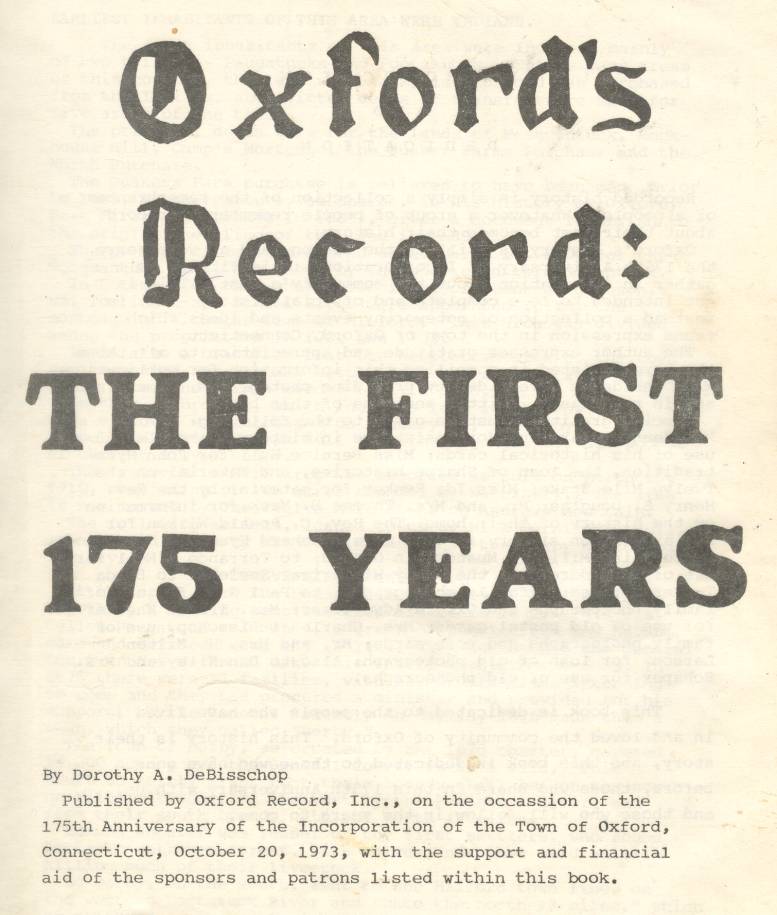
Oxford's Record: The First 175 Years -
INTR0DUCTI0N AND DEDICATION
Recorded history is simply a collection of the remembrances of a people. Whatever a group of people remember or record about their past becomes their history.
Oxford's history is still in the making, and as we observe the 175th Anniversary of Incorporation, it is fitting to gather in information about the community's past. This is not intended to be a complete and official history -- it is instead a collection of noteworthy events and ideas which found expression in the town of Oxford, Connecticut.
The author expresses gratitude and appreciation to all those who have assisted in compiling this information for publication. Many residents have aided by providing photographs, remembrances and in some cases, written sections of this book.
Special gratitude must be given to the following:
Mr. Kenneth Marsden, for assistance in history of hotels and use of his historical cards; Miss Bernice Hull for John Hyde tradition, the loan of Sharpe histories, and material on the Twelve Mile Stake; Miss Ida Renker for material by the Rev, Henry S. Douglas; Mr. and Mrs. Thomas B. Meek, for information on the history of their home; The Rev, C. Ronald Wilson for his article on slavery in this area; Richard Ryan for his piece on Colonial Military Musters in Oxford; to Terrance O'Neil for use of his address to the Derby Historical Society; to Beeda Tucker for use of family photographs; to Paul Gazy for use of family photographs and Oxford Advertiser; Mrs. Truman Wheeler for use of old postal cards; Mrs. Charles DeBisschop, use of family photographs and post cards; Mr. and Mrs. H. Milton Larson, for loan of old photograph; Also to Dan Kiley and Mrs. Schaper for use of old photographs.
This book is dedicated to the people who have lived in and loved the community of Oxford. This history is their story, and this book is dedicated to those who have gone before, those who share in this 175th Anniversary with us, and those who will follow in the years to come.
-
EARLIEST INHABITANTS OF THIS AREA WERE INDIANS.
The first inhabitants of this area were Indians, mainly of two tribes -- Paugatucks and Pootatucks. Unlike many areas of this country, the land which comprises Oxford was purchased from the Indians, and written deeds of transfer were made for five areas of the town.
The principal deeds were for the lands of Wesquantuck, Rock-house Hill, Camp's Mortgage, the Quaker Farms Purchase and the North Purchase.
The Quakers Farm purchase is believed to have been made prior to 1689, or thereabouts, as Sharpe, in his History of Oxford, Part First, (published in 1885), cites a document referring to the original settling of the land in 1689.
Sharpe also cites an old deed dated March 19, 1700 for the Wesquantuck area, now known by the shortened term Squantuck.
In December of that year a committee of Ebenezer Johnson, Wm. Tomlinson and Samuel Riggs were appointed to buy the mortgage of Nicholas Camp of Milford. This area was divided among the proprietors in 1702 and 1703.
It is also a tradition that the Kettletown area of the town was purchased for a brass kettle from the Indians at a very early date, and sold a second time in 1679.
Another Purchase, which includes land in the Towantic area of town, was purchased on January 31, 1710, by Samuel and Lieut. Joseph Hull of Derby, agents, for six pounds of current silver money.
The Twelve Mile Hill area was recorded as sold on March 15, 1710, consisting of 100 acres bounded by Waterbury. The area is now marked by The Twelve Mile Stake on Andrews Mountain.
The following article, loaned to us by Miss Bernice S. Hull, is a speech given by Marjorie Woodruff at the Derby Historical Society:
THE TWELVE MILE STAKE.....
At the spot where the Housatonic and Naugatuck Rivers come together, a trading post was established in 1642. This was called Paugatuck. In 1654, a group of people from New Haven came and settled here, and in 1655, they petitioned the General Court in New Haven to make this little settlement a town. In 1675 there were 12 families, with 11 more families intending to come and they had procured a minister and provided for his support; so the General Assembly on May 13, 1676 made them a town, which they called "Derby."
The Town of Derby, as created by the 1675 charter, covered 14,000 acres, and the General Court, in 1671 said, "This Court do hereby grant that their bounds shall be; on the south on Milford bounds; on the west by the Pootatuck River, and from their south bounds unto the north 12 miles.
Edward Wooster was leader of the first settlers, who found Derby an unbroken forest, with wolves and other wild animals killing much of their livestock.
So Derby, on the south, went to the Milford town line, on the west to Pootatuck River and "unto the north 12 miles," which as measured by the early inhabitants, was on what is called Andrews' Mountain. No one really knows who put the twelve mile stake in place. There is a record of a vote granting to John Stanley, 12 acres of land on the hill, "at a stake set down by Derby men."
In March, 1768, the 12 mile stake is mentioned, but by this time the stake had disappeared and a living apple tree stood where the 12 mile stake had stood. The apple tree died and a pile of stones replaced it. In June, 1905, the D.A.R. Chapters of Derby, Naugatuck, Seymour and Ansonia gathered at 12 mile stake and dedicated a boundary stone.
Miss Sarah Prichard in her chapter on English place names in the Waterbury history says, "The restoration of the name of this ancient hill, and the replacing in enduring and suitably inscribed stone, of the 12 mile stake, is an honor which Naugatuck might well have conferred upon herself, if indeed the ancient towns of Derby and Waterbury neglected their opportunity of an anniversary meeting on the same hill for the same purpose."
The D.A.R. Societies must have heard of Miss Prichard's remark, and as one of their interests is the marking of important historical spots, decided to replace the marker with a permanent stone. On June 14, 1905, 200 members of the chapters, including, I believe, some members of the Waterbury Historical Society, arrived by carryall and carriage, on steep Andrews Mountain, to dedicate a stone marking the ancient division line. The day was a perfect one and they could look across the country to Waterbury on the north and Naugatuck toward the east and Long Island Sound on the south. Andrew's Mountain is said to be 25 or 30 feet higher than any of the hills for miles around.
The ladies enjoyed a lunch at the Andrews summer home and held their meeting on the porch.
Mrs. Maria Pinney, of the Derby chapter, gave the historical facts concerning the old town of Paugassett. Rev. Joseph Anderson gave the address of dedication, and closed his talk with this thought -- "and so a wood stake decays, a tree dies, and a heap of stones becomes scattered, a rock with this inscription may become an enigma, but as long as the human heart throbs responsive to a story, that stone will live and will convey its gentle lesson to the generation of men."
The boulder is about 40 feet from the Andrews home. It is about 4 feet long, 2 feet wide and stands about 2 feet above the ground.
On top, the ancient boundary line divides the rock into two parts. On the south side in the word "Paugassett" and on the north side, "Mattatuck", Ancient Boundary, 1680, On the front of the boulder is inscribed, "Marked by the Daughters of the American Revolution of Derby, Waterbury, Seymour, Ansonia, 1905,"
The stone referred to in the speech still stands, and was placed by the cooperation of Robert W. Hill, who supervised its placement with seven men, six horses, and a full equipment of ropes and tackle.
-
THE EARLY SETTLEMENT IN QUAKER FARMS AREA.
The date of the first settlement in Oxford has not been firmly established by preserved documents, but Sharpe cites an early record designating the westerly portion of town as the Quaker's Farm, in l683. He presumes from that settlers had also settled there by that date.
He also cites an early document listing a layout of 170 acres at Quakers Farm for Lieut. Johnson, made March 27, 1688, which refers to "the common road," through "the place commonly called the Quaker's Farm."
As there was a road and in 1680 there was need to establish boundaries in that area, it appears that there were a considerable number of settlers in that area at that time.
Other early settlers for whom records have been preserved appear to have settled in the area at an early date, and a few of them are listed below:
- Joseph Hawley, 1705, exchanged land with Thomas Sharpe.
- Samuel Riggs land, laid out of Five Mile Hill, 1699. This land was bounded by land of John Hulls, John Tibballs, and Wedow Denman.
- John Chatfield, 1711, in the swamp upon the Five Mile Brook.
- John Tibballs, 1711, adjacent to S. Riggs and John Hull.
- John Pringle, over the Eight Mile Brook, bounded by land of Samuel Nichols.
The above listing would indicate that N. J. Wilcoxson was in error when he listed the early settlement of Quaker Farms in his address at the Centennial Celebration, July 4, 1876. In that address, he said:
"The first English inhabitant,of Oxford, as I take from record, was Dr. Butler, a quaker and hunter, who for some years from the year 1715, had a hermit residence."
He continued on to state:
"The first English person born in Oxford was Lieut. John Griffin, born in 1725, died 1821, aged 96 years...."
One early inhabitant of Quakers Farm was David Tomlinson, who emigrated to that section from Woodbury about 1782, at the age of 18 or 20. He was a merchant who developed his business from a room in his dwelling to a highly successful operation. He owned 1,500 acres of land in the area, and enjoyed the reputation of being an outstanding agriculturist.
He also invested heavily in foreign trade, which eventually caused his financial ruin. He chartered vessels, and once his vessel and cargo were taken by French privateers.
He was a member of the State House of Representatives, and at the time of his death in 1822, at the age of 60, he was a member of the State Senate.
-
THE EARLY PARISH OF OXFORD.
The first records of Oxford as a unit, are not those of a town, but those for a parish which has continued to the present day Oxford United Church of Christ, Congregational.
At the time of the parish formation, the separation of church and state was unknown, and the state in fact assumed the authority to grant or refuse permission to form church parishes.
The first petition for a separate Oxford parish was made to the General Assembly of the State of Connecticut in May, 1740, and on the seventh day of May, 1741, the petition was granted.
After listing the petitioners and the boundaries of the proposed parish, the grant reads:
"It is thereupon resolved by this Assembly, That the above said memorialists, inhabitants of Derby, Waterberry, and Woodberry, situate and living within the bounds and limits above described, be and become together one entire, separate and distinct ecclesiatal society or parish, subsisting and known by the name of the parish of Oxford, and endowed with all powers and privileges wherewith other parishes within this government are by law endowed."
Under the customs of the time, the parish had the powers of taxation of residents, public education, and other functions which are now considered to be municipal affairs.
The first meeting of the society was held June 30, 1741. The session was held at the house of Samuel Twitchell; Isaac Trowbridge was elected clerk. Isaac Knowles was chosen as moderator, and a committee for prudential affairs was appointed. Members were Caleb Perry, Ebenezer Riggs, and John Lum. The meeting also voted to hire a minister, and appointed a committee of John Towner, Abial Fairchild, and Samuel Twitchell to hire a minister.
A tax of five pence upon the pound of the List of 1740 was ordered, for the costs of Mr. Birdsey, but the residents on Rock House Hill were exempted from the tax.
Ephraim Washband was elected as collector and treasurer.
At a later meeting held October 6, 1741, the group voted to build a meeting house, near the site of the present Congregational church.
The session also rescinded their vote to hire a minister, and agreed to a tax of one penny on the pound to pay the costs of the parish. Timothy Wooster and James Wheeler were appointed to hire a minister for that year.
Meeting notices were to be posted at the houses of John Lum, Jonathan Griffin, Joseph Lewis, Isaac Knowles, Joseph Davis, and Joseph Wood. It was also agreed that the meetings on the Sabbath would be held at the house Samuel Twitchell.
-
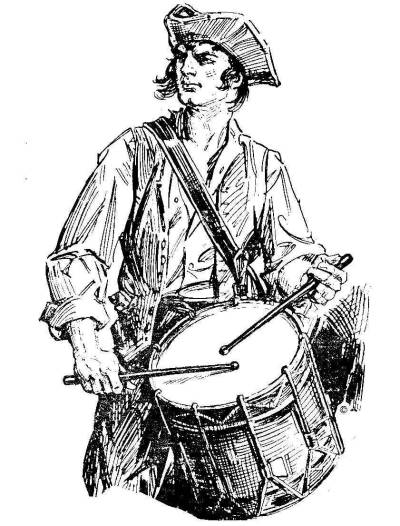
THE BELL, THE HORSEMAN, AND THE DRUM.
By Richard Ryan.
It is Saturday and the time is noon -- hear the wail of the siren atop the Oxford Center Firehouse. It's a good idea to test a warning system. It's nice to know that help can be called when and if there is an emergency. Think back to the year 1798 and how emergencies were handled in those days.
There were fires and crimes then as there are now, and definitely the townspeople, during the years of the Revolution, were conscious of the dangers inherent in a war situation. What actually would have happened in Oxford Center in the Revolutionary Ere, if British warships were observed approaching the Connecticut shoreline, or worse, if a British regiment was seen marching toward what is now called "the Valley"? How would the people of Oxford been prepared to meet such an emergency?
That is a very interesting question, and it is difficult for those living in the twentieth century to imagine exactly how such a situation might have been met. There were no sirens for there was no electricity. The only means available for sounding an alarm in those days were a bell, a rider on horse-back or a drum. Today, when the alarm is sounded, groups of dedicated volunteer firemen are available to answer the call. During the colonial period, who would have answered the bell, or the horseman, or the drum?
Every township worthy of the name had a militia, a group of able bodied men, willing to sacrifice their time and talents to meet the needs of the community. In the center of Oxford, during the Revolution, there was a large green. Oxford Road, as we know it in 1973, did not exist. The old road came north from Seymour, as it does now; but instead of going through the center of Oxford, it ran behind Victory Park and up Riggs Street to Academy Road. It turned a sharp left on Academy Road and ran past the Congregational Church, and then made a large sweeping circle around the center green, to what is now Dutton Road. The road continued up the hill, and through the woods until it crossed Governor's Hill Road, and then continued in a northerly direction until it met what is now called Hogsback Road. (In the old days, we called it Pig's back Road.)
You may wonder how I know what the old town looked like during the Revolution and during the time of Incorporation. Please allow me to introduce myself. My name is Chauncey Judd, and I lived during the Revolution, and played an active part in the affairs of Oxford during those days.
At the age of fifteen years, I began to attend all the training sessions of the militia which were held on the Oxford Center Green. Every Saturday, at noon I heard the sound of the field drum which called all of us to muster. We marched, and we drilled, and we practiced with muskets, pitchforks, and clubs. And as youths filled with the spirit of adventure, we almost looked forward to the day when we might be called upon to defend our little town against a regiment of Lobsterbacks (as we called the British in those days). When each Saturday's training session came to a close, many of the men, accompanied by their wives, would join in a social gathering.
The ladies brought specially baked muster bread (like modern day ginger bread, but much tougher), and the men always seemed to find an adequate source of liquid refreshment. We were very formal in those days, and we used big words to describe very common events. The late Saturday afternoon gathering (which today we would call a party) was a post-muster jollification.
In spite of all my dreams of fighting the British under the command of Washington, my part in the war was not quite so glamorous. One evening, in March of 1780, I was returning home after a visit to the home of a young lady who had struck my fancy. I lived at the northern boundary of Oxford (where Towantic Hill Road is now located). In those days it was called Gunntown.
On my way home that evening, I came across a group of men who insisted that I accompany them to an unknown destination. Some time later I learned that they were British supporters who had burglarized the home of an American Revolutionary sympathizer in Bethany. Being afraid that I would recognize them, they took me hostage. During the next several days of my captivity, I learned the details of their plot. They had originally met to plan their deed at Whittemore's Tavern (which still stands in Seymour). Their plan was to steal large amounts of money and silk goods and turn them over to the British in Long Island.
When I unexpectedly met them on their route of escape, their scheme came to an abrupt end, and their stolen goods were quickly discarded. At that point, their only concern was to escape from this region to the safety of British territory. In order to prevent me from identifying them to the authorities, they took me with them. For over a day we hid in a narrow cleft in the rocks to the south of Gunntown Road (Towantic Hill Road) and then under cover of darkness I was dragged along Riggs Street until we reached the home of the cousin of one of the robbers. It was called Captain John Wooster's Tavern and was located at the falls near the corner of Park Road and the main road leading to Derby.
We stayed there overnight, and I knew from the frightened actions of my captors that the militia of Bethany and Oxford were probably in pursuit of them. The next day, in the middle of a blinding snowstorm, they took me over Great Hill towards Derby Landing, and then, by boat we traveled down the Housatonic River, past Stratford and across Long Island Sound to British territory.
I didn't know it at the time, but the alarm had indeed been sounded in Bethany, Oxford and Derby. Observers who were sympathetic to the American cause had watched us as we rowed past the Stratford lighthouse, and by means of telescopes were able to determine exactly where we had landed on Long Island. Within a matter of hours, a rescue party was following our path. During the next night, the robbers feeling secure in British territory, and having fallen asleep, were taken captive by the colonial militia.
At first they thought that I was part of the conspiracy, and I was taken with the others to Newgate Prison in Simsbury. Eventually the authorities in Connecticut learned the truth and I was allowed to return home as a hero.
I was welcomed back to Gunntown and to Oxford with open arms, and I must admit that I thoroughly enjoyed my reception as a local war hero. My only regret was that being otherwise occupied, I never had the opportunity to answer the call of the bell, the horseman or the drum.
By Richard Ryan
-
OXFORD RESIDENTS AND THEIR ROLES IN THE AMERICAN REVOLUTION.
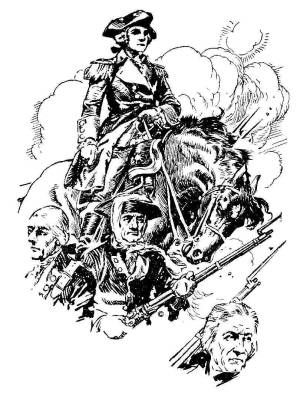
Although there are no records of Revolutionary War actions taking place within the confines of the town of Oxford, a number of residents participated in the war, and Oxford young men were subject to the efforts of the British to enlist men from the Colonies to serve in her armies.
N. J. Wilcoxson listed the names of Capt. Samuel Candee, Capt. Job Candee, David Peck, Edward Bassett, Isaac Chatfield, Timothy Johnson, Phineas Johnson and Jeremiah M. Kelley.
The Litchfield-Hoyt History adds two others to the list: Prudence Lounsbury, Uri Scott.
STORY OF TIMOTHY JOHNSON'S PART IN THE REVOLUTION as related by Judge N. J. Wilcoxson.
"Mr. Timothy Johnson related to me an incident that I must not omit to mention. The corps of which he was one, was on the bank of the Hudson, under Gen. Wayne, and in presence of Washington. Wayne besought Washington for a permit to lay siege to the British fortress on the bank of the Hudson called Stony Point. Wayne was refused permission. He besought a second time. Washington said the undertaking was too hazardous, it could not be successful, and refused him permission, believing it would be but a sacrifice of men, Wayne, nothing daunted, applied a third time to the Commander-in-Chief for his permit; told his plan and expressed his confidence of success. This he did with earnestness, such as told of the will to his purpose. Permission was granted him. He was allowed to pick his men. Timothy Johnson, my narrator, was one chosen, and as I think he said, his brother Phineas was another. The men chosen, they marched onward to the onslaught. Washington re-viewed them as they passed -- he looked very sober, and thought they would all be killed. They were marched in to the enemy's picket. They halted. They were fast. Wayne came along with a piece of bread and meat in his hand, saying, "Blood may run in rivers; any one who desires it may leave the ranks and he should not be branded with cowardice." But one left. Wayne then went through the line of troops and took the flints from every gun, that there should not be a gun fired giving light for the enemy's aim. The night was densely dark. All made ready and about to commence the march. Wayne said, "Death to the man that attempts to leave or falters in duty." Onward they marched and soon came upon the enemy's picket. The picket hailed. No answer. He fired and ran. Wayne and his force ran after him, The fortress was encircled with the limbs of the apple trees piled high and thick, the twigs of which were sharpened to a point, so that it would be impossible to get over or break through.
But said Mr. Johnson, "We were so close upon the sentinel or picket, that he could not fill the gap made for him; we ran through the same and so entered the enclosure."
The enemy in the meantime kept up a brisk fire, but not a man was hit. They made up to the walls of the fort and set about scaling. The man first over the wall was killed, the only one lost of the detachment. The contest was sharp and and severe, but short. The British soldiery surrendered. Wayne received a severe wound with a cutlass over the eye, a cut in such a manner as to cause the eyelid to fall.
"He bled like a butcher," as it was told to me. Wayne said that he would ever proud of carrying the scar of that wound.
From N. J. Wilcoxson's Centennial Address, July 4th, 1876.
COLONEL JOHN DAVIS
Another Oxfordite who was involved in the Revolution was Col. John Davis, who built the house on the corner of Route 42 and Chestnut Tree Hill Road, now owned by the Mosavich family.
Davis was a young man when captured by the British when they occupied New York, at a time when it was a practice of the British to capture young American men, to prevent their joining the rebel cause and to induce them to serve in the British army.
Davis was held prisoner for some time and later returned to Oxford.
EDWARD BASSETT
Born in 1751, he married Polly, and had three children: Andrew Bassett, born Sept. 14, 1791; Joel, Sept. 21, 1792; William, Sept. 18, 1794. Edward Bassett died, January 21, 1841, aged 90 years. Buried in old Zoar Bridge Cemetery.
Bassett served in the third company of the First Regiment which marched from Derby for the relief of Boston in the Lexington Alarm. He is listed as serving with Col. Bradley, Gen. Wadsworth, with Shelton's Light Dragoons, and Second Regiment of the Artillery.
ISAAC CHATFIELD
Born 1755, he married Sarah, and had four children: Lois, born Oct. 28, 1790; John, born May 30, 1793; Truman, born June 16, 1796; Zera, born December, 1798. He died September 25, 1837, at the age of 82.
He served at Brandywine, Germantown, Monmouth, and other places in Capt. Pendleton's Company in Col. Jeduthan Baldwin's regiment.
ELIJAH HARGER
Not an Oxford resident at the time of the Revolution, but is buried in the old Hillside Cemetery. He enlisted in Hartland, Connecticut, and was on guard duty at the time Major Andre was captured.
Died October 2, 1887, aged 83 years.
JEREMIAH KELLY
Listed only as a pensioner living in New Haven County in 1832, with no record of his service
URI SCOTT
Listed in 1840 Pensioners from Oxford. On June 12, 1803, Uri Scot and his wife Esther were received into communion at the Congregational Church, by letter from the church in Salem.
DAVID PECK
Served in the Ninth Regiment at New York, 1776 and later at Westchester Border. Was present at the battle of Monmouth, and was listed in 1818 as a New York resident.
JOB CANDEE
He and his wife joined the Congregational church on July 20, 1788. He was stationed at East Haven, New Haven, West Haven, and also at West Point.
SAMUEL CANDEE
He and his wife Mabel joined the Congregational Church on April 5, 1778. He is presumed to be the Samuel Canday who is listed as serving in the First Regiment at the Siege of Boston.
-
THE JOHN HYDE TRADITION
By Miss Bernice Hull
"In the town of Oxford on Bowers Hill in Revolutionary days, there stood a farmhouse owned and occupied by Mr. John Hyde. The chimney of this house was probably ten feet square and it boasted five fireplaces as well as a large brick oven where the family baking was done. Mr. Hyde had a son named John Salem Hyde. As the American army was seriously depleted, it became necessary to secure raw recruits, but John did not wish to enlist in the army. Armed and equipped with the required papers, the officers started out to secure him.
One can easily imagine the family seated in the long kitchen before the fireplace, quietly chatting about the news of the day, when their conversation was suddenly interrupted by the sound of horses' hoofs. Someone exclaimed, "It's the officers after John!" The officers asked in vain, for John had vanished like a spirit. After calling him, they began a search of the house from attic to cellar. The hunt became more exciting as members of the family joined in the search.
Angered at their defeat, the officers went to the barn to continue their pursuit, but no trace of John did they find. Despairing of capturing him alive, they ran their bayonets into the hay mows, hoping at least to secure his body. The mother, growing frantic, called again and again to her son to give himself up. It was all in vain. With oaths and curses the officers finally mounted their horses and rode away.
The great mental strain was more than the mother could bear, and she could only moan, "Have you seen anything of John Salem Hyde today, Have you seen anything of John Salem Hyde?" After the officers had departed, and quiet had once more been restored, John appeared to tell his story.
When the officers were announced, unnoticed by anyone, he mounted the large open chimney and, securing a foothold on one of the cross sections, had remained there unseen and unheard until the officers were miles away.
His mother never regained her reason. Quiet as usual, she went about her daily tasks, but to everyone she saw, she asked the same questions "Have you seen anything of John Salem Hyde; have you seen anything of John Salem Hyde today?"
The house mentioned in Miss Hull's story was bought by John Hull and burned about 1897.
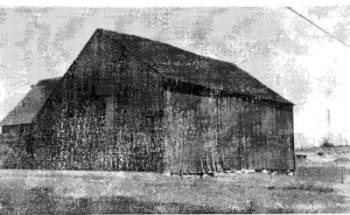
Barn where American officers tried to secure Hyde. -
FOLLOWING THE WAR OF INDEPENDENCE FROM ENGLAND, OXFORD SEEKS ITS SEPARATION FROM THE TOWN OF DERBY.
Account of the incorporation of Oxford, by N.J. Wilcoxson.
"To the year 1798, Oxford was part and parcel of the town of Derby. As any matter of historical nature would be so much of Derby's history, we must consider Oxford people as a community in the parish capacity. About the year 1791, the people aspired to become a town. It was then they preferred their petition to the General Assembly for incorporation as such. Year after year, to the seventh, they presented their petition, when on the seventh they were successful, and Oxford was incorporated a town. Not in the least daunted for being six times repulsed, they persevered until victory crowned their efforts. Their indomitable determination, their energetic action, their unfaltering perseverance, are to be regarded with admiring approbation. When speaking of this with one who was active in the cause, I said, "How long were you in gaining success by prevailing with your petition?" He said, "Seven years; just as long as it took our country to gain her independence."
I must not omit to say, the people at last resorted to strategy, and by strategy they succeeded. The town election of the town of Derby was at hand, The town meeting was warned to be held at nine o'clock forenoon, but never opened till one o'clock afternoon. The people of Oxford agreed to go together in a body, and be on hand and open the meeting of the town at 9 o'clock a.m. It was carried out to the letter. The hour of meeting was set and known to every man who might vote. They all congregated and formed in procession on the main street of the central part, and ready at a given signal simultaneously to start. The signal given, the procession moved. It was so much the custom then to open a town meeting with a prayer, that proceedings without prayer were hardly regarded as legitimate. To save trouble from that direction, Rev. Wm. Bronson, minister here, was taken along to offer the opening prayer. The signal for a move being given, the procession moved on; no time was lost. They reached the place of meeting. It was nine o'clock. They set about the business of the hour with a diligence that told what was meant.
The Derby people were in consternation. They started out and ran their horses in every direction, calling on persons to hasten to the meeting. But before enough of the voters could be gotten there to outnumber the Oxford voters, Nathan Stiles, who resided where Dr. Thomas Stoddard now resides in the town of Seymour, was chosen Town Clerk, and the meeting had voted that town meetings should be holden one half the time in Oxford.
Derby no longer opposed the movement of Oxford to become a separate town, but turned over and aided in the matter. These facts were given me by Capt. David McEwen, a prominent citizen, one ever ready and active in public enterprise, a man of laudable character, a farmer by avocation, and when in the prime of life was one of the most thorough, flourishing and successful operators. I am told he was marshal of the day and led the procession.
In and by the act of incorporation, it was ordered that the first town meeting be held on the third Tuesday of November, 1798, that Thomas Clark, Esq., warned the meeting, and that John Riggs, Esq., served the meeting as moderator. It will at once be seen that the people then as a town community were in a crude state, and without authority vested in themselves for town organization.
The town meeting was held in accordance with the foregoing. One who was in attendance told me that snow fell heavier than we often know it to fall, yet the meeting was as fully attended as any town meeting he had known in this town.
(from his Centennial speech, July 4, 1876)
-
THE FIRST TOWN MEETING
The first selectmen of the town of Oxford were David Tomlinson, Charles Bunnel and Caleb Candee. The town clerk was Ebenezer Wooster and John Riggs was named treasurer.
-
THE FIRST CHILD BORN IN OXFORD AFTER INCORPORATION
The first child born in Oxford after its incorporation was Sherman Lines, son of Zebulon and Lois Lines, who was born November 12, 1798.
-
LAYING OF THE TOWN GREENS
The public green in the Center of Oxford was given by a Mr. Chatfield, "for a site for a meeting house, according to Wilcoxson. The site was called "Meeting house acre land" and consisted of land donated by Chatfield, and land from proprietors and owners of land on the easterly side of the turnpike road, forming the Upper Green.
The Lower Green was laid out by the proprietors committee for a public common and military parade ground.
-
EARLY TOWN ROADS
One of the most important problems facing the new town was the matter of roads and highways through the town. At that time, many roads were turnpikes, which were privately operated. These were let out to the lowest bidder, who would maintain the roadway and collect tolls as compensation for his efforts.
However those roads which were not traveled extensively enough to justify toll collection were often in disrepair.
In 1809, a tax of three cents on the dollar on the list of 1809 was laid to repair the highways. However, the tax was not to be paid in cash, but in labor.
The rate of computation for labor was 75 cents per day in the spring and 50 cents per day in the fall for a man or a three cattle team.
That meeting also voted that each man liable by law to do road work should be required to perform two days work on the high way, over and above paying his tax.
Much discussion was carried on among the voters concerning what roads should be developed. In April of 1810, the town meeting appointed the selectmen to view the layout of the road from the Turnpike Road near David Candee's to Five Mile Hill, and another road from the Turnpike to Quaker Farms and thence to Ousatonick Turnpike.
However, by September of that same year, the voters changed their minds and voted to instruct the selectmen to take no action.
The early townspeople also opposed the development of a bridge in the Rimmon Falls area, voting on April 13, 1807 to send Abel Wheeler as representative to oppose "any petition that may be brought to the General Assembly to be holden at Hartford in May next praying for the privilege of collecting a toll on Rimmonfalls Bridge."
Thus began a long struggle between the town meeting voters and the highway firm, which was resolved twenty years later, by an offer from Sheldon Clark.
He agreed to place a deposit of 100 pounds in money for the town, with the town being allowed to draw interest on the fund to be used for the maintenance of the bridge.
"If prudently and fortunately engaged, the interest after that time will probably build and keep in repair all the bridges that will ever be wanted in that place," Clark wrote.
The offer was accepted, and Pines Bridge was constructed in the area which later became part of Beacon Falls.
-
THE EARLY TOWN MEETINGS CONSIDERED A WIDE VARIETY OF TOPICS.
In early town meetings a great variety of topics were discussed and decided upon. An unusual situation in February of 1810, found the voters considering the problem of grave robbery.
"At a meeting of the inhabitants of Oxford, legally warned on the 24th of February, 1810:
Whereas, on or about the night of the 16th of January last the grave wherein the dead body of Mr. Enos Towner late of this town was interred and was without the leave or knowledge of the relatives of said Towner and the selectmen of this town of Oxford, and the dead body taken out and conveyed to some place unknown to the relatives or the selectmen or the inhabitants of said town, which is against the peace and contrary to said law in such case... Whereupon it was voted by the meeting that Mr. David McEwen, Elias Scott, Abel Wheeler, Esq., and Harvey Osborn be a committee to inquire and search after and obtain if possible said body of said Towner and when obtained to deliver the same to same's relatives in as good a condition as may be; and also to advise with and assist the Grand Juror of this town in finding out and apprehending the bodies of the perpetrators of said crime; and provided they should not succeed in finding and obtaining said dead body and in apprehending the bodies before the 25th day of March. next, it shall be the duty of said committee to consult with the selectmen of neighboring towns in this state and such other persons as they may think proper respecting said subject, petitioning the Governor of this state to issue a Proclamation offering such reward as his excellency may think proper for the apprehending of said offenders.
And also, in said consultation to take into consideration the expedience of annihilating the institution or corporation of the medical college in New Haven, and the most effectual legal means to accomplish the same.
Report to be made to this meeting on Freeman's Day in April next."
The same town meeting also voted that if any person reported the location of the body, the disclosure would not be used against him, provided the body was returned to the relatives as it did not make any trouble to the town.
At the next freeman's meeting in April it was voted that the committee should continue its efforts and also petition the General Assembly to make restrictions on the Medical School in New Haven.
THE EARLY TOWN MEETING SPOKE ON NATIONAL AND INTERNATIONAL ISSUES.
The inhabitants of the new town were also unafraid to speak their mind on issues of national and international importance. Listed below are the minutes of a Freeman's meeting, dated April 11, 1808, expressing the disapproval of the embargo act:
"Voted that the Inhabitants of the Town of Oxford do disapprove of the laws laying an embargo upon the commerce of the United States and that it is their wish that all proper measures may be taken for the purpose of having said law repealed."
It was also voted at that meeting that the selectmen should prepare and direct a petition to the President of the United States of America seeking repeal of the laws.
The selectmen were also instructed to send copies of the petition to the Speaker of the House and Speaker of the Senate in Congress.
There is no record of how successful the efforts of the townspeople were, in evaluating the subjects which were undertaken by the town meetings of early Oxford.
It does not appear that the case of the grave robbing was ever resolved, and that medical center referred to in the early town records is still in existence, thriving in New Haven.
What role the little town of Oxford played in the ending of the embargo act is unknown, but it is certain that the wide-spread outcries which were raised by small communities and large played a role in the developments which followed.
-
OXFORD TRIES TO GIVE AWAY A ROAD
At one time the townspeople of Oxford attempted to give away a road, but they could not get anybody to accept it. The town even offered to pay a company to take the road off their hands.
At a town meeting held on November 18, 1930, the residents voted to direct the selectmen to give the Dug Road to the Dug Road Turnpike Company for the consideration of $200 to be paid by the town to the company.
The meeting also voted that there would be no opposition to a toll on the road, provided Oxford residents would be exempt from the toll.
However, residents had to hold a special town meeting on December 3, 1831. In the thirteen months since the previous meeting, the selectmen had been unable to give the road away, in spite of the financial inducements offered.
The residents were forced to rescind the stipulation that Oxfordites should be exempt from the toll, before the company would accept the road and the $200.
-
SLAVERY IN OXFORD
by C. Ronald Wilson.
It must be pointed out in the very beginning that slavery existed in Connecticut from 1637. This slavery was not Negro slavery, but Indian slavery. Indians taken in the Pequot War of 1637 were given to the colonies as slaves. In 1646 a law was passed by the New England Confederation which authorized the seizure and enslavement of Indians from native villages giving sanctuary to fugitives "either to serve or to be shipped out and exchanged for Negroes as the cause will justly bear".
Indians proved unsatisfactory as slaves, the prime reason being that they could disappear into a neighboring village and not be recaptured. Negro slavery grew from 1650 on. The largest slaveholder in Connecticut was a Mr. Godfrey Melbone, a wealthy gentleman, a graduate of Oxford and a resident of Brooklyn. He had between fifty and sixty slaves. There were 5,085 Negroes in this state according to a 1744 census.
According to the town and church records, slavery was not extensive in Oxford. One reason for this may have been its rural nature. The only place where any picture of slavery can be drawn from the records of Oxford is from the records of the Oxford United Church of Christ, Congregational.
The Congregational Church was the establishment in this State until 1818, and its church rules reflect the general attitude of the state.
Slavery was based on the Old Testament model, and slaves could sue their masters for freedom, and they were "persons under the law", both civil and religious law. Slaves could hold property and membership in the church. There is no record of any statute denying or limiting the instruction of the Negro in New England's early history.
The seating of Negro slaves in church in Oxford as well as in the rest of the colony was not so much a racial question as one of social strata. Each group or class possessed clearly defined rights and duties.
In 1738, the Connecticut Association of Ministers dealt with the question of slave membership in the church.
The Question:
Whether the Infant Slave of Christian Masters May Be Baptized in Their Master's Right; Provided they Suitably Promise and Engage to bring them up in the Ways of Religion?
Resolved:
In the Affirmative.Slaves were considered a part of the family -- not members, but a part of the family unit. They held the same status as did minor children.
The following records will give us some idea of the number and position of the Negro slaves in Oxford in our Colonial days:
- Pero and Phillis:
- On February 19, 1749, Pero was baptized in the Congregational Church in Oxford. On January 15, 1750, Phillis was baptized in the same church. Both being servants or slaves of one James Wheler. On June 30, 1747, Pero and Phillis had been married in the church and in the year 1779 they had their daughter Desire baptized. Pero was taken into full membership in the church on February 19, 1758-59 and died and was buried from the church on April 13, 1789.
- It is clear that in Pero's life the church was open to him, his wife and child.
- The following accounts will show that Pero was not an exception:
- October 1, 1777, "Roger, Negro, and Beck, Negro wench" were married.
- Beck joined the church May 1, 1766. "Beck, wife of Roger, Negro".
- September 12, 1790, Milly presented for Baptism by Roger, Negro
- Desire, Negro wench, Baptized September 7, 1777.
- Same day Mehitable, daughter to Desire, Negro wench, baptized.
- October 29, 1786, Abel, Son of Desire, Negro, Baptized.
- September 7, 1777, Desire, Negro Wench, owned her Covenant
- 1780, no date. Laban, Son of Desire, wife to Laban, Negro.
- March 31, 1751, Dora, Negro, admitted to full communion.
- November 27, 1745, Peter, Negro Servant to the Knowles, received to Communion from the Pastor and Church of Christ in Southbury. (Isaac and Martha Knowles).
- April 3, 1765. Peter, Negro, dismissed and recommended to the church at Amity.
- Tobias and Rachel, Negro servants to Capt. John Wooster, married June 19, 1776.
- Jethro Martain, Negro, to Olive, Negro, married December 31, 1788.
- Pal, a Negro boy and servant to David Johnson, died in the 5th year of his age, May 12, 1766.
- Jenne, Negro Servant child to David Johnson, -21st year, June, 1773.
- Huldah, Negro servant to Decon Ebenezr Riggs, died in the 9th month of her age, May 21, 1818.
- Town Records, deaths
- Philip, Esq. Tomlinson's Negro, 36, 1818.
- Chickery Jeffery, a black, 45, 1832.
- St. Peter's deaths
- Rachel Hall (colored) daughter of Timothy and Olive Drake, d. July 12, 1857, aged 36 years.
The slave was never a full citizen of the community. He or she could hold property, church membership and even sue for his or her freedom if maltreated. They could not hold office in the town. It would appear that they never held offices in the church, though in some communities slaves were Deacons and we know of one slave who became a pastor of a Congregational Church in Connecticut.
Slavery in Oxford was not extensive. It was considerate for its time in history. The black was a part of our community and most likely contributed to our early growth and stability.
OXFORD FAMILIES WHICH ARE REPORTED TO HAVE OWNED AT LEAST ONE SLAVE ACCORDING TO OLD DOCUMENTS OR COMMUNITY TRADITION.
- John Holbrook family owned Titus, for whom Titus Lane was named.
- Josiah Nettleton, owned Black Sim.
- Captain John Wooster, owned Tobias and Rechel.
- Old Lum family on Rock House Hill is reputed to have owned slaves.
- Isaac Knowles, owned Peter.
- David Johnson, owned Pal and Jenne
- Deacon Ebenezer Riggs, owned Huldah
- James Wheler, owned Pero and Phylis.
- Pero and Phillis:
-
SOME INTERESTING ITEMS VOTED UPON IN EARLY TOWN MEETINGS.
- December 10, 1804:
- "Voted to pay the selectmen for doing town business at one dollar per day."
- December, 1806:
- After having elected the new selectmen the assembly voted, "the selectmen do their service to the town the year ensuing gratis."
- January 1, 1810:
- Isaac M. Wales, Justus Cande, Elihu Bates, Samuel Cande, John Bassett, and Jehiel Peet were elected to be "a committee to make a division of the town poor."
The action was a follow-up from the annexation of a part of Southbury to Oxford. The part annexed was originally part of the old ecclesiastical society of Oxford.
- January 9, 1830:
- "A petition was read from sundry persons, praying that the selectmen be authorized to view and lay out a road from over near to Zoar Bridge to or near to the Baptist meeting house in Quaker Farms in Oxford."
It is Possible the meeting house referred to was Christ Episcopal Church, as it was originally established as a community church.
Some interesting aspects of community and family life have been recorded in THE SEYMOUR RECORD. They were submitted in most cases, by Oxford residents of the day. From these brief notes, it is Possible to imagine life in Oxford during those years.
- April, 1873:
- "A new steamboat has been launched on the Housatonic and a few days since a pleasure party from this place took a trip to the Milford Point and on their way they had the pleasure of Christening it." -- from the Riverside correspondent.
- June 28, 1873:
- "Mr. D.P. Johnson, of Oxford killed a black adder, which he saw coiled around a tree eleven feet from the ground. It measured 5 feet, 7 inches long, and 11 inches in circumference. On opening him, a whole gray squirrel was found in his maw."
- The writer goes on to suggest that it was a common black snake, and not an adder after all.
- June 28, 1873:
- "A colored man, named Jordan Scott, assaulted Mr. William Upson with a horsewhip, giving him a wound near his left eye."
- July 12, 1873:
- Riverside -- "An insane man has been wandering through out street the past few days annoying the inhabitants."
- July 27, 1873:
- "Mr. Rice of Beacon Falls killed a rattlesnake over four feet long in the eastern part of town."
From the above, we may see that life in Oxford has changed from what it was a century ago.
- December 10, 1804:
-
OXFORD IN 1819:
The following is a description of Oxford in 1819 from Gazetteer of Connecticut, published 1819.
"Oxford is a post township, situated in the northwestern section of the county, 14 miles northwesterly from New Haven, and 40 miles southwesterly from Hartford; bounded on the north by Middlebury and Waterbury, on the east by Woodbridge and Derby, on the south by Derby, and on the southwest by the Ousatonic river, which separates it from Newtown in Fairfield county, and on the west by Southbury. Its mean length from northeast to southwest is about 8 miles, and its mean breadth nearly 5 miles, comprising about 38 square miles.
"The surface is uneven, being diversified with hill and dale. The prevailing soil is a gravelly loam; but in the western section of the town it is a calcareous loam, and is generally fertile and productive. There is a large proportion of forests, the timber of which is principally oak, walnut and chestnut. Considerable quantities of wood and timber are annually got to market, principally to New Haven, but some of which is sent to New York. The leading agricultural productions consist of wheat, rye and some other grains, grass, butter and cheese; small meats, fowls, esculent roots and culinery vegetables are sent to the New Haven market.
"The town is well watered; the Ousatonic washes its southwestern border, and the Naugatuck runs through its northeaster section, in addition to which there are numerous small streams. Upon the Ousatonic there are several shad fisheries. The Woodbury turnpike, leading to New Haven, passes through this town; and also the Southbury turnpike leading to the same place, from up the Ousatonic river. "Of the mechanical employments and establishments in the town, the most important are 1 Woolen Factory, 3 or 4 Lime kilns, 1 large Hat Factory, 2 Fulling Mills and Clothiers' works, 3 Carding Machines for customers, 3 Grain Mills and 6 Tanneries. There are 3 Mercantile Stores and 1 Public Inn.
"The population of the town, in 1810 was 1,445; and there are about 200 electors or Freemen, about 220 Dwelling Houses, and 1 Company of Militia.
"The amount of taxable property, including polls, as rated in making up of lists in 1816, was $35,020.
"The town contains 1 located Ecclesiastical Congregational Society and 13 School Districts; besides the located, there are 2 Episcopal Societies and a Society of Methodists. There is a primary or common School maintained in each of the School Districts, for a suitable portion of the year. There is 1 Social Library, 1 Clergyman, 1 Physician and 1 Attorney in town."
-
EARLY MANUFACTURING IN OXFORD
Oxford was early in its history a prosperous industrial town. Chiefly due to the abundance of water-power which was available on the towns numerous streams and rivers.
An early factor in the development of industry in Oxford was the importation of Merino sheep from Spain by General Humphreys who made his headquarters at the falls of the Naugatuck, and named the village Humphreysville. The area was later renamed Seymour.
One of his early workingmen was a young Samuel Wire, who learned in the large woolen factory of Humphreys, and after set up his own mill on the Little River. He purchased from John W. Wooster, in 1814, half a factory, house, barn, dam and waterworks. The factory was apparently something of a clothier's shop and fulling mill at the time he purchased it.
Wire carried on business at the site for about thirty years, using wool purchased from surrounding farms. Many residents would take wool to the mill to be carded and spun and then would bring it home to knit or weave at home.
The mill's principal product was satinet, which was shopped to New York and also retailed in the local areas. Wire sold the place in 1846 to Clark Wooster and Hiram Osborn, with Wire relocating in New Haven, where he served as city Sheriff.
There was a mill at Quaker Farms on the Eight Mile Brook, which was developed by Isaac Rowe, Sr.'s twin sons, Isaac Jr., and Frederick. It was established on the former estate of Squire David Tomlinson. The property was about a hundred rods northerly of Christ Church, and contained a dye shop and a small dwelling.
Isaac Rowe died a few years later, and in 1831, the property was sold to Ira Sherman and Horace Candee, who in 1833 sold it to Benjamin Hawleyville of Maine and Mary Burritt of Southbury.
Later owned by DeForest and Hine, the factory was closed about 1850.
Sharpe says of the site, "The writer remembers skating on the pond with the schoolboys in the winter of 1858-59, when he taught the Quaker Farms School. The conical nests of the muskrats, rising two or three feet above the surface of the pond, made convenient seats for the skaters while adjusting their skates..."
Sharpe also lists a mill in the Punkups area, which was founded by James Dawson, an Englishman. The property was also originally owned by a man by the name of Lees, who later had a son named Robert Lees. Dawson and Lees sold out to Ira Bradley and William Guthrie, and later the mill was sold to James and Samuel Radcliffe of Bristol.
At one time there was a screw manufacturer at Quaker Farms, operated by H. E. Bidwell on Eight Mile Brook, about a mile south of the present Route 188. The small screws were sold to hardware dealers throughout the state, and parts of New York and Massachusetts states. The firm also manufactured auger screws for sale in Seymour and Westville, and shear screws for manufacturers of shears in South Britain and Naugatuck. It is said that a sawmill was also operated here at that time.
At Red City Daguerreotype and ambrotype cases were made, and later William Tucker had a shop there for the manufacture of wagon wheels and horse equipment
Numerous sawmills were in operation, throughout the town. In addition, hay rakes were built by Isaac Towner on the main road in the Center
Sheldon Church, in 1852 owned a sawmill and nearly a square mile of land in timber.
There was even at one time a turning shop, which manufactured croquet sets.
A familiar name is found in a sawmill which originally was owned by William and Sheldon Church, and was later leased to Edward L. Hoadley.
At one time there were eight dams with shops and mills in the area now comprising Oxford.
There was also a cider distillery on Rock House Hill.
A major industry was the manufacture of hats, and casks and kegs were made for the West Indian trade.
There were also a number of shoe shops in the area, with shoes being exported to the city of New Haven and to the south there was a shoe shop at the south end of Riggs street, several on the main road from the Center to Southbury, and one in Quaker Farms.
Terrance O'Neil, who is an Oxford native, recalls that there was a button factory on the O'Neil Road, about 100 yards north of the bridge. He spoke also of a grist mill at the pond below that location. The pond, known as Bidwell's Pond, also was the location of a sawmill, and a cider mill.
"Just as you cross the bridge north of that bridge on the stream where the eight mile brook comes to Lake Quassapauge, there is an old wagon factory up in there, about 100 yards in," he recounted.
There was also in early times a copper mine on the southeast of Copper Mine Road, which was owned by George Lum.
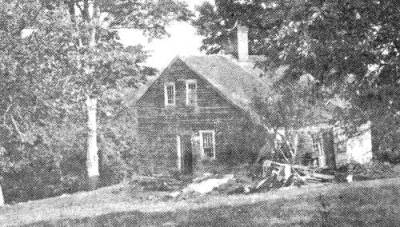
Old Homestead, believed to have been the O'Neill house before renovations. It, like many other homes in Oxford, has been in the family for generations.
Mrs. Ida E. Ingersoll Renker informs us that the following members of the Peck family were all born at the same house at 231 Riggs Street:
- Emma Peck Tucker, b. June 22, 1879, d. Mar. 20, 1950.
- Mable Peck Wheeler, b. Feb. 28, 1882, d. Dec. 3, 1953.
- Otis Henry Peck, b. Jan. 11, 1877, d. Nov. 22, 1935.
- Daisy Peck Ingersall, b. Dec w, 1886, d. Mar. 15, 1970.
- Sarah Peck Rowland, b. Jan 23, 1889, d. April 14, 1962
-
LIFE IN EARLY OXFORD
Life in the early days of Oxford was difficult for the residents, and in 1794, there was a small outbreak of smallpox, which affected several families, killing nine.
At this time there was a pest house in Derby, but there is no record of special quarantine facilities on Oxford.
MY STORY OF QUAKER FARMS, a talk given by Terrance O'Neill, at a meeting of the Derby Historical Society, Sept. 22, 1965 at Christ Episcopal Church, Quaker Farms.
It is now 345 years since the Pilgrims landed on Plymouth Rock and thus became the founders of The New England Colony. I believe it to be true that we know more about early Plymouth than we know about the founding of the place in which we live. (There may well be a reason for this, because this place was a part of Derby for over 100 years; before that it belonged to the Indians.)
The spirit with which the people in Plymouth fought the hardships and difficulties in those distant days, their followers carried with them down through the years along the winding footpath of time to the days of the Revolution.
Our independence has been won and two thirds of a century later, our Federation of States had been preserved in human blood.
Thus, 263 years after the Pilgrims' bold move, the people of the colony found themselves building their way of life into a new future. Let us see what shape we were in.
Our mode of travel was in those days on foot, horseback, or horse and buggy. The footpath was nearly a line to where we were going. The one on horseback took a similar course, but the horse and the buggy or wagon had to have a road to travel on. Mud holes were filled in with stones and long hills were arranged with water-buts to carry off the water and prevent the road from being damaged. Steep and long hills were avoided. Bridges were usually covered by large flat stones. The larger streams would have stringers of timber across, hewed flat on top and covered with plank.
The roads and bridges were let out on contracts to low bidders for repairs. This went on for years. One day a man drove an automobile up the main street. That sealed the doom for the dirt roads. Shortly thereafter, State Aid for highways became the rule.
There are two main streams here; one originating in the Towantic section, known as Little River, ran through Oxford and entered the Naugatuck at Seymour.
The Eight Mile, the larger of the two, begins in the springs around Lake Quassapaug and flows as the boundary line between Woodbury and Middlebury, Southbury and Oxford into Quakers Farms, and enters the Housatonic, below the Connecticut Light and Power dam at Stevenson.
On these two streams, many dams were built, supplying water to run small mills of different kinds. On Little River there were six of these mills -- four of them I have seen in operation.
On the Eight Mile, there were five dams, but only one mill was in operation -- Radcliffe's.
The old schoolhouses passed away with their 3 R's, geography, history and grammar. These were not good enough for the modern age.
The old inhabitants, to mention only a few were, James Bartlett, Capt. Perry, H. Tomlinson, Stephen Mallett, - Hinman the shoemaker; Hawkins and Meigs, farmers; Ben Nichols, Beach Downs, Sam Bassett, and many others amongst whom were Thomas Doolon, known as Whistling Tom; Ned Heffernan, Civil War Veteran and an excellent singer; and poor old John Fannin who could quote more history than anyone I ever heard. He could saw wood, thrash rye, pick corn and many other things. He became totally blind at the age of fourteen.
The places of interest are many, the most noteworthy of which is Pisgah Mountain. The eastern side of the hill is studded with a steep formation of rock and whose summit has many acres of level land. It is northwest of Quakers Farms. Standing in the middle of this plateau on a large shelf of rock and looking westward across the Housatonic River, one could see in days gone by, in full view, nearly all of Newtown. The growth of surrounding trees has shut out the view today.
The persons who gave the name to the mountain long ago, must have read the Bible, for in the Old Testament you will find a request made by Moses to his children to take him to the top of Mt. Pisgah so he could look across the River Jordan and see the Promised Land.
Also, an interesting place is on the eastern side of the Eight Mile Brook, below Quakers Farm, called Punkup. There survived until they died or moved away, the last segment of the Algonkin Indian. If one will search closely, he will find stone tiles and markings outlining his abode in this place. The highway running through this section has always been called Punkup Road.
At a town meeting some years ago, a newcomer tried to have the name Punkup dropped, claiming it was a silly sort of name and should be changed. It is interesting to note how much of the Indian's land has been taken from them in exchange for a brass kettle and a few quarts of rum. But we still have Punkup with us and remember the Indians by it.
Newgate is another section, the southern part of Pisgah, which derives its name from that infamous prison in England of long ago, where political prisoners were kept. The burned sections of the overhanging ledges still tell us that American prisoners were kept here during the Revolution and therefore the name Newgate was given to it and to the road that passes by to the south.
Some people in the past have been inclined to have the name of such places as Pisgah, Punkup and Newgate changed to some family name. They might as well ask us to forget the Bible, forget our sacrifice for freedom, forget the American Indian. We cannot do these things.
I pass on to another little known place - Long View, north east on Pisgah, where a person on a clear day could look and see Long Island Sound.
The tree under which the Indian smoked his pipe of peace with the white man, long ago was the Old Oak Tree that stood on the hill by the side of the road a mile and a half south of Quaker Farm. It had been slowly bidding us farewell for several years. One by one, its limbs had fallen, until only one was left. That one also fell in a storm a few weeks ago. Only the short trunk is left. My father used to tell of seeing bear hanging on its limbs, back in 1850, being skinned and cut up for the family's meat supply. The old tree has passed from the scene.
Farming was the main occupation in this section since the beginning, very early in the 17th century. The farmer raised most of what he required to eat. Coffee, tea, sugar, spices, cloth and the like, he got in exchange for the vegetables and meat he took to the village from Waterbury to Shelton.
Wheat, Rye and Buckwheat was raised in abundance. Grinding the grain was done in Oxford Center and Quaker farms. The whole process was in which the grain grew on your land to bread in your own kitchen. What a difference today.
According to history, this place called Quakers Farm, came into existence about the year 1683. There were many disagreements on this section, but finally the transfer of Quakers Farm to one John Butler was settled on. Who the Quaker was, no one seemed to know. The record of the first child born in this place, carries the date of 1725 of John Griffin, born presumably in the old Griffin House, where Dytko now lives, at the corner of Park Road and Moose Hill Road.
In 1798, Oxford became a town, but previously, for over a hundred years, it was a part of Derby, and it seems odd to say now that to begin with Quakers Farm was the center of business in Oxford.
Before I forget, I will mention the severity of our winters from 1880 to 1902. Winter often began with snow on the ground and ice on the ponds before Thanksgiving and continued severe until around the first of March, when Spring was in the air. There was one exception.
The winter of '88 went along as it usually had until the second week of March. It snowed lightly for about two days, but on the third day it snowed harder and toward night the wind changed to the northeast and the Blizzard of March in 1888 was upon us. Never before, or since, has a winter storm been so severe to man and beast. Roads, bridges, fences and streams were obliterated from view. It was just one broad plane of solid white. Late May came and the drifts still showed on the north side of stone walls and buildings. The snow plough would have had a great time in this.
You all are, I am sure, familiar with the rains that came two thirds of a century later, washing away the bridges on Little River and the Eight Mile, with a loss of life and devastation unparalleled taking place on the Naugatuck River from Winsted to the Sound. Old man river has told us in the only way he knew "don't fence me in."
Many modes of life have passed away and new ones have taken their place. Railroads that ran close by are dwindling from the scene; the Trolleys have disappeared; the Horse and Buggy are no longer here and the sturdy Ox, that beast of burden so indispensable throughout all New England's history for the tasks he has performed, has gone. There was an animal well deserving of a statute to his memory.
The automobile, the truck, and the tractor, and huge monsters of iron and steel have changed the face of our world. Now we see man out in a plane, looking for a place to live on the Moon?
-
OXFORD CENTER
The area known as Oxford Center was built up along the highway of the Old Oxford Turnpike. This was chartered in 1795, and was for half a century one of the principal highways in the state, being a line from New Haven to the Southbury-Woodbury districts.
The highway served as a stage coach route and regular freight teams and farmers used the road to take produce to the city market or towns in the Naugatuck valley.
A toll house was established on the highway, on the east bank of the Little River, about a quarter of a mile below Oxford Center, proper, in the area where now stands Devaux Gas Station.
The central part of the town was considered to have the poorest land in town, from an agricultural standpoint.
In 1838, J. W. Barber said of the Oxford Center, in describing an engraving of his,:
"The elevation seen in the background is called 'Governor's Hill,' so named, it is said from its being principally owned, many years since, by a Mr. Bunnel, who was considered by his neighbors as a lordly kind of a personage, and had considerable to do with the law, being engaged in many law-suits for the support of his real or imaginary rights. From the important and consequential airs he assumed among his neighbors, he probably received the designation of 'Governor'."
"About one mile south of the central part of the town is a remarkable mineral spring; called "the Pool" from the circumstance of the waters being efficacious, and much used for the cure of salt rheumand other complaints. Once a month a yellowish scum will collect upon the surface of the water, which in a few days will run off, and leave the pool perfectly clear. In the coldest weather this spring never freezes; in the driest season it is as full as at other times."
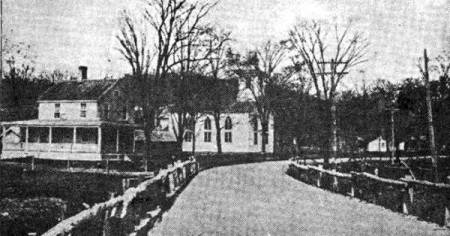
Above is a postal card photograph of Oxford Center, looking north, taken at about 1900. The Episcopal Church is shown; the adjacent house which is presently the rectory of the church, was not at that time owned by the parish. 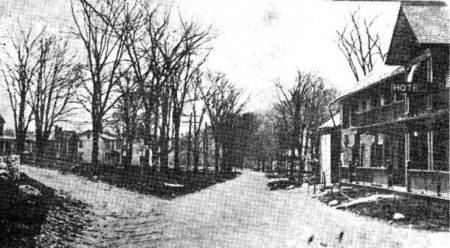
Another postal card of the same era is shown below, with a view of the Center from the area now occupied by the Oxford House, looking southwards on the Oxford Road. In the foreground can be seen the Oxford Hotel, now the Oxford House. It is said that the Oxford Grange held its first meeting and installation of officers in the rooms above the Oxford Hotel.
Across the street can be seen a green, with Academy road going up towards Riggs Street. On that green there is now a stone memorial to war veterans.
Between the corner of Governor's Hill and the Oxford Hotel there stood an old barn. It is said the barn housed old town records prior to the construction of the present town hall.
Barber also mentions Park Road:
"About one mile and a half south from the center is the 'Park,' formerly a place for deer. About eighty or ninety years since, a Mr. Wooster owned and enclosed about one hundred acres of land for the purpose of keeping deer. It is said that he had the exclusive privilege by law of restraining any person from hunting deer within the limits of 'the Park'. Upon the outside of part of the enclosure there was a kind of a precipice, from which the deer, when pursued, would sometimes leap into the enclosure, much to the mortification and disappointment of unprivileged hunters."
-
ZOAR BRIDGE AREA OF OXFORD
Also Known variously as Riverside, Pleasant Vale, Punkups.
from Wm. Sharpe's Oxford Sketches and Records, Part 2., published in 1910.
"The Valley on the easterly side of the Housatonic river, from the Five Mile Brook to and for some distance above Zoar Bridge, was known for more than half a century as Punkups, as it still is by some of the older people of the surrounding territory. Eight Mile Brook was the dividing line between the towns of Oxford and Derby, and in consequence the people south of the line went to Derby to vote, while those north of the line voted in Oxford and as in the earlier times the lines of demarcation were not always closely observed, some took their choice of a voting place and went to the nearest.
"Derby was a Whig town, while Oxford was Democratic, and this with other reasons was incentive enough to incite a sterling old Democrat named Lum, familiarly known as 'Uncle Harry,' to engineer a set off that should put all of Punkups and part of Squantuck into the town of Oxford.
Lum arranged for a bill to be introduced into the Connecticut General Assembly, to allow Oxford to annex the areas in question. The bill was passed May 1, 1844.
Sharpe continues:
"Punkups was at that time a flourishing neighborhood. There was a woolen mill, a foundry, an axe factory, an auger factory, a bellows factory, a cotton mill, a sawmill and a tannery. The tannery had its own primitive arrangement for grinding bark. A huge circular block of granite was leveled on the surface and over the bark, laid on this, a granite wheel about a foot thick and five feet in diameter was rolled to crush the bark, just as apples were crushed in the ring mill of that day. A ring mill was a circular trough into which the apples were put and a circular disk made of wood, weighing some hundred pounds, propelled by a horse hitched to the end of a pole that went through the center of the wheel as a shaft, crushed the apples. As the season for making cider was a short one the ring mill in this case was available the larger part of the year for crushing bark for the tannery.
"But the progress of events changed Punkups. The old industries mostly languished and died out.
"About 1840, two brothers, Webb and Beach Downs, from Monroe entered on the scene. They had built by contract a breakwater at Black Rock, near Bridgeport, and had thereby cleared three or four thousand dollars. With this capital Beach took the sawmill at Punkups, and as he and Webb owned land across the river, they conceived the idea of moving Zoar bridge down where it would be convenient for them to bring their logs over.
"The Zoar bridge was then a big covered bridge. This they took down and moved it down, but without thinking it necessary to buy the stock of the bridge company."
"The result was that when they applied for a charter and toll rates, the old company opposed them on the grounds that whey were within a mile of the place where the old company was exclusively authorized by the legislature to collect toll.
"The Downs bridge was then nearly a mile and an eighth from the original location, but the charter of the old company did not restrict them to the exact location and they could if they chose build further south and this would preclude the proprietors of the Downs bridge from getting a permit to collect toll."
A charter for the Downs bridge was therefore refused, and as the old company immediately built a new bridge for the accommodation of Zoar people, the Downs bridge was thrown open to the public. It was a losing game and the Downs brothers never recovered from the financial loss.
"The bridge was carried away by a flood, November 13, 1853, and only small remains of the old abutments mark the place where it stood, a few hundred feet above Otter Rock."
Zoar Bridge was said to have been built before 1800. It was built with logs bolted together for the sides, and was carried away by an ice freshet in l835. This bridge was known also as the Ezekiel Curtiss Bridge.
It was replaced in 1837 by Elisha Hubbell, who kept a store on the east end of the bridge and collected the toll. The bridge passed through the care of William Bradley and George Sharpe, and was one third washed away in November, 1853.
The rebuilding was done by Philo Smith, but a year later another freshet partially undermined the west pier so that it settled down eighteen inches.
"These were the two highest freshets ever known, said folks who were eighty years old at the time. Walter Bradley, now living at Stevenson, was there and crossed the bridge when the water was at the highest mark, leading his horse across, and the water was running in the road between the barn and the east end of the bridge."
In 1857 another ice freshet carried off one pier and two-thirds of the bridge, which was again rebuilt. In 1875 it was again carried off, and the company decided not to rebuild it. At this time efforts were made to have the towns of Oxford and Monroe rebuild the bridge.
After some controversy, this was done in 1876, at a cost of $13,225.87, the towns each paying half the expense.
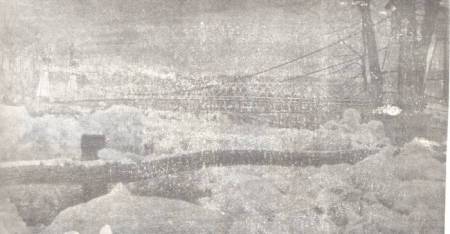
Zoar Bridge constructed in 1876 by the towns of Oxford and Monroe. 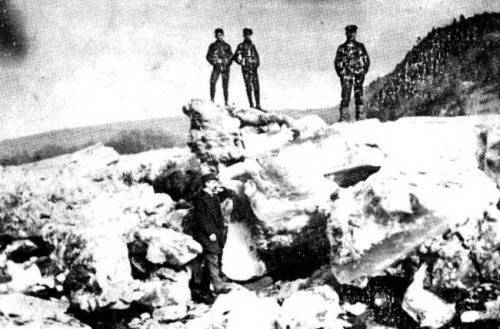
This picture is a photograph of an ice freshet. Although this picture was taken in Seymour, and not Oxford, the photograph gives the reader an idea of the size of the ice freshets and the magnitude of the problem involved in keeping the bridge open. Those men on the ice are standing above the roadway. -
OXFORD DURING THE CIVIL WAR
The History of the Old Town of Derby lists 105 names of Oxford men who are recorded as serving in the Civil War.
Wilcoxson in his Centennial address said, "In 1861, at the breaking out of the Civil War, Oxford's sons proved equal to the emergency. No fewer than seventy-five men entered the loyal army by enlistment, as I, who then kept the record very well know. Of this number, but few, probably not more than five disgraced themselves by desertion.
During the war itself, it appears that sentiment in Oxford was divided, probably owing to the fact that much of Oxford's industries were engaged in the southern trade.
It is said that at one time the Confederate flag was raised at Oxford Center.
Wilcoxson said of those who served in the Union army from Oxford, "Cheerfully they left their homes and with alacrity they proceeded to the scene of the war. Mainly they stood manfully at their post and bravely fought the battles of their country, and so continued till crowned with victory over the enemy. Thanks and more than thanks are due to them."
-
AN OUTLINE OF THE HISTORY OF EDUCATION OF CHILDREN IN OXFORD.
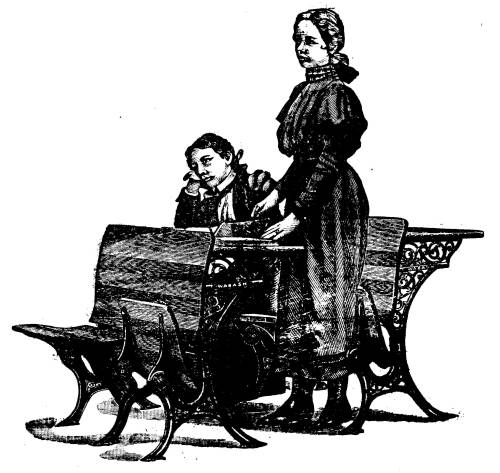
Oxford's first schools were established by the Congregational Society, when the parish in 1748 voted to hire a school master.
The teacher was to instruct pupils for three months, one each at the three sections of the parish. One month session was to be held at the Sabbath Day house, one on Quaker Farms road, and another in the eastern part of the parish.
By 1822, the schools had developed into a district system, with fourteen districts included in records of payment kept by Abel Wheeler, Esq., treasurer. The receipts show that dividends were paid with town funds twice yearly -- a March dividend paid in April and an October dividend paid in January of the following year.
The record for the Seventh District in 1823 read as follows:
Order on School Society Treasurer for $12.95
7th District, March 20th, 1824.Sir please to pay to Oliver Buckingham or bearer twelve dollars and ninety five cents it being the proportion of school money belonging to the Seventh School District in Oxford.
School Society
Abel Wheeler, Esq. treasurer
Oxford, Oct. 20, 1823
David Candee
Cyrus Humphrey , Committee.
The record also served as a receipt, with Joseph Tucker signing a statement that he received of Abel Wheeler, "Twelve dollars and ninety five cents on the within order it being in full."
The funds listed above appear to have been those obtained by the state from the sale of the western reserve lands. Under the system then in use, each town received a portion of these funds. In Oxford these were apparently divided among the school districts on a per pupil basis.
A complete listing of school money paid out through the treasurer is included below. It was generally the case that little if any extra funds were used for the education of the students, although the districts did have the power to lay a school tax.
District Amount of Dividend: April, 1821 Amount of Dividend: Oct, 1821 Receipt signed by: 1. $50.40 $28.08 Norris Candee
Ethel Lounsbary2. 23.40 13.68 Ira Hawkins
Augustus Buckingham3. 22.80 12.96 Chestor Chatfield 4. 27.80 27.00 Enoch Purkins
Ebeneezer Buckingham5. 28.20 16.92 Elijah Harger
Levi Candee6. 29.40 14.76 Russell Johnson
Carolinne Willmot7. 17.40 10.44 John White 8. 16.80 11.16 Lee Hawkins 9. 1.80 None found David Towner 10. 9.40 5.40 Isaac Twitchell
Lyman Riggs11. 13.06 6.12 Samuel Wire 12. 11.40 9.72 Sheldon C. Clark
Isaac Smith13. 19.80 11.88 Ezra Bassett
Merrit Brodley14. 27.00 12.24 Elisha Oatman As the figures given above should reflect the relative school population in the school districts, the figures for the Eighth district for 1822, the year following, are listed below.
- 8. l4.88 9.18 Clark Bordsley
From this, it would appear that the district was of average size, and one may surmise the the 1821 records have been lost.
Members of the School Society were paid for their work in those times, unlike our present unpaid Board of Education. The records for 1821 show the following payments to School Society Members:
- Abel Wheeler, treasurer of the society, 114.00
- David Candee, chairman of the society, 11.50
- Chauncy N. Hatch, committee member, 13.00
- Lemuel Beardslee, committee member, 13.00
It is not recorded why the committee members received twice as much as the chairman.
From the early records, it appears that the school society had responsibility for distributing the town's share of reserve funds for schools, but that the actual handling of the education was left to the district school committee.
The early records of the First School District in Oxford have been preserved, and a study of the minutes of that group's meetings gives an idea of the work of district school committees throughout the town.
- "At a legal meeting of the first school district held at schoolhouse Oct. 11th, 1825:
- Chosen:
- Chauncy M. Hatch, Moderator
- Sherman Buckingham, Clerk
- Jessie Joh, Treasurer
- Calvin Leavenworth, Collector.
- Voted that Mr. Wilcox be accepted as a teacher in the first district for the ensuing winter, provided he can be obtained for twelve dollars per month.
- Voted that David Candee, Jesse Joy, Daniel Tucker, be a committee to examine the school bills.
- Voted that David Candee, Horace Candee be assistant committees.
- Voted that the price of wood two dollars per cord for merchantable wood.
- Voted that the price for cutting and splitting with a suitable proportion for the stove be fifty cents per cord.
- Voted that board for the ensuing winter be one dollar and fifty cents per week.
- Voted that the committee be empowered to employ Miss Talmadge for the ensuing summer, provided she can be obtained for $1.25 per week.
- Voted that a book be purchased for the treasurer and the expense be put in the ensuing winter bill.
- Voted that the collector settle his bill with the treasurer for Thirty days from the date of his warrant.
- Voted that this meeting be dismissed.
- Chosen:
At a subsequent meeting held in December, 1825, the meeting voted to appoint a committee to procure an assistant teacher. In April of the next year Mr. N.J. Wilcoxson was hired to teach, with the assistant teacher to continue with him.
At a meeting held in 1826, the district voted that the public money should be proportioned between the school in the district according to the number of scholars sent to each, and the remaining expenses to be paid by the proprietors.
They also voted that school should start on the first Monday in November and continue for five months.
By 1830, the school was apparently in bad repair, and a vote was taken ,
"that a tax of 1 cent on the dollar on the list of 1829 be laid to defray the expense of repairs on said school."
The collector of the school bills for that year, Bennet Tenny, was excused, and N. J. Wilcoxson was appointed to collect the tax. Wilcoxson had been a teacher in the first district school, but at the time of this meeting was the owner of a private school in that district
However, by 1832, the school house needed more repairs and the committee voted another tax of one cent on the dollar. The measure appears to have met with some opposition, as a few weeks later, a subsequent meeting rescinded the vote which imposed the tax, and then voted to raise the tax to five cents on the dollar.
From the minutes, it becomes apparent that the school committee encountered its share of difficulties. In 1834 a special committee of Nathan J. Wilcoxson, Nathan Mansfield and Normand A. Bidwell was appointed to investigate the cause or causes of an incident where vandals, "overturned the back house."
By 1837, the school committee appears to have been in financial straits, as it was voted that the bills now due would be added to the cost of building or repairing the schoolhouse. But later that year, the committee decided that they could only afford to repair the existing building.
A committee of repairs was appointed, with the specific instructions to "build a necessary or back house with two apartments."
When the work on school repairs and the necessary was completed, it was voted to lay a tax of ten cents on the dollar to pay for the costs. However, it appears from subsequent records that the work was not done, and for years the district annually voted to repair the school and lay a tax, and every year, shortly after the vote was taken, another meeting was held and the original vote rescinded. It was some time before the school was suitably repaired.
In 1853, the district committee voted,
"that in the Warning of the Annual Meeting of the Oxford School Society the committee make suggestions of an arrangement by which scholars from any district in said society may attend the school of higher order and yet have the benefit of the public money. Such suggestion to be voted upon at the Annual meeting."
If the above suggestion was made in reference to an existing school is not indicated from the school committee minutes, but a year later that First District voted to establish a high school.
Voted,
"that the school be divided during the ensuing winter... that Rev. S. Topliff be the Committee of the High School... that R. R. Brousan, F. A. Candee and L. Fuller constitute a prudential committee for the high school."
March 22, 1856:
"Voted to use two third public money for the winter term."
From the above entry, it would appear that the schools were at that time still primarily funded through the western reserve funds, rather than by taxation. However, it is clear that the other third of the costs of education was to be paid by the proprietors of the school district.
-
THE SCHOOL CENSUS OF 1859.
By the year 1859, listed in the annual report listing all persons between the ages of four and sixteen residing in the district, the First District had the largest enrollment of the 13 districts reported, with 50 children.
A table of the districts reporting and their census results is listed below:
SCHOOL CENSUS OF 1859 OF PERSONS AGED 4-16 YEARS BY DISTRICT District Number Enumerator 1. 50 Nelson B. Williams 2. 35 William Butler 3. 25 Stiles Tucker 4. 20 Smith C. Wheeler 5. 15 Erastus Wheeler 6. (District either did not report, or the report has been lost.) 7. 24 James S. Wooster 8. 18 George T. Stoddard 9. 15 Albert B. Towner 10. 30 Ira G. Faws 11. 14 Silas Gunn 12. 17 Abram Bassett 13. 8 Dr. L. Barnes All those who enumerated the children were members of their district school committees, except Dr. Barnes, who wrote the title School Visitor after his name, crossing out the printed portion which read School Committee.
-
THE FIRST DISTRICT BUYS A NEW SCHOOL
"April 7th, 1866, at a Special held at the School House in said District, Lewis Barnes, Chairman, it was voted that the district purchase the Masonic Hall for a school house for said district.
"Voted that Nathan J. Wilcoxson and R. Hudson be a committee to purchase the same for the said district."
And at a later meeting:
"1866, April 14th. School Meeting reassembled.
Voted to accept the report of the committee which was that they had been to Southbury and purchased the Masonic Hall of Terry Munn, the owner thereof for a school house for the First School District of Oxford."
After a number of meetings on the subject of the new building, it was voted to authorize Samuel Riggs to install a suitable chimney. It was also voted that a tax of seven mills on the dollar would be levied.
"Voted that the expense of repairs be met by raising a sufficient sum by an assessment of all the taxable list of the district on the assessment list completed by the Town of Oxford," Sept, 24, 1866.
"Voted to collect a rate bill on the patrons of the school sufficient to defray the expenses of the past years schooling." October 2, 1867.
From the above entries in the minutes of the First District School Committee, it appears that routine costs of education were paid by the patrons of the school -- those persons who sent their children to study.
However, it is also apparent that the district did have the power to lay a special school tax on all property owners in the district, whether or not they had children using the school -- as they did to raise money for repairs to the new school house.
Other entries in the ledger indicate that the patrons of the school provided wood for the school, as well as the board of the teacher, and these were computed as part of each family's share of school expenses.
-
EARLY DOCUMENTS RELATING TO OXFORD EDUCATION SHOW AN INTEREST IN GOOD EDUCATION AND A STRIVING TOWARDS THAT GOAL
One of the earlier reports of the school visitors was given at the annual town meeting in 1856. The information in that report is given, as it is the earliest detailed account of the district schools which the author has been able to find.
"To the Town of Oxford in Annual Town Meeting Assembled on this 6th Day of October A.D. 1856, the subscribers, the visiting committee of the schools of the several districts of said town make the following report of the keeping of schools, their attendance and conditions and the expense thereof for the year ended September 30th, 1855.
"In the town there are located 13 school houses. In all these, except the 12th located at Pleasant Vale, and the 13th, located at Riggs Street, there were duly organized schools kept the winter term - and in the summer term all were so kept in all but one -- the 13th (Riggs Street)
"In the winter season there was kept in the central part of town a school of higher order, by Mr. Solomen Parsons, a gentleman from the state of New Jersey, a student of Wesleyan University at Middletown in this State.
"In the district schools winter term there were employed 3 male teachers, 8 female teachers. The gentlemen employed to teach were Mr. Stephen L. Mallett in the 2nd (Quaker Farms), Mr. Milo D. Northrafe in the 3rd (Chestnut Tree Hill), Mr. James Wheeler of Newtown in the 8th (Hulls Hill).
"Ladies employed, Miss Anna C. Fairchild in the 1st Centre, Miss Lucy Ann Perkins in the 4th, Christian Street; Miss Martha L. Chatfield in the 5th, Five Mile Brook; Miss Frances B. Wheeler of Southbury in the 6th, Pines Bridge; Miss Laura Hale in the 7th, Bowers Hill; Miss Julia A. Fairchild in the 9th, Red City; Miss Harriet C. Chatfield in the 10th, Shrub Oak; and Miss Melissa Gunn in the 11th, Red Oak.
"Mr. Parsons was paid $1 per day and his board, fuel and lights. Kept 3 months.
"Mr. Mallett was paid $1 per day and boarded himself. Kept three months.
"Mr. Northop was paid $18 per month and his board. Kept 3 1/2 months as known to your visitors.
"Mr. Wheeler was paid $11 per month and board. Kept 4 months.
"The ladies employed in the winter term continued 2, the term of five months; 5, a term of four months; and one 3 1/2 months.
"Four boarded themselves, four others were boarded by the district employing them. The wages paid those who boarded themselves were, one at $16 per month; 2 at $14 and one at $12. Of such as had board of their employers, wages ranged as follows -- one at $10 per mo,, one at $9 1/2, one at $9 and one at $8.
"Of the summer schools, as I have said, 12 were in keeping. Only one, the 13th in Riggs Street was vacant. Because of the exceeding small number of scholars no school is or has been kept for several years. Females were employed in all but one, the 12th at Pleasant Vale. Mr. N.D. Hinman was employed to take the scholars of the district into his institute. He is paid $3 per week. His term is 23 weeks.
"The ladies who were employed continued a length of term - one for 4 months; one for 5 months; three for 5; five for 4, and one for 3 months. Five of these boarded themselves, vis. the 1st, 2nd, 3rd, 4th, & 5th.
"These five were paid - one $16, two, $10; one, $8; and one $6 per month,
"The other six lady teachers had their board in the district that employed them. The wages paid them being $5, $6, and $8 per month.
"The school houses, ...are in a comfortable condition. Mostly they are commodiously arranged and all as we find are adequate to the comfort and convenience required for the purpose of intended object. Some repairs have been done on the one in the 8th District.
"Other than this there has been no change during the year for which we are reporting. As has been reported, we report, all schools are furnished with a blackboard on which are done exercises in the performance of arithmetic and algebraic solutions and also exercises in the study of geography, grammar and spelling - very favorably assisting the scholar in the onward progress.
"Some of the schools- not more than half the whole number, are furnished with outline maps. This furniture is valued by your visiting committee as a most estimable aid of the scholar in his learning of geography. It were well for every school to have them.
"No district has a school library. Such a furnishing might not be without its good effect.
"In our schools have been taught all the usual branches and in addition there is in some of the schools Algebra and some higher mathematics.
"Your visiting committee here speak of the schools as in a respectable condition. A very little exception if any may be made to this general expression. The teachers employed for both Winter and Summer terms are worthy of respect in their position and usually the scholars attending are entitled to our approbation for their attention, their performance, their proficiency, and their deportment.
"The number of scholars generally in our schools is small - necessarily so, our schools must necessarily be less prosperous. Of the result of the school of Higher Order we do best to mark it was attended by ... 30 scholars engaging themselves in all the common branches -- Algebra and the higher mathematics, Book Keeping and Lattin, resulting in the customary success.
"Your visiting committee desire a full healthy prosperity in our educational departments - a prosperity imparting intelligence, invocating to intelligent to the full extent of the population of our limits. For this reason we recommend that worthy persons be employed to teach, that the schools be kept a full length of term and that a prompt and punctual attendance be given.
Signed by
Nathan J. Wilcoxson,
John N. Marvin
Miles D. Northrop
School visitors.
The following year, 1857, Wilcoxson gave the annual school report and commented on the attendance records of the students.
"Our scholars generally enter school and on the school register the scholars name is written, but when we look after the average attendance we find the number there to fall considerably below the number registered -- probably one thrice less than are registered. This we mark is greatly retarding the... scholars advancement. In the prospects of success of the scholar, as all must know, a steadfast perseverance is all important, as much so as in the prosecution of any business whatever. The time of a person is never worth more than when employed in school.
"The remark has been made that a person for the first four years of his live learns more than in any one four years after the first. A little attention to the matter will convince us that the remark is, if not altogether correct, in a great degree it is true. Convinced of this fact, we shall at once acknowledge that the time of that age we call childhood and youth is too precious to be lost in prodigality."
In the annual report of 1858, the visitors wrote:
"As a generality, the people of the subject of schooling are rather too sleepy. And we have it to say there is not in the schooling department that enthusiasm the subject demands, a subject which is amongst the subjects one of vital importance, as all must admit."
By 1860, the school visitors became more harsh in their assessment of the school's progress and blamed the failure of the educational system on the lack of community support:
"All that could be desired and reasonably expected of our schools has been accomplished -- but much we are obliged to say remains undone what might have been done, all of which is chargable only to a want of interest, negligence and ignorance.
"In the first place we wish to notice some evils connected with our schools. And first, our Annual District Meetings are only formal affairs where the barest possible number get together and choose for their officers indifferent, uninterested and sometimes incapable men. The plan has been in some districts to apply the principle of rotation -- a mode to say the least not to be recommended.
"Choose your Committees as you would choose your wives simply, for their good qualities and never put them away without cause.
"In the next place capability in a teacher is not regarded so much as cash. We can instance where $3 a month lost us a good and capable teacher and filled his place with a wishy washy concern just fitted to keep intellect from starving.
"Your visitors confess that they tolerated him, because that while he had no positive, there was still an absence of negative qualities.
"There are districts in this town where cash has not in years that are past been of paramount importance. Anyone who becomes acquainted with the young people who have grown up about us can judge of their locality.
"It is for the interest of everyone in the community that we should have good schools. Our taxes for the support of criminals and paupers are amongst our heaviest expenses and of those who people our alms houses and prisons there are but few posessed of a decent education.
"We have in this town men barely able to read. We have youths between 10 and 16 fast following in their tracks.
"Dissension exists in some of the districts, we are sorry to say, but as they are out of our province to cure, we will not dwell on them further than to say that 'harmony is always essential to prosperity.'
"Much has been done the past year of a commendable nature. A new school house has been erected in the Second District and though it is not a model to follow or all that could be desired, still it furnishes the school a commodious and convenient room. The 5th and 7th districts have repaired largely so that their houses make a more suitable appearance, and it is to their credit that it was done with voluntary effort.
"The 11th or Red Oak District have also enlarged their house to furnish a Sunday School & other religious purposes. More labor will be required to make it available or even suitable for a winter school."
Who's to blame? The District Committee return too many of a suitable age whose names never appear on the School Register. Now and then one is schooled at home, but we recommend that all who are absent from school should be noted by the District Committee and reported to the Selectmen if thought worthy, to be dealt with according to the law provided.
Speaking of the school in the 4th district, the report continues,
"We could not fail to notice one new feature not commonly found or practiced in our schools. We allude to the introduction of singing and we would recommend its adoption by all other schools. Every child should be learned to sing and every one tries sooner or later to do his own singing. So long as there is an inherent desire to sing, we say cultivate it by all means. If your teachers are not competent, let them learn, and let us set the thing in motion now.
"If needs be let us have public singing schools where the old as well as the young may be taught how to bring out the melody that is in their hearts. Give us singing in our schools we say if possible, and let some plan be devised to teach our scholars how to sing. In Germany the whole thing is regulated by law. Everyone is required to attend school and all are required to sing as well as read. So that an entirely illiterate or unmusical German is never to be found...
"Your committee of education has determined on a standard series of books for all the schools. Every school will be notified, and as fast as new books are wanted, they will conform to that standard, and thus save a multiplicity of books as well as expense, while we shall reform a great and increasing evil."
The annual reports from 1861 --1865 all cite the need for greater public support of the district school committees. The 1865 report cites a new school law which requires that the prorata cost to a scholars parents should not exceed $6.00.
This maximum tuition fee was a problem in the smaller districts, where the scarcity of students created a higher cost per student. The committee offered this suggestion:
"Would it not be advisable to fix the expense of popular education at a certain limited sum and for the excess thereof over the public moneys, levy a town tax - pay the same into the town treasury and draw therefrom for the payment of educational expenses?"
A special committee was appointed by the town meeting to investigate the proposal, and they confirmed the wisdom of the visitors' suggestions.
Information taken from the Report of the Connecticut Board of. Education Annual Reports, for the years 1762 and 1871, show the changes which took place in school funding during those nine years.
- Amount of money received from the school fund:
- 1762: $347
- 1771: $282
- Amount received from the Town Deposit Fund:
- 1762: $155
- 1771: $145.66
- Amount received from local funds:
- 1762: $23
- 1771: none
- Amount received from town tax:
- 1762: $172
- 1771: $2067.24
- Amount received from district tax:
- 1762: none
- 1771: none
The Annual Report of the School Visitors in 1869 shows that the school system had improved, and it contains the most optimistic view of the local schools.
"Gentlemen -- In presenting our annual report we have cause for congratulation on the general prosperity of our schools. In each of the 13 districts schools have been taught for periods varying from 6 to 8 1/2 months each, averaging nearly 30 weeks as is now required by law.
"At its last annual meeting the town made an appropriation of 3 mills on its Grand List for the use of schools & this raised with what we received from the School Fund, Town Deposit Fund and Local, a sum total of 12026.54 for the support of our schools. After giving each district its 150 requirement, the remainder was divided according to the average attendance of scholars the preceding year.
Wilcoxson then listed the districts and their allotments, and continued:
"There is no appreciable difference of income and expense unless otherwise provided for save in the 6th and 10th districts. In the Pines Bridge district the weather and the blockaded state of the roads in winter made an unusually small school smaller and by the rule of distribution adopted it was the recipient of much less than their requirements and less by considerable than a district assessment would have given them. We advise an appropriation for that district sufficient to put them on an equal footing with the rest. In like manner, the 10th District are in arrears being regarded by us as a joint district with Seymour, and a distribution allowed only on the average attendance from Oxford. Some way also should be devised for their relief.
"Difficulty has arisen in the joint district between Oxford and Seymour, and is not likely to be obviated from a want of a desire to compromise on the part of Seymour.
"All of our schools are in a position where financially at least they will meet consideration. The present law requires that after distributing $60 or its proportional part, if a joint district, the remainder of the school money shall be divided according to the aggregate attendance of scholars in town. This gives an advantage to the stronger district. The law will work well evidently in thickly settled communities by compelling or inducing a larger attendance - but in sparsely settled and wide extended districts & yet with a sufficient number of scholars to demand a school, no larger an attendance can be induced than there are scholars, and consequently although that district may stand high on the assessment list - it will receive a less amount than the district which has more scholars and less taxable property.
"This difficulty will be met by consolidation and subsequent action in that direction may be deemed advisable. If so immediate measures will prove the remedy.
"And herein lies one difficulty in consolidating that the joint districts are badly located for that purpose and we should have to redistrict - and if by redistricting we could do away with 2 or 3 schools and have only 10 schools to support where now we have 13, our taxpayers would eventually be the gainers - although some who are now provided with school accommodations near their doors might feel incommoded by a new arrangement.
"Our teachers as a class were capable and well qualified, judiciously adapting themselves to the wants of their several schools, and it can be truly said that our town has for several years had a corps of teachers unequalled by any of the towns about us. But owing to our inability to pay high wages, they are continually leaving for more lucrative positions which we are happy to state they always fill acceptably and with an ever increasing energy.....
"Though we are disposed neither to praise beyond measure nor to attribute unmerited blame, yet with a desire to encourage emulation on the one hand and repress indifference or faults on the other, we cannot avoid especial mention of Mrs. Tomlinson of the 5th; Misses Stoddard, Bassett and Ford of the 1st, 10th & 13th, and Mr. Riggs of the 6th, who has an ease and method in teaching which will eventually rank him amongst the foremost in that profession.
"In like manner we class the winter school in the first as partially defective & that in the 11th during the same period a total failure, the result of self sufficiency in one teacher and inefficiency in the other.
"It is one desireable feature in a school that a vacation should not be too long, especially in the case of younger scholars who are too apt to forget in a 15 weeks vacation much of which they have learned in a 12 weeks school. This evil must be inseparable with communities comparatively destitute of money and children, except it shall be met with a liberality greater than as yet experienced....
"Many complain of their taxes and say that teachers are too liberally paid. It may be true in the case with teachers, for they dear at any price -- but a good teacher in a country school, who is earnest in his work needs to be a very Hercules. For though it may appear to some a very easy matter to keep school (& it is so - still it is a very hard task to teach successfully) to some it is a matter of pride to know that they are giving in proportion to their neighbors in any good work. To them it may be a satisfaction to know that for raising the largest amount of money for each child enumerated, we stand the eighth town in the state (8.68) and Wolcott leads the state (11.55).
The condition of education in Oxford is shown in the Connecticut School Report of 1874, with several references worthy of note, The state superintendent gives a report on "The Declining Towns," wherein he defines the declining towns as those who are declining in population. The report notes that such communities are in danger of getting discouraged.
The Population of Oxford is listed as follows: 1800 1,410 1810 1,453 1820 1,683 1830 1,763 1840 1,626 1850 1,564 1860 1,269 1870 1,338 In that report, Oxford is ranked as 86th in the state, out of 166 towns and cities in its ability to pay for public schooling, based on the amount of taxable property to every child between the ages of four and sixteen years.
However, Oxford is ranked as 25th in the state, in terms of per pupil expenditures during that year.
In the report on the condition of school houses, eight were listed in good condition, two in fair condition, and two in poor condition.
School visitors for the year were John Harger, Dr. Lewis Barnes, N. J. Wilcoxson, R. S. Hinman, O. G. Osborn and S. Hawkins.
- Amount of money received from the school fund:
-
ATTENDANCE OF SCHOLARS IN THE DISTRICT SCHOOLS
It is strange to read some of the early reports on attendance and see that the state and district school committees accepted as a natural fact the idea that many children would not attend any school.
In that respect, the 1879 school report of the State Board of Education shows that Oxford's schools were reasonably well attended. Oxford's population in the 1970 was 1,338, compared to 1,318 in the neighboring town of Southbury. In the school year of 1877-78, Oxford is reported as having nine persons of school age who attended no school. Southbury is reported to have 31 such persons. In that year Oxford ranked 40th in the state's 167 towns and cities in the percentage of average attendance in winter, as compared with the number enumerated.
The annual reports of the school visitors for the year 1881 show that most expenses incurred in each of the districts were for teachers wages, with a lesser amount spent on fuel and incidentals in each district.
Thomas Osborn, of the district committee of the Center district, said of the condition of the school house, "In any other town in our State our School house would be considered poor. As our grandparents received their intellectual culture within its walls, it is reasonable to infer that our grand children may be compelled to pursue their studies inside the self same structure. It's location being on the bank of a stream, mud hole in front, no shade, no play grounds. School room low, poorly ventilated with scarcity of room for recitations. Reforms have been made from time to time, such as roofing, & Etc., but repair all we will its the same old building still, with all its inconvenient surroundings.
That school district reported a total of $303.18, with 280 in teachers wages, $11.02 in fuel, $3.06 in repairing the school house and $11.10 in library and apparatus.
The Center District was the only school reporting any expenditures other than wages, repairs and fuels, indicating that none of the other districts purchased books, maps or globes during that year.
Repairs made during that year, within the 13 districts, were also made by the third, ninth, and tenth districts.
In 1885, the annual report urged that districts be consolidated, urging that only eight districts be kept. By the year 1889, Dr. Barnes was severe in his criticism of the district schools and urged a take-over by the town.
"In most of the districts it is difficult to find any one who is willing to act as a District Committee, and those who act as such take but little interest in the schools. The school registers show no visits from any of them during the past year. Perhaps the better way would be to leave the whole matter of our schools in the hands of our school visitors and our selectmen. At present our committees only hire the teachers and procure the fuel. It seems as if these services could easily be performed by the joint board, and a saving of labor be made. A law tending toward consolidation was before the last legislature. We ought to hail any new method and be willing to attempt a trial of anything that promises good results, for we are, in our present indolent methods of doing, far from showing our children that the public is soon to look to them, or in impressing them that the public sentiment of the community will soon be reposed in them, and if it is to a healthy sentiment it must emanate from half trained or ignorant minds."
The state report published in 1890, lists Oxford as having 13 schools, with seven of them in poor condition, and only two of them having libraries. In those two libraries were a total of 40 books. The report lists the total enumeration at 248 students, about 30 less than a decade prior to that date.
A number of improvements were made in the schools at the insistence of the school visitors. During the next few years the Center School was built, and major repairs were undertaken at other schools, including the move of the Quaker Farms School, and the opening of the Hawkins School in that area
During the year 1900 the change from a district system to a town system was made, and control of the schools rested with a Board of Education.
By 1911, a state superintendent who worked for the State Board of Education worked in Oxford.
The 1917 Report of the School Supervisor indicates that the consolidation of school powers under the town had made some economies possible:
"The greatest economy has been exercised by the committee in the administration of the schools. Every bill has had the closest scrutiny, and wherever possible, without loss of efficiency, expenses have been pared down to the minimum. The result has been a saving to the town of more $1,000.00 over the costs of last year; this too, in spite of the increased cost of getting work done, and of increased pay to teachers.
"Less repair work has been done than that necessary to meet the requirements and the needs of the schools. Deferred repair work is not a saving, and the committee is advised to consider the plan of building a new school at Shrub Oak, or completely remodeling the old one."
William Holmes was the state supervisor, and the Board of Education was listed as Thomas Schreiber, chairman; Elijah B. Treat, Secretary; Wallace Tomlinson, Glover W. Cable, William E. Conway and Charles Pope
The 1918 report of the school supervisor was the first annual report of I. Burten Dunfield.
Teachers listed were Ophelia Dahinden, Center; Mrs. Mary E. Prescott, Chestnut Hill: Justine E. Doolittle, Christian Street; Lillian Smith, Red Oak; Elizabeth M. Blodgett, Riggs Street; Margaret Burke and Margaret E. Owens, Shrub Oak; Carrie A. Pratt, Quaker Farms; Marguerite Maher, Riverside; Julia Bronson, Belle.
The report is interesting in several aspects -- showing the results felt in the community by the war and also the impact of the construction of Zoar Dam.
"War conditions have caused a scarcity of teachers. Many have gone into the service, or into other lines of work, where higher salaries are paid. It has therefore been necessary, in order to retain old teachers and to secure new ones to pay higher salaries to teachers than has heretofore been expended. This is only just and to be expected. We are fortunate, however, in being able to retain the majority of last year's teaching force. This is due to the betterment of conditions throughout the system and willingness to pay worthy teachers enough to remain.
"Consistent with the practice throughout the State, and to the demands placed upon us by the war, summer schools have been maintained in each town for the purpose of carrying on Red Cross work and increased production of food, by war gardens. Oxford was not behind in this respect and the following report of Miss Margaret Kehoe will serve to prove that the money expended in maintaining the school was well spent."
The report listed a seven week summer school held at Shrub Oak, Center, Quaker Farms, Christian Street and Chestnut Tree Hill. A total of 60 persons were enrolled. Thrift Stamps were sold and work was done by pupils in sewing, with 101 towels turned, basted and hemmed; 67 comfort bags made.
A list of pupils attending high school was given, which included 20 students as follows:
- Waterbury:
- Catharine Shelden, Alice Easmes, Tricillo Gardo, Elizabeth Heidkamp
- Naugatuck:
- Margaret Luskay; Derby, Dagmar Nelson
- Watertown:
- Isabelle Pope
- Seymour:
- Florence E. Wetmore, Harold Cable, Edna Rowland, Martha Horbal, Mildred Baldwin, Catherine J. Keeler, Dorothy J. Keeler, Dorothy E. Hibbard, Evelyn Pope, Dorothy Pope, Lester Tomlinson, Marion Shelton, Regina Graf and Helen Crofut
"The conditions at the Riverside School up to the opening of school in September were rather uncertain. The construction of a new dam at Riverside has brought to the place an abnormal increase in population.
"How much of this population will remain permanently is still a matter of conjecture. However, the present building is too small and accommodations inadequate for the increase, which must be provided for at once. The committee has decided to enlarge the building sufficient for the present and future needs. In the meantime, double sessions will be necessary, since there is not seating capacity for all at one time.
"It is hoped that the adjust will be made at once, since the situation at present is difficult for both teacher and pupil and unfortunate to the system.
The 1920 report of the supervisor reports that the Riverside school population has declined, owing to the completion of the dam, and that school would be held in one room, and the old portion of the school used for a cloak room and fuel storage area.
The supervisor cited the opening of a new two room building at Shrub Oak to relieve crowded conditions there, and said that the excess furniture and equipment would be moved from Riverside to Shrub Oak.
In 1921 the state superintendent urged the consolidation of the towns schools, then nine in number. The concept of consolidation was not developed into a Centralized School until 1948.
The 1921 report reads:
"Should Oxford consolidate its schools? or should it seek to remodel and put in standard shape the present buildings. If consolidation is the thing then a minimum lay-out on the present sites is best. Some time ago the town voted consolidation for Riggs and Chestnut Tree to the Center. Should not this be adopted rather than lay out money on the present buildings? Bible School also could easily be accommodated at Shrub Oak. This play would do away with at least two teachers and the upkeep of three buildings and would make possible a graded school and better educational advantages. It is urged that committee consider consolidation as a future program. Consolidation would reduce the difficulties of --
- Securing teachers and boarding places
- Poor attendance caused by distance and lack of transportation
- Care of transportation of high school pupils
- Reduce the number of teachers and cost of up-keep
- Provide for better educational advantages."
The superintendent spends some time discussing the attendance within the schools, and cites Taffield Kluczinsky, Christian Street for perfect attendance for the year.
By 1932, the supervisor reported that due to a decrease in the number of pupils at Bell School, it was closed. It was also reported that all the teachers of that year had normal school certificates or the equivalent education.
In 1935, the supervisor again spoke on the need for consolidation:
"Children in one room schools are denied the social and health values that are appreciated and experienced in the consolidated schools.
By the end of 1947, school bonds were issued for a new centralized school, which is now known as the Oxford School.
The Annual Report of the Town for 1949 contains the following report:
REPORT OF: CENTRALIZED SCHOOL BUILDING COMMITTEE- The new school was opened for use by teachers and pupils November 22, and was formally dedicated December 18, l948.
- The contractors have completed their work and it has been approved by the architect... All known bills have been taken care of...., showing a total of $257,O46.79.
- In addition to the above the townspeople and friends of Oxford have contributed most generously as individuals with money and equipment to make the school complete....
- The untiring devotion of Mr. Seeley to the creating of a good school for Oxford was responsible in a very large measure for the success of the whole project. Many generations of Oxford children will benefit from his good work."
- The committee members were Eldridge E. Seeley, who died on June 12, 1949; Hubert E. Stoddard, vice chairman; Mrs. Francis B. Seccombe, Secretary; Merwin E. Terrell, R. Harold Treat, Charles P. Pope, Fred R. Bice, Jr., Franklyn R. Sanford.
However, the new school was soon outgrown by the population, and an addition, which is presently a wing of the Oxford School, was constructed.
The principal's Report in the annual report of 1952, by Edmund J. Schade, who later became superintendent, remarks on this situation:
"The School year 1951-52 has been one which started out in a dismal way but wound up in a blaze of glory.
"On opening day in September, certain problems were presented to the principal, teaching staff and children which at the time seemed impossible to overcome. Because of the crowded conditions, it was necessary to establish two classrooms in the gymnasium. During this period, the new building was under construction, which caused considerable confusion and disturbance.
"With the opening of the new addition in March, these problems gradually disappeared and the school program was improved and expanded."
Cited by Schade were the organization of a school band, sewing instruction for girls, a ballet class, and the institution of a semi departmental plan of instruction in the upper grades.
In the school year 1953-4, enrollment increased again, and the town was forced to employ double sessions in order to house all the students. The addition of the campus type buildings located on the hill above the Center School was constructed to meet this problem.
The Great Oak School, located on Governor's Hill Road, was approved for construction by referendum in 1967. The site had been purchased following town meeting approval in 1966 to contain 140 acres. On this site the elementary grades of kindergarten through three are now being conducted.
Present work is being done by the School Building Committee for its development as an eventual high school with the addition of a separate building to house elementary students on the same site.
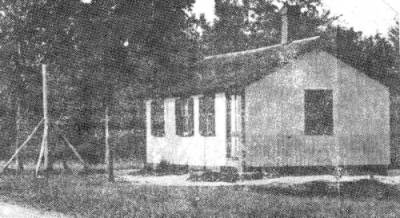
PHOTOGRAPH OF THE RIGGS STREET SCHOOL. Now a residence, on Riggs Street From the Seymour Record, April 1, 1973:
"On Thursday evening last, a school exhibition was held in the Riggs Street school house under the direction of the teacher, Miss Sarah Ward. The Scholars who had been taught well acted their parts well and everything passed off very pleasantly."
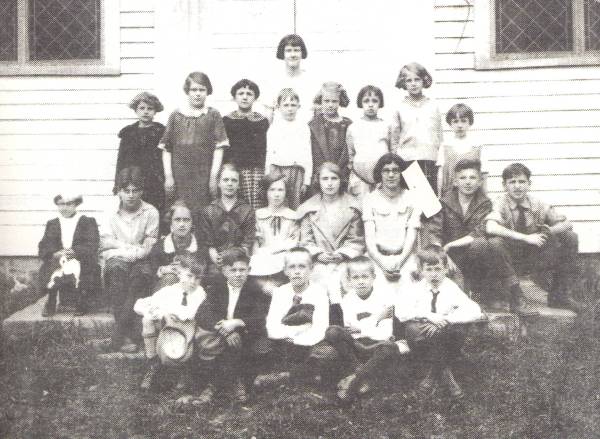
STUDENTS OF THE CHESTNUT TREE HILL SCHOOL (Pictured in front of St. Peter's Episcopal Church on a class trip.
- Teacher: Miss Chadsey shown in background.
- Students top row, left to right: Florence Kaytis, Marian Treat, Elizabeth Abello, Richard Miles, Nellie Mosavich, Marion Miles Samoker, Elizabeth Cable Grabowski, Frances Miles Samoker.
- Middle Row: Virginia Betuenus, Hanford Cable, Helen Mosavich Phillips, Harriet Clark Chase, Elna Mullen, Elizabeth Gazy, Mary Abello, Eddie Bea, David Miles.
- Bottom Row: Billy Mullins, Edmund Betuenus, Clifford Larson, Milton Larson, Reese Miles
- Waterbury:
-
THE CHURCHES IN OXFORD, 1973
- Christ Church, Quaker Farms
- St. Peter's Episcopal Church,
- Oxford United Church of Christ, Congregational
- Immanuel Lutheran Church
- Riverside Methodist Church
- St. Thomas the Apostle Church
All the above churches in Oxford have some form of a printed church history, the records of the two Episcopal Churches being the most complete, as they were compiled and published as separate hard-cover books by the late Norman Litchfield.
The Congregational, Lutheran and Catholic churches all have reviewed their history on the occasion of special events when commemorative booklets have been published by the church.
A History of the Pleasant Vale Church, or the Riverside Methodist, was written by Miss Johanna Busk in 1968.
All of the foregoing have been used to present to readers of this history a general view of the development of the various denominations within the community of Oxford, Connecticut.
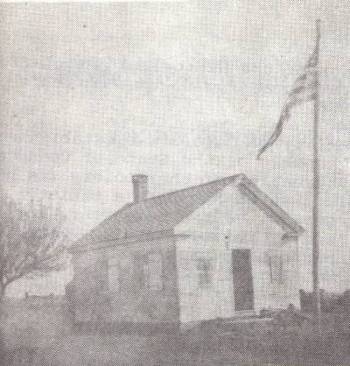
The Old Chestnut Tree Hill School, as it stood 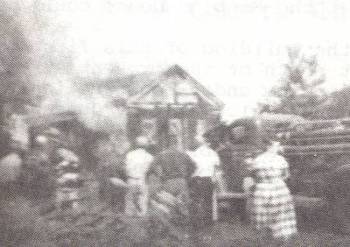
The building was burnt in 1956 -
OXFORD'S OLDEST CHURCH: THE OXFORD UNITED CHURCH OF CHRIST, CONGREGATIONAL.
The following is a portion of the Historical Sketch from the booklet issued on the occasion of that church's 225th Anniversary in 1966.
"The Ecclesiastical Society of Oxford was established, by an Act of The General Assembly of the State of Connecticut, in May , 1741. The first meeting of the Society was held June 30th, 1741 when it was voted to hire a minister for the present year." For several years thereafter, until a Meeting House was built and a Minister settled, Ministers were hired for one year periods on probation.
"At a meeting held on October 6th, 1741, it was 'voted and passed by 2/3rds part of the inhabitance of said Parish or Society.... to build a Meeting House and to move to the General Assembly in their next session at New Haven (Connecticut had two Capitols at that time) to pray for a Committee to appoint order and affix said place whereupon their Meeting House shall be erected and built'. At the same time it was voted 'that Mr. Sam Twitchell's house shall be Ye place to meet on Ye Sabbath til Ye year is over.'
"A site was chosen near the highway on the east side of Little River on land owned by Ephriam Washband and deeded to the Society on October 20th, 1741. The Society met on that date and agreed by vote ' to build a Meeting House thirty eight foots long and thirty two foots wide and nineteen foot posts.' A building committee of three was chosen and a rate of twelve pence on the pound was levied, ' in order to Ye carrying on of Ye building of said Meeting House.' Further taxes were levied from time to time so that the Meeting House could be completed and a Minister settled.
"The spot chosen for the building of this first meeting house was about 100 feet south of the present structure. Though the actual building was under construction for some 14 years, it was sufficiently closed in by June of 1743 so that the first meeting was held on June 21st, 1743.
"A petition to the General Assembly by a number of members of the Parish for permission to embody into a Church Estate and to settle a Minister was granted. The Congregational Church of Oxford was formally organized on January 9th, 1746. The Rev. Jonathan Lyman was called in June 1746 on four weeks probation and became the first settled Minister. He served this church for 18 years until his accidental death in 1763.
"It is presumed that the old cemetery property was acquired sometime between 1746 and 1763 since it is recorded that Jonathan Lyman was buried there.
Oxford Congregational Church
United Church of Christ
Oxford, Connecticut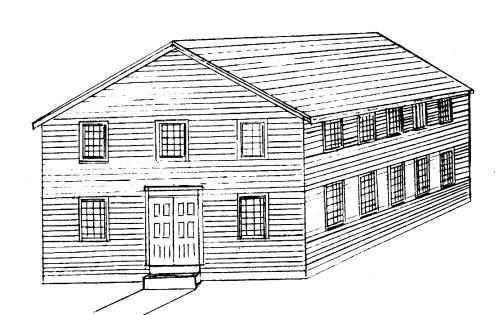
First Church Edifice The Rev. David Bronson of Milford was called to fill the vacancy left by Rev. Lyman's death and was ordained on April 25th, 1764 and settled as the Minister. It was during his Ministry that the original church building was burned and the second and present edifice was built on "Meeting House Acre." Built by Timothy Candee at a cost of $3,300, it was first occupied in 1795 having been under construction for two or three years.
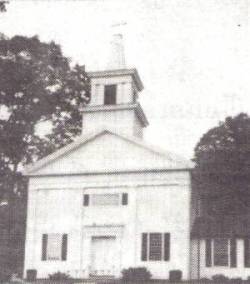
Oxford Congregational Church "Rev. Bronson served the church for more than 40 years, during which time some of the social customs had a marked change. The celebration of Christmas was not observed until the turn of the century - marriage was by civil contract only and most burials were without any religious services. Also during his settlement, the Federal Constitution was being written and the affairs of the community, State and Nation were indeed the concerns of the church. During the ten year litigation concerning the separation of Oxford from Derby, Rev. Bronson and many parishioners were deeply involved. Oxford, incorporated in 1798, was originally included within the boundaries of Southbury and possibly Milford as well as Derby."
The Old Parish hall was purchased sometime between 1890 and 1900. It was built in 1804 and had served variously as a Masonic Hall, a store, a residence, post office, and private school. It was originally used by the church as a parsonage until 1907 when the present parsonage was purchased from Dr. Barnes.
In 1953 the Ecclesiastical Society was dissolved and all property was transferred to the Oxford Congregational Church, and the group was officially Incorporated.
In 1958 a canvass was held among members of the church to raise funds for a new parish house.
Carl Blanchard of New Haven was the architect for the parish house. Ground was broken the following year. The house was dedicated on September 20, 1959.
In 1964 the old Parish House was torn down and the lot cleared.
-
ST. PETER'S EPISCOPAL CHURCH
In 1749, a missionary from the English church became rector of the Episcopal Church in Derby, the Rev. Richard Mansfield. Residents of Oxford who worshiped in the Church of England had to travel to Derby until 1760 when services began in Oxford homes.
The Rev. Mansfield founded St. Peter's Church in 1766, with the purchase of five acres of land from Joseph Davis.
The old church was built in 1767 or thereabouts on Governor's Hill Road.
During the time of the War of the Revolution, the church appears to have been closed, as the Episcopalian churches were generally suspected of Toryism because of its connections with England and because of passages within the Prayer Book with reference to the king.
The Rev. Mansfield served as clergy, while serving also in Derby. Many efforts were made to obtain a minister.
The first settled minister was Chauncey Prindle who served from 1807 to 18l4.
N. J. Wilcoxson, in his Centennial address said,
"Rev. Mr. Prindle, a native born citizen of Oxford, a graduate from Yale College, after a twelve years ministerial service at Watertown, was pastor at St. Peters for several years. Mr. Prindle was justly noted for sound and forcible intellect, for stern integrity, and as orthodox and firm in principle. He was a useful minister. His last residence for many years was a farm in the northerly part of Oxford, where he died at a great age in the year 1832.
"After Mr. Prindle, Rev. Aaron Humphreys was Pastor. Rev. W. A. Curtiss, a native of Coventry, of this State, came here in April, 1829 from New York. His pastorate continued little more than two years. He was a preacher of considerable ability, but such was his imprudence and indiscretion that he was ever upsetting his own dish. Rev. Ashbel Baldwin, Rev. Dr. Burhans, Revs. Messrs. Todd, Sanford, Marvin, Nichols, Eastman, Loop, Gray, Smith, Clark, Pierce, (for about ten years,) Anketel, Buck, were in turn in charge of the parish and church as Presbyter, The church edifice first erected stood on the hill westerly from the central street and adjacent to the cemetery. It was taken down and removed and the edifice now standing on the Public Green was erected in the year 1834. It was dedicated by Bishop Brownell in the year following. Rev. Charles Smith was then minister."
An interesting puzzle concerning the church tower has challenged local historians for some years. The description of this Church which is given in the contract for the building of the new church in 1834, calls for a tower 20 feet high with belfry and windows in front.
A picture of the center of town drawn in 1838 by J.W. Barber, depicts the church with such a steeple, which is gothic in design, much like the contract specifications.
Norman Litchfield, who wrote the history of both Episcopal churches in Oxford, reported that he could find no record of the design of the tower having ever been changed.
It is surprising that such a change would not have been recorded somewhere, or that Wilcoxson did not comment upon the tower change in his centennial address, as he did mention the construction of the new church. As that speech was given only 28 years after the Barber drawing, it seems probable that, had such a change occurred during that time, it would have been noted in that speech.
It may be that the sketch in question was not drawn from a viewing of the area, but that Barber relied, at least in part, upon the specifications for the building as listed in the original contract to aid him in the sketch. If this was the case, then it seems likely that the tower may never have been built to the original plans, and changed in design before construction.
St. Peter's organized its first Sunday School in 1851, during the rectorate of the Rev. Charles J. Todd.
The church has had two parsonages listed on its records. Prior to the purchase of the first rectory on Academy Road, clergymen apparently resided in rented homes. That house served as rectory from 1903 until 1935
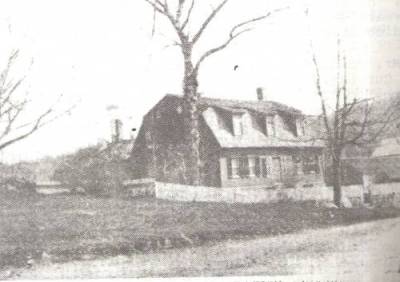
Rectory on Academy Road, after addition of dormer windows, about 1904 In 1935 the old Rectory was sold and the present one purchased adjacent to the church building.
One of the church clergy most prominent in the community was the Rev. L.F. Morris, who served from 1887-1897. He was an active member of the town's school committee, and was one of the leaders in the movement to have Oxford's school districts consolidated and placed under town control.
Another clergyman who left a mark on the town was the Rev. Henry S. Douglas, who served from 1931 to 1948. During his tenure the town observed the 250th Anniversary of the Coming of the White Settlers to Oxford, as well as the George Washington Bi-Centennial in 1932, Douglas became an avid student of local history.
In 1935 the Tercentenary of Connecticut was observed and Mr. Douglas and the parish were active in that observance.
-
CHRIST EPISCOPAL CHURCH, QUAKER FARMS
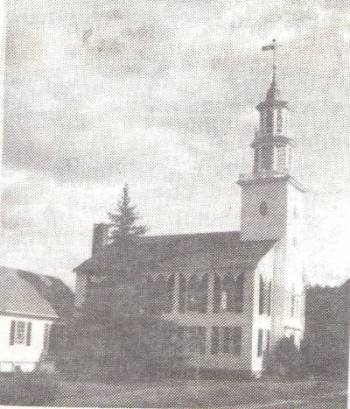
CHRIST EPISCOPAL CHURCH, QUAKER FARMS An account of the history of Christ Church was prepared by Mrs. Lydia von Wettberg and represents a condensation of A History of Christ Church in Quaker Farms, which was written by her father, the late Norman Litchfield in 1954.
We thank the Rev. Timothy Carberry for allowing us the use of the material.
"The name of Quaker Farms appears in records as.early as 1683, but is was many years before the people of Quaker Farms had a church nearer than Oxford Center... Of particular interest, therefore, is the entry of February 10, 1812 in the old record of St. Peter's 'that this parish approves the erection of a chapel in Quaker Farms for the benefit of the Episcopalian Society in said district ... provided that the Society shall never be taxed for the erection of said chapel.' The people of Quaker Farms would at last have a building of their own although they would continue as part of the 'Society in Oxford' and could have the services of the rector or curate no more than half of the Sundays."
The building is believed to have been completed in 1813, and was consecrated in 1817. Many of the subscribers to the building fund were not Episcopalians. A provision of the subscription pledge form noted that the chapel was to be a place of worship by every denomination of Christians, when not occupied by the Episcopal Church clergy.
The church was a chapel under the control of St. Peter's Church from 1812 until 1826, when it requested a separation from the parent church, which was granted. The Parish of Christ Church, Quaker Farms was officially established in 1827.
The first clergyman was the Rev. Sturges Gilbert who also officiated at churches in Bethlehem, Roxbury and Woodbury. He served until Easter, 1827.
From that date until 1866, the church shared a clergyman with St. Peter's although both churches retained their identity as separate parishes.
In 1966 Christ Church requested a full-time clergyman, who was the Rev. John A. Rogers, Jr. He served from 1966 to 1970.
The present Vicar, the Rev. Timothy 0. Carberry, is the second full-time clergyman of the parish, having served since December, 1970. In June of 1972, the church elected Father Carberry as its own rector and became an independent self-supporting parish, ending its history as an aided parish.
-
RIVERSIDE METHODIST CHURCH
The early Riverside church was built about 1810 between the Housatonic River and the road to Derby by people living in the area called Stevenson, consisting of sections of Oxford, Monroe and Newtown.
People of all denominations built the meeting house, and work was done on a community basis for the building of a two storied chapel with galleries in the rear and on two sides
Inside the chapel there were three windows on each side of both upper and lower floor. The pulpit and the alter were at the opposite end of the chapel to the entrance. The original windows were of plain glass, and later a stained glass window, "The prodigal Son," was installed behind the alter.
The chapel was early lighted by 18 oil lamps hung in a chandelier in the center of the ceiling. Lamps on the side posts and candles on the alter completed the early lighting system. A man stood on the six foot ladder to light the lamps for services.
Water from the well at the house was carried across the road in a pail for the cleaning of lamps and other necessary purposes. A large stove heated the chapel.
The meeting house had no kitchen or special room for socials, but picnics and festivals were held out of doors or at the home of members.
There was a group of Methodists living in and near the area called Pleasant Vale in 1792, and a circuit was formed in 1813, to include the group.
The meeting house was open for any one to preach in and it was variously occupied by Quakers, Mormon Apostles, Methodists, Second Adventists and in one case it was said a man spoke in an unknown tongue. However, the Methodist clergy were the only group with a regular circuit in the area, so they became the predominant users of the chapel.
Over the course of time the frequency of Methodist meetings was increased to weekly, and they occupied the building on a regular basis.
Sharpe notes that a vote was once taken to turn the old building over to the Methodist Episcopal presiding elder for the district, "but the vote was said to be invalid, and the record of the vote being afterward burned, the building was still a neighborhood affair."
However, when the Housatonic Power Company, now the Conn. Light and Power Company, proposed to build a dam across the river to generate electricity, the question of ownership of the community chapel became important.
The company negotiated with the congregation and received an option on the land and building, provided the company would provide a similar piece of land and provide a new church to replace the one to be flooded.
In order to legalize its title to grant this option to the River Company, the congregation was incorporated as the Stevenson Union Church Association in 1897. The ordained elder of the Methodist Episcopal Society was made an ex-officio member of the Association.
At the same time, the river company offered to exchange with the Riverside Cemetery Association, land near the new church site. Furthermore, it would guarantee, provide for, and pay for the removal of all the bodies, including those in the pauper's corner, with all their monuments to the new location of the cemetery, to be located next to the property of the Union Church Association.
A special law of Connecticut, approved in February, 1897, authorized the removal of all persons and headstones to the new lot. In May, 1899 the agreement was signed for the removal, when the dam was to be constructed. The final agreement was signed in 1918.
Work on the dam proceeded from 1918 and 1919, and no services were held by the church as the old church had been demolished and the new church was completed in the fall of 1919.
Services of Worship were held once or twice during each summer by visiting clergy until June 1940, when the Rev. Cyrus W. Severance of Derby became pastor. He was followed by the Rev. Matthew Gates and Rev. Edwin Towle.
Under the influence of the next clergyman, Rev. Russell Bales, it was voted to join the Methodist conference.
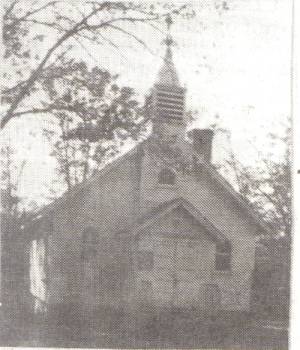
Riverside Methodist Church, Coppermine Road, Oxford -
ST. THOMAS THE APOSTLE, ROMAN CATHOLIC CHURCH IN OXFORD
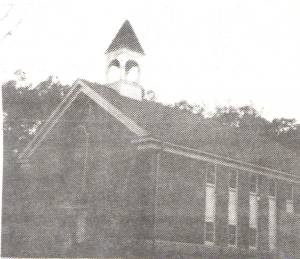
ST. THOMAS THE APOSTLE, ROMAN CATHOLIC CHURCH IN OXFORD The earliest records of Catholic Services in indicate that the Rev. Richard Gragan, pastor of St. Augustine in Seymour, traveled to Oxford to celebrate Mass on an occasional basis in the home of Harriet Frazier on Oxford Road.
About 1905 the Catholics of Oxford were placed under the jurisdiction of the St. Rose Church in Newtown. Mass was at that time celebrated in the Union Church, in the building now known as the Chapel of the Good Shepherd in Southbury.
Also during that period, Catholic services were held in homes in Oxford by Newtown clergymen.
Thomas Coman, a New York City judge, left in 1909 a sum of money to establish a Catholic Church where none was located, and in September 1911, a site was purchased for the sum of one dollar from August and Virginia Pelletier, with the Rev. George T. Sinnott, pastor of St. Rose Church, Newtown, working to establish the mission.
That fall the work began on the original building under the direction of Arthur Peck and Fred Hildebrandt. The dedication ceremony was held in July 1912, and the chapel was at first called St. Mary.
Organization under the name of St. Thomas the Apostle took place in October, 1916.
Early in the church history only about nine families attended regularly, and Mass was said every other Sunday.
The church passed under the director of St. Thomas Church in Beacon Falls, under the pastorship of Rev. Jeremiah J. McAuliffe . The congregation was returned to the jurisdiction of St. Augustine Church in 1948 as a Mission Church.
During eighteen years as a mission church of the Seymour church, the building was renovated. Also during this time, the Oxford Board of Education agreed to allow the church to use its facilities for religious education after school hours.
In 1966 the St. Thomas the Apostle Church was officially designated as a parish, to meet the growing needs of the larger flock, and the Rev. Joseph R. Barlowski of Bristol was appointed as first resident pastor.
In 1966 land was purchased in Quaker Farms, with the intention of building a new church and rectory. However in February of 1971, parishioners voted to purchase a new parcel of land adjacent to the rectory. The property in Quaker Farms was sold, and construction began on the new church February 27, 1972.
The last Mass celebrated in the Coman Memorial was said on December 24, 1972, and the new church was formally dedicated on January 28, 1973.
The Coman Memorial was sold to the Rev. Ronald Rockey, who has established a small independent, non-denominational parish in the old building, after a renovation of the building, which is now known as Wildwood Chapel.
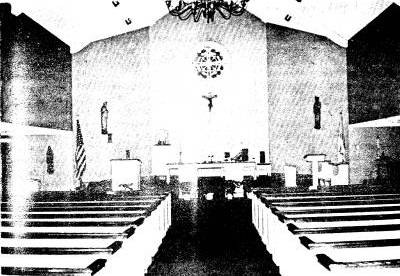
INTERIOR OF ST. THOMAS THE APOSTLE CHURCH. Record photo by Chip Wilcox -
IMMANUEL LUTHERAN CHURCH
The Immanuel Lutheran Church was organized in 1892 in Seymour, and formerly occupied a site on West Street in that town, although its new building is on Great Hill, Oxford.
The first building was erected in 1894 under the leadership of Pastor R.C. Lucas, who was succeeded by Pastor Meuller. In 1899, under Pastor Lemke, the Trinity Lutheran Church of Shelton was organized in 1899. Thereafter the two churches were one parish served by the resident Seymour Pastor.
During the pastorate of Pastor Konrad, a parsonage was built on West Church Street, Seymour.
In July, 1942 the enlarged and renovated building on West Street, Seymour was dedicated.
In 1964, the Trinity of Shelton separated from the Seymour parish and Pastor Otto Borchert became the full time pastor in Immanuel, Seymour. In September of that year St. Paul Lutheran Church of Ansonia merged with the Seymour church, with half of the membership joining Trinity of Shelton and the others joining Immanuel of Seymour.
A new Parish Building was dedicated in June 12, 1966 on Great Hill Road, Oxford, as the initial stage of developing the church in Oxford.
Three acres of land were donated for the church by Mr. and Mrs. Hubert E. Stoddard, and two more were purchased by the Ladies' Aid for the parish.
The present pastor of the Church, the Rev. Eugene Johnson, now resides in the Meadowbrook district of Oxford not far from the church.
The building which stands on Great Hill was designed to be the first of three units of the new church plant, and was constructed during the pastorate of Pastor Otto A. Borchert.
Pastor Borchert remained with the parish for more than thirty years. When he first came to the parish the members often knew little English and services were conducted in German for the benefit of elderly persons who did not understand the English services.
The church observed it's seventy-fifth anniversary on October 28 and 29, 1967, while still using the church building in Seymour.
-
PUBLICATIONS IN AND ABOUT OXFORD
One of the most difficult problems in writing a history of Oxford is the lack of suitably preserved and stored documents of the community's early life
Two early publications which detailed the proceedings of the community were the Oxford Advertiser and the Seymour Record.
The Seymour Record is well known to area residents interested in the local history of Seymour, Oxford, Beacon Falls and other communities of the vicinity. The paper was published by William C. Sharpe who founded the paper in 1871. He was the son of an Oxford man, Lugrande Sharpe. William was at one time a school teacher in Oxford, and throughout his work with the Seymour Record maintained a lively interest in the affairs of the local schools.
Sharpe was also interested in local history, and wrote a History of Seymour, and the standard work on Seymour history, Seymour Past and Present. He also published two volumes on Oxford History, History of Oxford, Part 1, and Oxford Sketches and Records, Part 2.
These two volumes have been especially helpful in the compilation of this book, and the author wishes to thank Miss Bernice Hull for the use of the books. Through the cooperation of Miss Hull and the Seymour Public Library, plans now are made to have the books micro-filmed so that the material may be more generally available. In addition one volume of the material, xeroxed from the original has been provided to the Oxford Public Library for the convenience of residents and future historians.
Another publication in the 1800's is the "Oxford Advertiser," which was published by J. E. Hinman. This publication was published twice a week on a single sheet of paper, folded so as to make four pages.
It contained advertisements from area merchants, principally from Seymour.
The advertiser sold for twenty-five cents a year. Hinman was also a book and job printer. His name is spelled variously in some of the publications, with it appearing as Hinman, in an ad on the following pages.
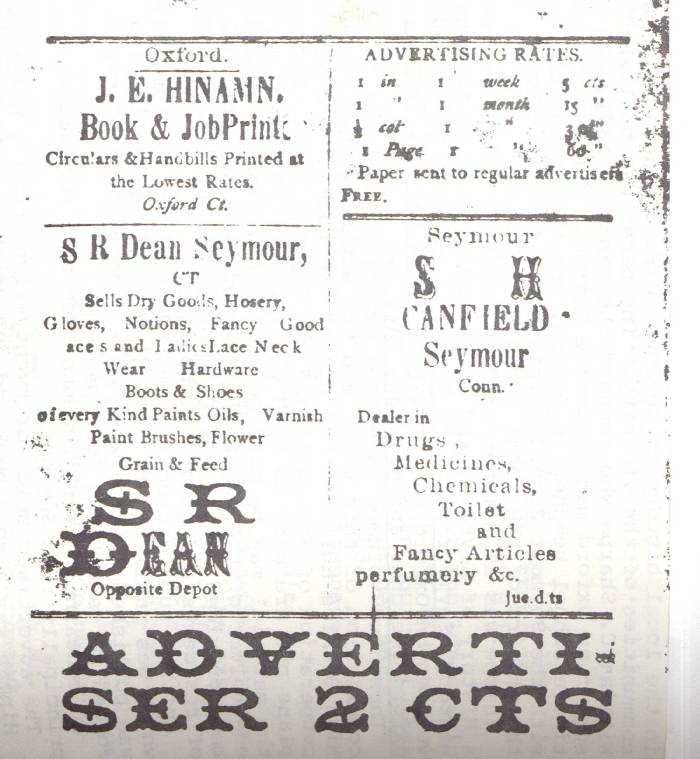
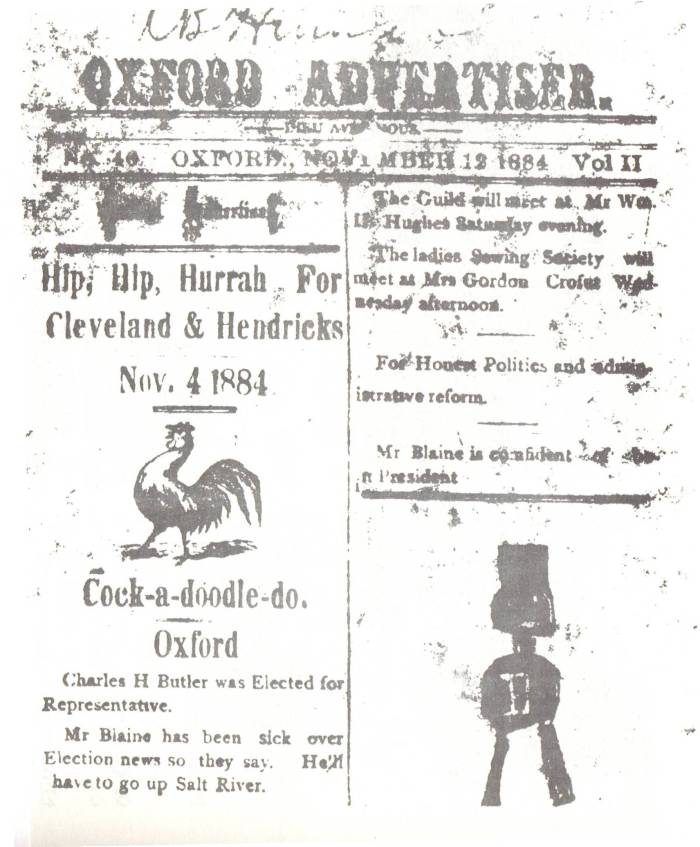
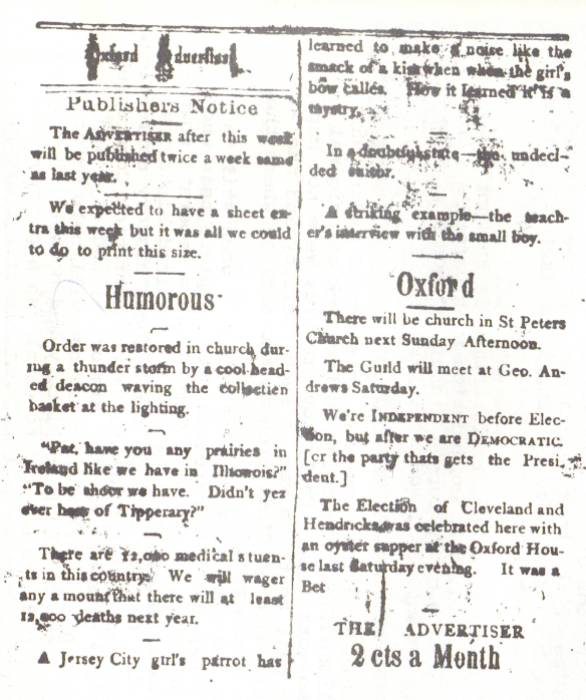
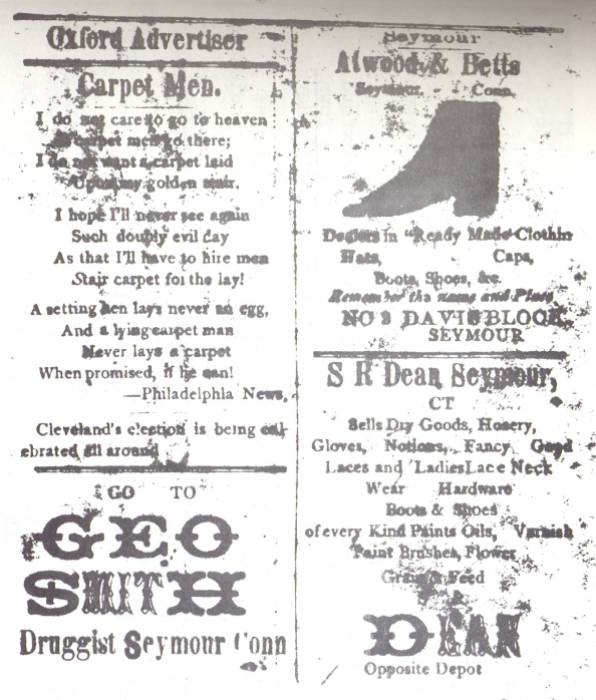
From the time that Hinman ceased publication, until last year, there was no regular publication in the town of any newspaper or flyer of any sort. In December, 1972 The Oxford Record was first published weekly and mailed to all residents through June 21, 1973. At that time it was combined with The New Seymour Record, under the new name, THE RECORD. Since that time publication has continued on a weekly basis to subscribers in Seymour, Oxford and Beacon Falls.
In any summary of the histories and records of Oxford, special mention must be made of the History of the Town Of Oxford, by Norman Litchfield and Sabina Connolly Hoyt, Ph.D.
Mr. Litchfield had written two previous histories of the Episcopal Churches in Oxford. Dr. Hoyt had a syndicated newspaper column.
These two collaborated to produce a history which was first published in 1960 and re-issued in 1967.
The book is a valuable reference tool.
In compiling this book, the author attempted to concentrate on subject areas not covered fully in the Litchfield-Hoyt history, but necessarily found that some duplication of material was unavoidable.
The author of this book was told by Mrs. Lydia von Wettberg, daughter of the late Mr. Litchfield that few unsold copies of the book remain and that the original plates have been destroyed, making it unlikely that the book will be republished.
Also of interest to local historians is another book to be published in conjunction with Oxford's 175th Anniversary by a newly formed historical society. The book is to be entitled, "Oxford, l798."
As of this date, no complete history of Oxford has been published, chiefly owing to the lack of original records to work from. Early town records were not kept in a town hall as there was no such facility and the records are hard to find, even in those cases where they have been preserved.
Records for the early days of the area when still a part of Derby are in many cases more complete than the records of later dates, when Oxford was a separate town.
It is to be hoped that the newly organized historical society will be able provide for a local history collection. One of the goals of the Anniversary Celebration Committee has been the formation of the historical society, and it has been hoped that the observance will help Oxford residents focus on the past history and do what they may to preserve old records and to establish a permanent location for a display by the local historical group.
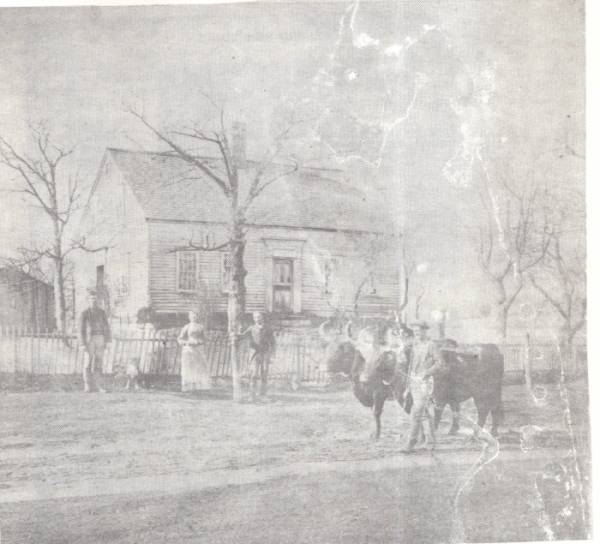
Old photograph of the R. B. Hinman homestead and family.
Left to right: H. P. Williams; his mother, Elsie who was a school teacher; Mrs. Hinman; Frank Perry, and R. B. Hinman with his span of oxen. Hinman's father was the tax collector at one time.
(Photo courtesy of Paul Gazy)
-
OXFORD REMEMBERS
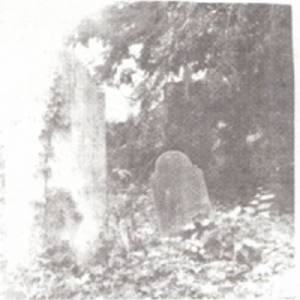
Jack's Hill Cemetery is an old cemetery. The cemetery has been occasionally repaired by youth groups in the town. 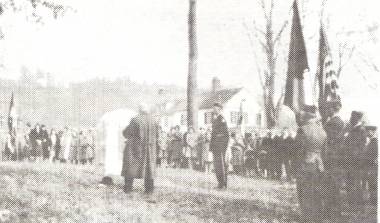
Oxford's Memorial to the Soldiers of World War I.
In 1931, Oxford erected a bronze tablet, set in stone on the upper green, bearing the names of all those who were in the Armed Services during World War I.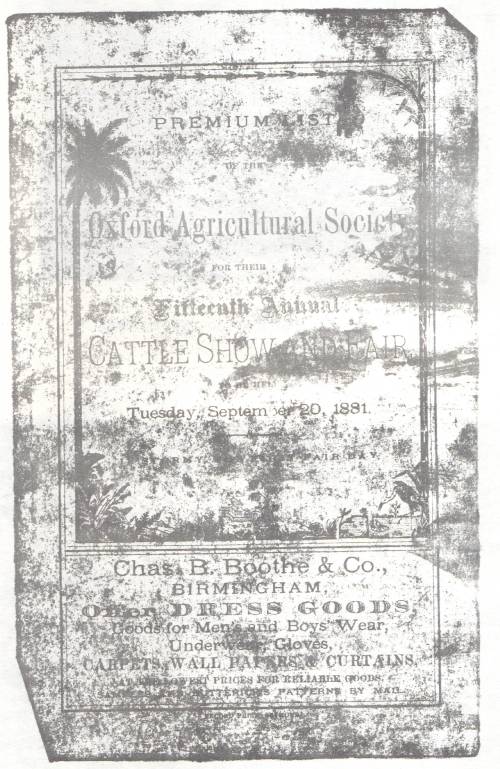
In the late 1800's, Oxford had an annual fair, which was held in September of each year. Pictured above is the cover to the annual fair book, 1881. The book listed the various divisions of agriculture, livestock, and home-made goods which would be judged and awarded premiums. 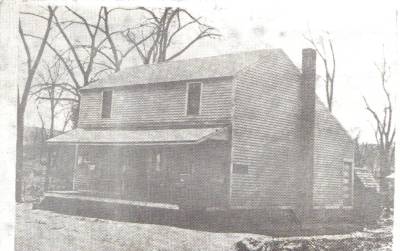
The old general store, now Steinecker's 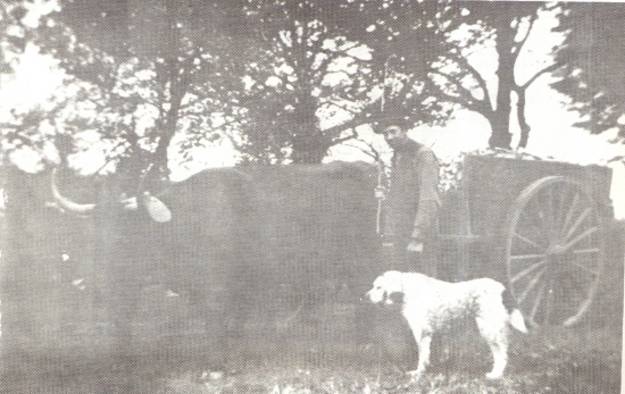
Burt Tucker with his span of oxen 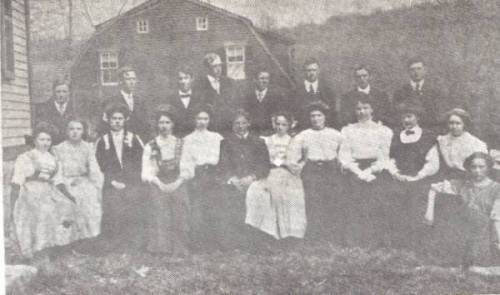
Oxford Congregational Church Summer Circle 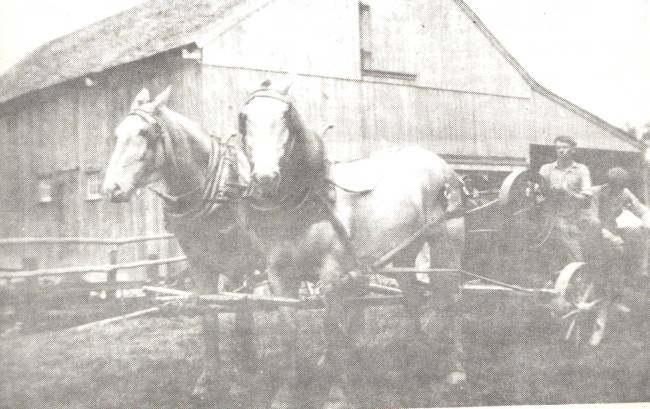
Burt and William Tucker with team of draft horses -
OXFORD HOTELS AND TAVERNS
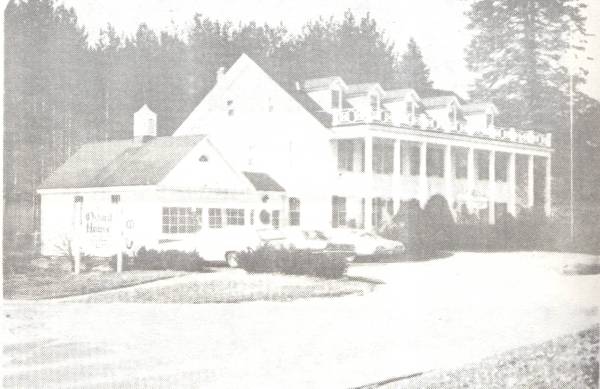
The Oxford House The above photo is a picture of the Oxford House, which was a stage coach stop in Oxford at one time. It was the scene of Oxford's Charter Day luncheon on the occasion of the town's 175th anniversary.
In the early days, Oxford hotels were under the control of the Civil Authority, a joint commission composed of the selectmen, constables and the Grand Juror.
Early town records show that on the 4th day of January, 1802 six tavern keepers were approved. They were as follows: Josiah Washband, Ruben Bunnell, Daniel Cande, Abel Watras, Nathaniel John, and Ward Garnet.
-
THE OXFORD HOUSE OR HOTEL
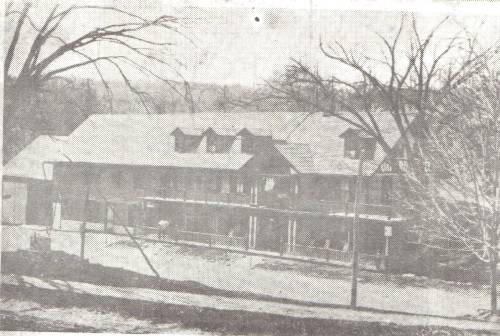
The Oxford Hotel as it appeared prior to its renovation. and conversion to the Oxford House. The Oxford House on Route 67 has long been a landmark in Oxford. According to Judge N.J. Wilcoxson, the building was built in 1795 by Daniel and Job Candee.
The hotel was at one time a post office, according to Wilcoxson.
-
REPRODUCTION OF ANNUAL TOWN REPORT FOR YEAR ENDED, 1884
OXFORD TOWN REPORT FOR THE YEAR ENDING September 15th, 1884.
SELECTMEN'S REPORT ROADS, BRIDGES AND RAILINGS Roads worked by contract $1,805.50 ROADS NOT ON CONTRACT Frank Beebe cutting ice on river road $1.50 George Martin " $1.75 Wm. O. French " $2.00 Charles French " $1.50 Beach J. Downs work on road of James Wheeler $2.00 Beach J. Downs Michael Fanning $8.00 H. E Smith blasting rocks $2.00 $18.75 BRIDGES AND RAILING F. C. Candee 2,000 feet plank, bill of 1883 $35.00 S. P. Sanford 634 feet plank $11.10 H. B. Smith labor on Eight-mile brook bridge $2.00 Charles French putting up railing $1.50 H. E. Smith 112 feet plank for sluice, and putting in $2.96 D C. Riggs carting plank $1.25 David C. Riggs spikes $70 David C. Riggs 144 bolts $14.75 C. E. Lum 138 feet railing at 5 cts $6.90 C. E. Lum 14 posts $4.20 Wm. 0. French 5 days putting up railing on River and Forge road $7.50 W. 0. Davis putting in sluice on Chestnut Tree Hill, two men & team $5.00 W. 0. Davis putting in stone sluice $10.00 Meigs Bros. 84 feet plank at l 3/4 cts $1.48 Meigs Bros. labor on bridge $80 C. B. Flagg 28 feet plank $49 C. B. Flagg sleepers $3.00 C. B. Flagg spikes $10 C. B. Flagg labor on bridges $2.50 John Church 499 feet sleepers and plank at 13/4 cts $8.61 John Church 180 feet timber at 1 1/4 cts $2.25 John Church 200 feet timber at 1 1/4 cts $2.50 John Church 42 feet railing $2.10 John Church labor on bridge $3.50 John Church spikes $25 John Church bolts $42 John Church railing $1.00 H. S. Hine 380 feet plank, and laying $6.65 H. S. Hine sleepers and laying $6.35 John Dillon 791 feet plank $13.84 John Dillon drawing plank $1.00 John Dillon cutting ice on river road $2.00 John Dillon repairing Eight-mile brook bridge $1.00 Frank H. Downes 387 feet plank at 1 3/4 cts $6.77 Frank H. Downes 428 feet railing at 4/5 cts $21.40 Frank H. Downes 10 lbs. spikes $50 Frank H. Downes labor and team work on bridge and sluice $11.50 Frank H. Downes labor putting up railing and widening road $5.00 George R. Baldwin work on bridge $2.00 George R. Baldwin work on bridge $2.00 Horace Hinman labor on bridge $1.00 John Wooster plank and laying $50 John Wooster 6 lbs. spikes $24 John Wooster 1 day's work with oxen $3.00 John Wooster 6 days' work putting up railing $9.00 John Wooster 105 feet plank $1.83 John Wooster 3 days putting up railing $4.50 John Wooster 16 lbs. spikes $64 John Wooster 7 days putting up railing $10.50 John Wooster 595 feet poles and 234 posts $41.45 E. N. Wheeler 120 feet plank at 1 3/4 cts $2.10 E. N. Wheeler labor and spikes $90 George Martin labor on Eight-mile brook bridge $5.00 George Martin 94 feet railing at 3 cts $2.82 George Martin spikes $10 F. W. Hubbell railing, sleepers, and planking bridge on Cemetery road $3.00 Town of Monroe planking eastern approach Zoar bridge $1.75 Town of Monroe spikes for same $27 A. W. Lum 1,000 feet plank at 1 3/4 cts $17.50 Samuel Hawkins 140 feet sills at $1.70 $2.38 Samuel Hawkins 996 feet plank $17.42 Samuel Hawkins labor on four bridges $1.00 Samuel Hawkins carting plank from mill $2.00 L. W. Lake 1,175 feet plank at 13/4 cts $20.56 Oliver Downs railing on river road $1.50 Oliver Downs railing on river road $1.50 Oliver Downs railing on Forge road $1.50 James H. Bartlett 350 feet railing at 5 cts $17.50 James H. Bartlett 24 posts at 30 cts $7.20 George Martin 1 1/2 days' work on Five-mile brook bridge $3.00 George Martin team work on Five-mile brook bridge $1.00 Charles T. Sherwood labor and spikes on Zoar Bridge $55 $395.08 TOWN OFFICERS Assessors Albert D. Smith $20.00 George P. Sanford $20.00 $40.00 Board of Relief George Andrews $10.00 Wm. M. Hubbell 10.00 F. W. Hubbell 10.00 $30.00 Board of Education Lewis Barnes $56.00 David Hawley 11.00 C. E. Lum 19.20 Samuel Hawkins 13.00 Orlando Osborn 8.00 $107.20 Selectmen F. C. Candee $100.00 C. E. Lum $35.00 George R. Baldwin $37.50 $172.50 Board of Registration E. J. Thrall $12.00 F. A. Leek 6.00 Wm. M. Hubbell 8.00 Lewis Barnes $4.50 $30.50 Collector A. B. Hinman 55.99 Moderators A. D. Smith, checking $2.00 James Riggs, box tending 2.00 Wm. Hubbell, checking 5.00 James H. Bartlett, moderator 1882 2.00 James H. Bartlett, moderator 1883 2.00 James H. Bartlett, moderator 1884 2.00 $15.00 Road Inspector D. C. Riggs 35.00 Town Clerk Lewis Barnes 54.50 Registrar of Births, Marriages and Deaths Lewis Barnes 19.96 Treasurer C. H. Butler 40.00 Auditors E. B. Treat $12.00 H. E. Smith $12.00 $24.00 SCHOOLS 1st school district $240.00 2nd 174.75 3rd 138.00 4th 163.41 6th 132.50 7th 72.00 8th 164.06 9th 140.00 10th 119.75 11th 141.50 12th 133.00 13th 65.00 Town of Southbury, joint district 11.93 Town of Southbury, joint district 13.65 $1,709.55 Court and Counsel Fees John W. Alling, on account case Housatonic Water Co. $200.00 Damages Frank H. Downs, 1 sheep killed by dogs 4.00 Abatements Washington Benham,overpaid taxes list of 1882 5.46 A. B. Hinman list of 1881 and 1882 63.85 $69.31 PAUPERS F. W. Hubbell paupers on contract, bill of 1883 220.00 E. F. Bassett coffin for Peterson 15.00 E. F. Bassett coffin for W. S. Peterson 11.00 S. P. Sanford supplies for Peterson 5.10 C. E. Lum supplies for George Smith, paid by Derby 3.10 F. W. Hubbell paupers on contract, 1884 220.00 F. W. Hubbell " " " 1884 220.00 Lewis Barnes medical attendance and medicines for Solomon Peterson 11.00 Lewis Barnes medical attendance and medicines for William Peterson 12.00 F. C. Candee supplies furnished Munger, paid by the town of Morris 22.00 Lewis Barnes medical attendance for Munger, do 5.00 F. C. Candee getting coffin for Munger, and attending funeral, do 5.00 E. F. Bassett coffin, &c., for Munger, do 14.25 C. H. Butler furnishing supplies for Munger, do 10.20 Charles Paery digging grave for Munger, do 5.00 T. S. Osborn & H. C. Chatfield taking care Munger, do 6.00 S. P. Sanford supplies for Munger, do 18.30 C. C. Rider digging grave for Peterson 5.00 Lines Hinman digging grave for W. S. Peterson 5.00 $812.95 MISCELLANEOUS EXPENSES W. C. Sharpeprinting town report $7.50 Jarvis Somers reporting vital statistics from Southford 2.50 Benjamin Nichols 1 day on Waters case, Bridgeport 4.00 J. M. Emerson printing 200 road contracts 3.00 J. M. Emerson " 200 bonds 2.00 Derby Printing Co. printing 50 dog notices 2.00 E. A. Lewis & Co. tax lists 2.75 E. A. Lewis & Co. grand list 1.75 E. A. Lewis & Co. expressage 25 H. C. Osborn insurance on town buildings for 3 years 10.00 F. W. Hubbell building fence between Henry S, Hubbell's and town farm 5.00 Samuel Hawkins expenses to Hartford on River road 3.50 L. W. Lake warning electors' meeting 1.25 S. P. Sanford glass 2.30 Lewis Barnes expenses to Hartford on River road 2.00 S. P. Sanford rent town hall 35.00 A. B. Hinman warning electors' meeting 1.25 A. B. Hinman 1 tax book 1.75 C. H. Butler ndex books for voting 2.00 C. H. Butler stationery 1.26 Beach J Downs expenses to Hartford on River road and Housatonic Water Co 5.30 W. O. French expenses starting for Hartford on River road and Housatonic Water Co. 2.30 Charles Gilbert expenses starting for Hartford on River road and Housatonic Water Co. 2.50 Nicholas French expenses starting for Hartford on River road and Housatonic Water Co. 2.30 Sally D. McEwen rent of farm 80.00 Sally D. McEwen rent of farm 80.00 Samuel Hubbell expenses in starting for Hartford 2.00 John E. Hinman printing 500 town orders 1.75 $267.21 RECAPITULATION Roads on contract 1,805.50 Roads not on contract 18.75 Bridges and railing 395.08 Town officers 624.60 Schools 1,709.55 Counsel fees 200.00 Damages 4.00 Abatements 69.31 Paupers 812.95 Miscellaneous 267.21 $5,906.95 Dr.
To 180 Orders drawn on Treasurer amounting to..... $5,906.95
All of which are respectfully submitted
F. C. Candee
C. E. Lum
G. R. Baldwin
SELECTMEN
TREASURER'S REPORT
-------------
CHARLES H. BUTLER, Treasurer,
In account with Town of Oxford.
Dr.To balance from last settlement $1,870.65 Received from A. B. Hinman, collector 5,844.40 " " State for schools 564.75 " " Deposit fund for schools 246.54 " " Local fund for schools 22.93 " " Town of Southbury for schools 62.61 " " Town of Naugatuck for schools 23.57 " " County Commissioners for licenses 215.65 Received from Lewis Barnes, clerk, for dog licenses $74.00 " " Rent of Zoar Bridge 150.00 " " Town of Morris for support of N. Munger 89.15 " " Town of Middlebury for support of John Clark 7.50 " " Deposit fund, loan 300.00 " " A. B. Hinman, percentage 49.57 $9,521.32 Cr. By paying general town orders $3,572.22 " " School orders 1,695.90 " " Interest on notes 496.79 " " State tax 467.89 " " Military tax 198.00 " " County tax, special 374.31 " " Justice Hughes' order case State vs. Parsons 22.86 " " on Note to Mrs. Mary Lum 800.00 Cash Balance $1,893.35 $9,521.32 THE LIABILITIES OF THE TOWN ARE: Sundry notes to Deposit Fund $1,859.00 Order No. 54, 1866 Deposit Fund 1,300.00 $3,159.00 Zoar Bridge Acct., at 5 per cent-- Note July 30th, 1880, bal. on H. A. Lum $4,000.00 " July 30th, 1880, George Lum 1,000.00 " Aug. 4th, 1880, to Francis A. Riggs 500.00 " Aug. 4th, 1880, to Carrie L. Riggs 175.00 " Aug. 4th, 1880, to Burritt Davis 100.00 $5,775.00 $8,934.00 ASSETS ARE AS FOLLOWS: Cash balance $1,893.35 Balance due on Tax Books, lists 1881 and 1882 1,200.00 Amount due on Tax Books, list 1883 5,952.52 $9,045.87 Unpaid current orders 2,905.70 Assets over liabilities 111.87 Liabilities unprovided for 2,793.83 CHAS. H. BUTLER, Treasurer.
We hereby certify that we have examined the accounts of the Selectmen and Treasurer and find them correct.
E. B. Treat,
H. E. Smith,
Auditors
Record Print, Seymour
-
Identities in Photo!
Below is a copy of an email sent to Oxford Past. Thank you, Jane!
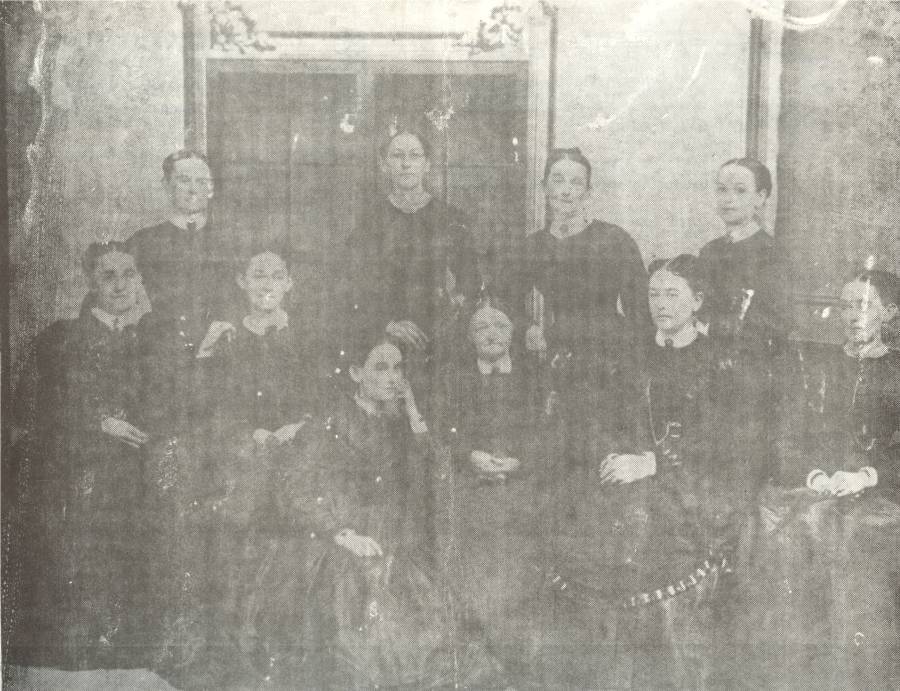
"I saw the picture of Elizabeth Perkins Candee and nine of her twelve children on the Oxford Past page. A daughter, Mary, who died young, and sons William Sydney Candee (died 1865) and David P. Candee (living in New Haven at time of 1870 census) are not in the picture. I have a photocopy of the picture and can identify everyone. My great aunt, Bessie Candee Hitchcock Kinney, labeled it. The husbands are in parentheses. Greetings!
I saw the picture of Elizabeth Perkins Candee and nine of her twelve children on the Oxford Past page. A daughter, Mary, who died young, and sons William Sydney Candee (died 1865) and David P. Candee (living in New Haven at time of 1870 census) are not in the picture. I have a photocopy of the picture and can identify everyone. My great aunt, Bessie Candee Hitchcock Kinney, labeled it. The husbands are in parentheses.- Kneeling on floor is Catherine Rosabelle Candee (Henry Washington Hitchcock)
- Seated: (from the left)
- Hannah Augusta Candee (Frank Hall)
- Mary Josephine Candee ((1)____Canfield (2) James C. Wicker)
- Elizabeth Perkins (Enos Candee)
- Jane Ann Candee (Robert E. Isbell)
- Esther R. Candee (Dr. Laurence Sterne Hotchkiss)
- Standing: (from the left)
- Martha Melissa Candee (J. Terry Munn)
- Elizabeth Candee
- Eunice Candee (John A. Peck)
- Charlotte Candee (Sereno S. Thomas)
The picture had to have been taken before 1872 when Catherine died. The clothing should give help dating it but I haven't looked into that yet.
Submitted by:
Jane Hitchcock Platt, great granddaughter of Catherine Candee Hitchcock.
Milford, CT e-mail: Jane Hitchcock PlattShown on the opposite page is the Candee sisters and their mother, Elizabeth Perkins Candee. An interesting story about this family is part of the history of the Meek house on Academy Road, which once served as the rectory to St. Peter's Episcopal Church.
At the time of its dedication in 1903, the Rev. Theodore Peck addressed the congregation concerning the history of the old home, and a record of that speech has been preserved. It is printed below, and the reader must keep in mind that the speech was given seventy years ago.
"On the 3rd of April, 1845, Enos Candee came into possession of the property by deed from Bernard and Nancy Humphrey of Derby. It was during the life of Enos Candee that the old place was one of the famous homes of Oxford.
"Mr. Candee was a farmer of large and generous style, and the place still shows signs of the arrangements made by him for the carrying on of the manifold operations of a large farm. Mr. Candee removed the original east chimney, which then stood as the west chimney now stands. He rebuilt it at the end of the house, making the basement wall the back of it. He built a smoke house in the attic, connected with the chimney, and in this cured the meats necessary for the winter use of his large family."
In the high basement he finished off a large kitchen, with milk room opening out of it. In this kitchen is a yawning fireplace, with the old crane still in place, from which the pots were suspended in cooking. At the right he built a fire-brick oven suited to the quantity and quality of baking requirements. On the left a great iron pot was set in the masonry to cook feed for the pigs, and probably, to boil the old-time soap. A door opens through the basement wall, making it easy to pass out the steaming food for the hungry pigs.
"The parlors were arranged by him in their present charming style, and were the scene of many festivities, which doubtless led up to the weddings which afterward took place when his many daughters forsook the old roof-tree..."
"Mr. David Candee, his only surviving son, has told me many pleasant details of the homelife of this large family: of the Thanksgiving feasts, when all gathered again around the home hearthstone; of the use of the house as a "Sabba-Day House," when the cold and weary people came after meetings to thaw out, and eat their luncheon and exchange the news...."
"The great lilac bush at the north of the house was set out by Mr. David Candee and his sisters, they having brought the root from Quaker Farms...."
"Enos Candee appears to have bought the place of the executors of the estate of John Twitchel, March 26, 1804. The description is 'five acres more or less, with house, barn and store theron standing". In 1801 the Records show that John Twichel owned the place. It was shortly after this time that tradition states that Morning Star Lodge, Free accepted Masons was organized in this house. Certain it is that there was a close connection for many years between the place and the Masons. However, the Records show that the Masonic Hall was built shortly after this time, and the house could not have been used as a meeting place for very long..."
<"On looking over the Records of the Congregational Society, I find that the meeting of October 6, 1741 called to decide on the place to build a meeting house, was held at the house of John Twichel. This carries our history back 163 years."
"Surely then, considering all of these things, we have done a good work in restoring this house for the use of the church with which it is connected by the ownership of several of its members, and the residence of two former Rectors, the Rev. Aaron Humphrey, and the Rev. John Anketell..."
The photograph shown on page 86 was given to the present owners of the house by Percy Hamilton Goodsell, Jr., who wrote the present owners of his recollections of the history of the house in November, 1966.
"Enclosed is the promised photograph of the Candee sisters and their mother, my great-great grandmother. She was Elizabeth Perkins, born in Watertown on January 7, 1799, and died October 10, 1885. She married Enos Candee, who was born in Oxford, July 22, 1792 and died there, February 10, 1786*. Unfortunately, I cannot identify all the sisters, but I do know that the second from the right in the rear row is my great-grandmother, Eunice, born September 19, 1821. She married on January 1, 1840, John Austin Peck and died in Naugatuck on January 28, 1903. The third from the right in the rear was the eldest daughter Elizabeth, who was born November 14, 1819. The one at the right in the front row is Hannah Augusta, who was born November 17, 1828, and married on November 18, 1858 to Frank Hall. She is the only one I ever saw, and that was when I was only three or four. The story is that Elizabeth refused to wear a black dress, like all the others, but insisted on wearing gray. There are several old copies of this picture in the family, and in all of them some unknown hand has blacked in Elizabeth's dress."
"I was much interested in Mr. Peck's record, especially since it controverts what I have understood about the history of your house. I had been led to believe that it was built by Caleb Candee, the grandfather of Enos, who was born in West Haven in 1722 and moved to Oxford where he died October 4, 1777. He is buried with his wife, Lois Mallory, in the Jack's Hill Cemetery. One of their sons was Job, born in Oxford, April 20, 1760, where he died December 2, 1845. He and his wife, Sarah Benham, are buried in the Church Hill Cemetery. He was wounded in the hand at the burning of Fairfield during the Revolution."
-
PATRONS
- Mr. and Mrs. Jay G. Abercrombie
- J. Victor Arvidson
- Alma A. Beckmann
- Mrs. Frances Blain
- Mrs. Dorothy M. Bolduc
- James and Elizabeth Brooks
- Mr. and Mrs. Charles DeBisschop
- Mr. and Mrs. Robert A. DeBisschop
- Katherine E. Fagen
- Mr. and Mrs. Lester Forst
- Paul Gazy
- James H. Giblin
- Arthur P. and Theresa Hoyt
- Mr. and Mrs. John Huxley
- Mr. and Mrs. James A. Kennedy
- Miss Katharine Matthies
- Mark McKee
- Mr. and Mrs. Thomas B. Meek, Jr.
- Mr. and Mrs. Harold W. Olsen
- Mr. and Mrs. Terrance O'Neill
- Arthur G. Osborn
- Mrs. Ida Renker
- Dr. and Mrs. Anthony Sava
- Mrs. Frances Sitar and David
- T V Specialists
- Mr. and Mrs. Ronald Stebar
- Mr. and Mrs. William Turschmann
- Lydia von Wettberg
- Mr. and Mrs. Richard Weisz
- Mr. and Mrs. Alden Wilcox
- Charles and Agatha Wyler
- Ed and Carol Zwick